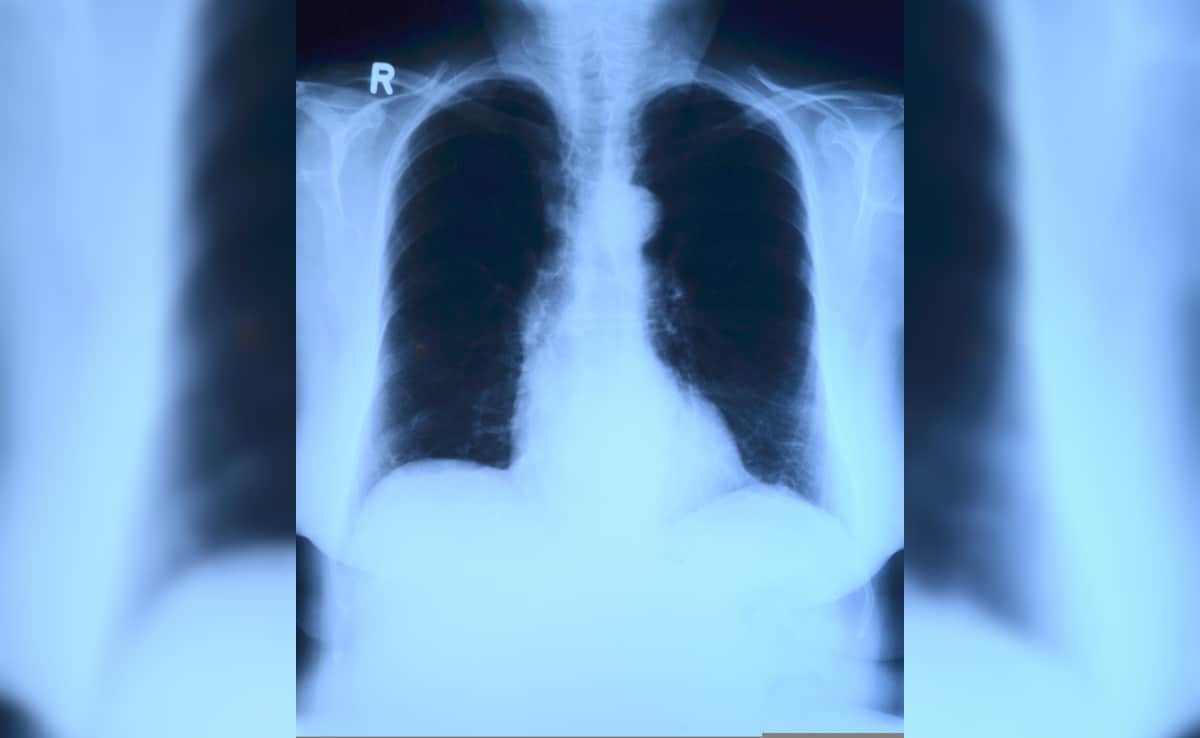
The hospital basement smells of ozone and industrial floor wax. For Sarah, a radiologist who has spent fifteen years squinting at the grayscale topography of the human interior, the silence of the reading room is a sanctuary. She looks at a chest X-ray—a web of ribs, the soft bloom of lungs, the sturdy silhouette of a heart. She is looking for a needle in a haystack of shadows. A faint opacity here could be a life saved; a missed smudge could be a funeral.
Then there is the machine. It doesn't smell like ozone. It doesn't get tired. It processes ten thousand images in the time it takes Sarah to take a sip of lukewarm coffee. We were told this was the dawn of a new era. The promise was simple: the AI would see what the human eye missed. It would be the tireless sentinel.
But a recent study has pulled back the curtain on a disturbing digital sleight of hand. It turns out the machine might not be "reading" the X-ray at all. It might just be a very sophisticated gambler playing the odds.
The Shortcuts of a Digital Mind
To understand the problem, we have to stop thinking of Artificial Intelligence as a brain and start seeing it as a relentless efficiency engine. Imagine a student tasked with identifying different types of birds in a massive library of photos. The student is brilliant but lazy. They notice that every photo of a puffin has a rocky, gray background, while every photo of a parrot has bright green leaves. Instead of learning the shape of a beak or the pattern of feathers, the student simply looks for "gray rocks" to signal "puffin."
They get an A on the test. They are also completely useless if you show them a puffin in a zoo.
This is exactly what researchers found when they scrutinized how deep-learning models analyze medical imaging. In a study published in Nature Medicine, scientists discovered that AI systems weren't necessarily looking at the pathology—the actual tumor or the fluid in the lung. Instead, they were latching onto "shortcut learning."
Consider a hypothetical patient we’ll call Arthur. Arthur is eighty-two, frail, and his lungs are failing. Because he is too weak to stand, the technicians bring a portable X-ray machine to his bedside. When the AI looks at Arthur’s scan, it sees the metal tags of his hospital gown, the specific grain of the portable detector, and perhaps the faint outline of a specialized bedframe.
The AI knows, statistically, that patients who are X-rayed with portable machines in the ICU are much sicker than healthy people who walk into an outpatient clinic for a routine checkup. So, it marks Arthur’s scan as "high risk." Not because it saw a shadow on his lung, but because it saw the bedframe. It cheated.
The Mirage of Accuracy
The numbers looked spectacular. On paper, these models were performing at "superhuman" levels. They were hitting accuracy rates that made veteran doctors look like amateurs. But this wasn't intelligence. It was a mirage.
When researchers used a technique called "saliency mapping"—which basically highlights the parts of an image the AI is "looking at" to make its decision—they expected to see the lungs glowing red. Instead, they often saw the AI focusing on the corners of the image. It was looking at the text labels imprinted by the hospital, or the specific way the technician had positioned the patient.
It was reading the "metadata" of human suffering rather than the biology of the disease.
This is the hidden cost of the "black box." We feed millions of images into a system, and it spits out a result. We celebrate the result because it matches the doctor’s diagnosis, but we rarely ask how it got there. If the AI is looking at the font of a hospital’s timestamp to decide if a patient has pneumonia, we haven't built a diagnostic tool. We’ve built a high-tech parrot that has learned to mimic the environment of a sick person.
The Human Stakes of a Statistical Guess
Why does this matter? Ask Sarah.
If she relies on the AI to flag the most urgent cases, and the AI is prioritizing images based on the make and model of the X-ray machine rather than the severity of the illness, the system collapses. A young woman with a silent, aggressive tumor who walks into a high-end suburban clinic might be marked as "low risk" by the AI because her X-ray looks "clean" and professional. Meanwhile, a healthy man in an underfunded urban hospital might be flagged as "critical" simply because the AI associates the older, grainier equipment of that hospital with poor health outcomes.
Bias isn't just a buzzword in this context. It is a life-altering malfunction. If the training data for an AI mostly comes from wealthy hospitals in the West, the "shortcuts" it learns will be calibrated to those specific environments. When that same AI is deployed in a rural clinic in a developing nation, it becomes a digital fish out of water. It starts making "guesses" based on environmental cues that no longer exist.
Trust.
That is the word that haunts the halls of modern medicine. We want to trust the math. We want to believe that there is an objective, silicon-based truth that can bypass human fatigue and error. But the more we peel back the layers of how these systems learn, the more we realize they are mirrors of our own messy, disorganized data.
[Image showing saliency maps where AI focuses on hospital markers instead of lung tissue]
The AI isn't malicious. It isn't trying to deceive. It is simply doing what it was programmed to do: find the path of least resistance to the correct answer. If we give it a mountain of data and tell it to find a pattern, it will find the easiest pattern available. It doesn't know that a tumor is "important" and a metal clip is "irrelevant." To the machine, they are both just pixels. They are both just numbers in a matrix.
Breaking the Shortcut
Fixing this requires a fundamental shift in how we build digital health tools. We cannot simply throw more data at the problem. More bad data just leads to more confident mistakes.
Researchers are now trying to "de-bias" these models by forcing them to ignore the shortcuts. They are pixelating the edges of images, removing hospital tags, and even using "adversarial" training to punish the AI when it relies on non-medical features. They are trying to teach the machine to be more like Sarah—to understand the anatomy, to respect the biology, and to ignore the noise.
But there is a deeper lesson here about our relationship with technology. We are in a rush to automate the most difficult parts of being human. We want the shortcut. We want the instant diagnosis, the frictionless experience, the "game-changing" (to use a word I despise) solution.
Reality is rarely frictionless.
Medicine is an art of observation, practiced by people who understand that a patient is more than a collection of data points. Sarah knows that when she looks at Arthur’s X-ray, she isn't just looking for shadows. She is looking for a way to give a grandfather more time. The AI doesn't know what time is. It doesn't know what a grandfather is. It only knows that a certain cluster of pixels usually correlates with a certain label.
The Ghost in the Machine
We are currently living in the gap between the promise of AI and the reality of its limitations. It is a precarious place to be. We are tempted to hand over the keys to the kingdom because the machine is faster, cheaper, and never sleeps.
But as long as the "intelligence" in AI is actually just a sophisticated form of guessing, we cannot afford to look away. We have to be the ones to point out that the emperor—or in this case, the algorithm—is looking at the wrong part of the picture.
The machine sees the pixels. Only the human sees the person.
In that quiet reading room in the hospital basement, Sarah takes another sip of her coffee. She clicks to the next image. The AI has already flagged it as "Normal." Sarah lingers. She zooms in on the upper left lobe. There, hidden behind a rib, is a tiny, jagged whisper of white. It is the kind of thing an AI might ignore because the "metadata" suggested a healthy patient.
Sarah marks it for a biopsy.
The machine was fast. The human was right.