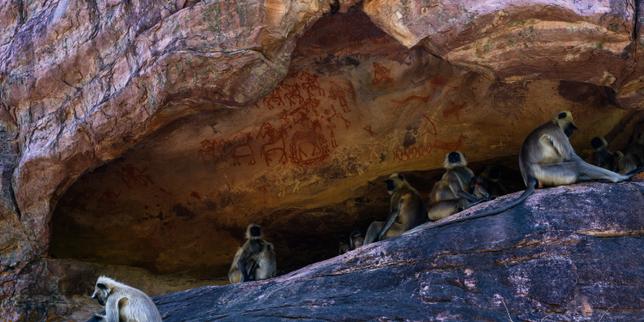
Deep in the craggy sandstone cliffs of Madhya Pradesh, India, you'll find a massive network of caves that completely shatters how we think about ancient art. Most people automatically point to Altamira in Spain or Lascaux in France when they talk about prehistoric masterpieces. That's a mistake. The Bhimbetka rock shelters house a staggering collection of rock art that stretches back tens of thousands of years. It dwarfs many European sites in both sheer scale and chronological depth.
Walk through these natural shelters and you're looking at a continuous visual record of human life from the Upper Paleolithic right through to the medieval period. It's a chaotic, beautiful timeline left by generations of humans who looked at these stone walls and decided to leave a trace. Yet, despite being a UNESCO World Heritage site since 2003, Bhimbetka doesn't get a fraction of the global spotlight it deserves.
That's a shame because the site holds secrets that challenge standard archaeological timelines.
The Raw Scale of India's Oldest Art Gallery
Bhimbetka isn't just a couple of isolated caves. It's an sprawling complex of over 750 rock shelters spread across seven hills in the Vindhyan Range. About 100 kilometers south of Bhopal, these sandstone formations rise out of a dense teak forest.
Indian archaeologist Dr. Vishnu Shridhar Wakankar stumbled upon them in 1957. He was traveling by train when he noticed unique rock formations that looked remarkably similar to those he'd studied in Europe. When he actually went to investigate, he found an absolute treasure trove.
What makes Bhimbetka insane is the layering. Prehistoric artists didn't just paint a wall and leave it. They painted over older art. Again and again.
Archaeologists have identified up to 16 distinct layers of paintings in some shelters. The oldest drawings are stark, dynamic stick figures of animals like bison, tigers, and rhinoceroses executed in deep red and green. As time moves forward on the stone canvas, the style shifts. You start seeing hunters with bows and arrows, domestic animals, communal dances, musical instruments, and eventually, royal processions complete with decorated horses and elephants.
The Paint That Survived Millennia
How does paint slapped onto an open-air rock surface survive for 10,000 or even 30,000 years? It sounds impossible. The weather in Madhya Pradesh is brutal, with blistering summer heat and heavy monsoon rains.
The secret lies in the chemistry. The ancient artists used local minerals. Red came from hematite (iron oxide), white from clay or limestone, and green from chalcedony. They ground these minerals into a fine powder and mixed them with organic binders. Researchers believe they used animal fat, tree resin, or even plant sap.
The porous sandstone absorbed this mixture. Over thousands of years, a natural chemical reaction occurred. The minerals in the paint bonded with the rock face itself, creating a protective glaze. The art didn't sit on the rock. It became part of it.
You can stand in front of Shelter 4, often called the Zoo Rock, and see this vivid reality. It features over 250 animal figures representing 16 different species. The clarity is wild. You can spot the distinct hump of a bull, the menacing horn of a rhino, and stag antlers drawn with incredible precision.
What Most Historians Get Wrong About Prehistoric Life
We often view early humans as desperate, miserable creatures focused purely on survival. Bhimbetka completely corrects that narrative. The art tells us that these people had leisure time, a complex social structure, and a deep appreciation for storytelling.
They weren't just charting their hunts. They recorded their celebrations.
One of the most captivating scenes depicts a group of people dancing in a circle, holding hands. It looks shockingly modern. Another famous painting shows a massive, mythical boar-like creature chasing a tiny, terrified human figure. Was it a record of a real encounter with a megafauna beast? Or was it a local legend told around a campfire?
The paintings also reveal a massive shift in human evolution. In the early layers, animals dominate the scene, drawn with a reverent, almost spiritual detail. Humans are small and secondary. In the later Mesolithic and Neolithic layers, the balance flips. Humans grow larger, more active, and more dominant. They ride horses, herd cattle, and wage wars against rival tribes. The art tracks the exact moment we stopped trying to survive nature and started trying to conquer it.
The Lingering Mystery of the Bhimbetka Dates
Dating rock art is notoriously difficult. You can't just carbon-date mineral pigments like hematite because they don't contain organic carbon. Instead, scientists have to date the organic binders mixed into the paint, which are often badly degraded, or date the archaeological layers found in the dirt directly beneath the walls.
Because of this, the exact age of Bhimbetka's oldest paintings remains a fierce debate in archaeological circles.
Some conservative estimates place the earliest paintings around 10,000 BCE. Other researchers argue that certain green and dark red figures belong to the Upper Paleolithic, making them closer to 30,000 years old. Excavations inside the shelters have unearthed stone tools that date back more than 100,000 years, proving hominids lived in these caves long before they started painting them.
This dating uncertainty means Bhimbetka is still a living puzzle. Every few years, new microscopic analysis or excavation techniques nudge the timeline.
How to Experience Bhimbetka Without Spoiling It
If you want to see this place for yourself, you need a plan. It's easy to just walk past the rocks, snap a few photos, and miss the entire point.
First, skip the midday rush. The mid-day sun washes out the colors on the rock faces, and the heat makes the walking trails exhausting. Arrive early in the morning when the gates open at 7:00 AM. The low morning light hits the sandstone at an angle, making the ancient pigments pop against the stone.
Focus your energy on the main public cluster. While there are hundreds of shelters, the Archaeological Survey of India has cleared a accessible pathway through about 15 of the most spectacular caves.
Look closely at the details. Don't just look for the big animals. Search for the small things: the feathers in a hunter's hair, the strings on a bow, or the tiny handprints stamped onto the rock. Those handprints are the most personal connection you can have with the past. An individual stood exactly where you are standing, dipped their hand in red ochre, and pressed it to the stone.
Hire a local registered guide at the entrance. The signage at the site is decent, but it won't show you the hidden layers or the faded figures that require a trained eye to spot. A good guide will point out the subtle transitions in style that reveal centuries of human progress in a single glance. Pack your own water and snacks because the site is intentionally kept rural and undeveloped to protect the environment. Keep your distance from the rock faces, don't touch the art, and let the sheer antiquity of the place sink in.