Clickbait media loves a good aviation horror story. They love it even more when they can slap a budget airline's name on it.
The latest viral panic circulating online claims a Ryanair passenger was "partially sucked out of a plane" and stuck for two agonizing minutes. It is a terrifying, cinematic image. It conjures up visions of a helpless traveler dangling at 35,000 feet, saved only by the heroic grip of their seatmates while the cabin descends in chaos.
It is also a complete fabrication.
This incident never happened to a Ryanair passenger. Not last week, not last year, not ever in the history of the carrier. Ryanair has one of the most immaculate safety records in modern aviation. It has flown billions of passengers over nearly four decades without a single fatal accident.
But facts do not get clicks. Sensationalism does.
By misattributing historical incidents, misrepresenting basic physics, and exploiting the average flyer’s lack of aerodynamic knowledge, modern media feeds a useless cycle of flight anxiety.
Let us dismantle the sensationalist nonsense, look at the actual history of explosive decompression, and explain the brutal physics of what really happens when a plane loses pressure.
The Actual History They Are Quietly Borrowing
To understand where this viral myth comes from, we have to look at actual aviation history. The media did not invent the concept of a passenger being partially forced out of an aircraft window. They just stole the details from real, tragic, or miraculous events that happened to entirely different airlines decades ago, packaged them up, and branded them with a recognizable budget airline logo to drive outrage.
There are only two major modern incidents in commercial aviation history where an occupant was partially forced through a cabin breach.
British Airways Flight 5390 (1990)
This is the closest match to the "stuck for minutes" narrative, but it was not a passenger. It was the captain.
While flying over Oxfordshire, an improperly installed windshield blew out of the cockpit. The rush of escaping air instantly pulled Captain Tim Lancaster out of his seat. He was pinned against the exterior of the nose of the plane, held only by his knees which had jammed in the flight controls.
Flight attendant Nigel Ogden rushed into the cockpit and grabbed Lancaster’s belt. For over twenty minutes, crew members took turns holding onto the captain in freezing, high-velocity winds while the co-pilot executed an emergency landing. Miraculously, Lancaster survived with frostbite and fractures.
This was a maintenance failure on a BAC One-Eleven, not a random window blowout on a modern Boeing 737.
Southwest Airlines Flight 1380 (2018)
This is the modern tragedy that tabloids frequently distort.
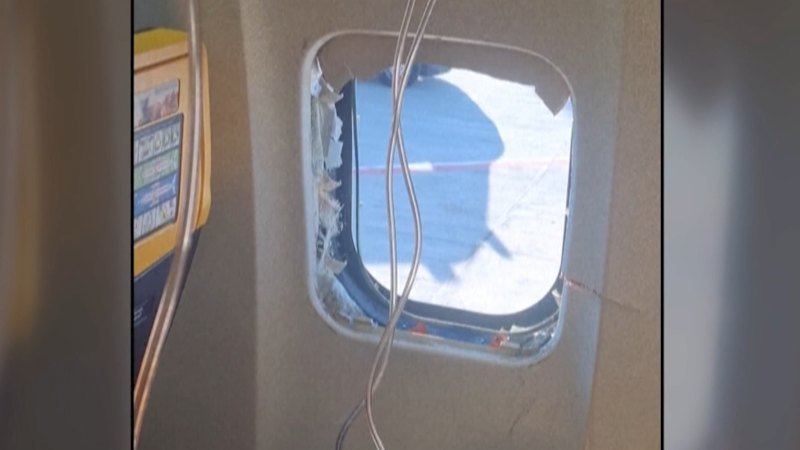
A Boeing 737-700 experienced a catastrophic engine failure over Pennsylvania. A fractured fan blade shattered the engine housing, sending shrapnel flying into the fuselage. A piece of that debris shattered a cabin window.
The sudden cabin pressure differential pushed passenger Jennifer Riordan partially out of the broken window. Despite the heroic efforts of fellow passengers who pulled her back into the cabin and administered CPR, she tragically passed away from her injuries.
To take a devastating mechanical anomaly from a domestic US carrier and rebrand it as a casual "Ryanair window failure" is not just bad journalism. It is a disrespectful distortion of real-world tragedies.
The Physics of "Suction" is an Absolute Lie
To dismantle this myth, we have to stop using the word "sucked."
You do not get sucked out of an airplane. You get pushed.
The mechanics of cabin decompression are governed by basic fluid dynamics and pressure differentials. It is not an invisible vacuum cleaner pulling you into the sky. It is the air inside the cabin desperately trying to escape.
Think of a commercial aircraft as a metal balloon.
At a cruising altitude of 35,000 feet, the outside atmospheric pressure is incredibly low—approximately 3.4 pounds per square inch (psi). Inside the cabin, the environmental control systems artificially pressurize the air to a comfortable level, usually equivalent to an altitude of 6,000 to 8,000 feet. This puts the internal cabin pressure at roughly 11 to 12 psi.
The difference between the inside pressure and the outside pressure is known as the pressure differential, represented as:
$$\Delta P = P_{\text{interior}} - P_{\text{exterior}}$$
Using our cruising altitude numbers:
$$\Delta P = 11.5\text{ psi} - 3.4\text{ psi} = 8.1\text{ psi}$$
An 8.1 psi difference might sound small. But when applied over a larger surface area, the force is immense.
If a cabin window measuring 10 inches by 14 inches (140 square inches) fails completely, the outward force acting on that opening is:
$$\text{Force} = \Delta P \times \text{Area}$$
$$\text{Force} = 8.1\text{ psi} \times 140\text{ sq in} = 1,134\text{ pounds}$$
Over half a ton of force is suddenly trying to push everything near that window out into the atmosphere. The air inside the plane rushes toward the opening at supersonic speeds.
If you are not buckled in, and you are sitting directly next to that opening, you are going to be pushed toward it by a wall of air.
However, this violent rush of air only lasts until the pressure inside the cabin equalizes with the pressure outside. In a standard commercial cabin, this equalization happens in a matter of seconds—not minutes. Once the air pressure equalizes, there is no more "suction" force trying to push you out. There is only the aerodynamic drag of the wind rushing past the fuselage.
Why Airplane Windows Do Not Just "Pop"
The common fear is that a passenger could lean too hard against a window, or a small crack could cause the entire frame to blow out. This is structurally impossible under normal operating conditions due to the redundant engineering of aircraft windows.
Commercial cabin windows are not single sheets of glass. They are a three-layered assembly designed to survive pressures far exceeding anything they will ever encounter in flight.
| Window Layer | Material | Function |
|---|---|---|
| Outer Pane | Heavy-duty structural acrylic | Takes the full force of the cabin pressure differential. |
| Middle Pane | Structural acrylic (with breather hole) | Acts as a 100% redundant backup. If the outer pane fails, the middle pane can hold the full pressure load. |
| Inner Pane | Thin plastic scratch shield | Protects the structural panes from passengers scratching, leaning, or spilling drinks on them. |
The tiny hole you see at the bottom of the middle pane—often called the "breather hole"—is a critical safety feature. It allows pressure to equalize between the cabin and the air gap between the outer and middle panes. This ensures that the heavy structural load of holding the cabin pressure is borne entirely by the outer pane first.
If the outer pane fails, the middle pane instantly takes over the load. The window does not fail unless both primary structural panes suffer simultaneous, catastrophic mechanical damage from an external source, such as engine shrapnel.
Dismantling the "People Also Ask" Panic
Let us address the typical questions that pop up when travelers search for airline safety anomalies. Most of these questions are built on false premises.
"Can you get sucked through an airplane toilet?"
This is a classic urban legend. Airplane toilets use a vacuum system combined with a Teflon-coated bowl to sweep waste away using minimal water. The vacuum pull is strong, but it is entirely self-contained. It is physically impossible to get "sucked in" or have your internal organs damaged by sitting on the seat while flushing. The toilet seat creates a physical barrier that prevents a perfect seal from forming anyway.
"What should I do if a window breaks near me?"
The answer is simple, boring, and highly effective: Keep your seatbelt fastened.
In every single historical case of rapid decompression, the passengers who suffered injuries or were displaced from their seats were those who did not have their seatbelts secured. The seatbelt is your primary anchor. It easily resists the force of escaping cabin air. If a decompression occurs, secure your oxygen mask first, tighten your seatbelt, and hold on.
"Why do budget airlines get blamed for these stories?"
Budget airlines like Ryanair, EasyJet, and Spirit are easy targets for sensational tabloid media. They fly millions of passengers daily, meaning their brand names carry high search volume.
People love to believe that paying less for a ticket means the airline is cutting corners on safety. But aviation maintenance standards are governed by strict international bodies like the FAA and EASA. A Boeing 737 flown by Ryanair must adhere to the exact same rigorous maintenance cycles, inspections, and structural integrity checks as a Boeing 737 flown by a legacy flag carrier.
Cheap tickets mean fewer complimentary snacks and tighter legroom. They do not mean compromised safety margins.
The Real Threat of Decompression is Not What You Think
If a cabin depressurizes, your biggest threat is not being ejected into the sky. It is the physiological toll of high-altitude exposure.
When cabin altitude rises above 10,000 feet, the partial pressure of oxygen drops. At 35,000 feet, the Useful Limit of Consciousness (TUC)—the time you have to take rational action before slipping into hypoxia—is shockingly short.
- At 30,000 feet: 1 to 2 minutes of useful consciousness.
- At 35,000 feet: 30 to 60 seconds of useful consciousness.
- At 40,000 feet: 15 to 20 seconds of useful consciousness.
This is why the emergency oxygen masks drop automatically. It is also why flight attendants insist you put your own mask on before helping others. If you spend 45 seconds trying to secure your child’s mask at 35,000 feet, you will pass out before you finish, leaving both of you incapacitated.
Along with hypoxia comes a rapid drop in temperature. At cruising altitude, the outside air is roughly -50 degrees Celsius. A structural breach means instant freezing fog inside the cabin as moisture condenses, accompanied by deafening wind noise.
It is loud, terrifying, and chaotic. But it is entirely survivable if you stay calm, put your mask on, and remain buckled in.
Stop sharing fake news about budget airline passengers dangling out of windows. The engineering holding your plane together is monumentally stronger than a tabloid writer's grasp of basic physics. Keep your seatbelt fastened, ignore the sensationalist headlines, and let the pressurization system do its job.