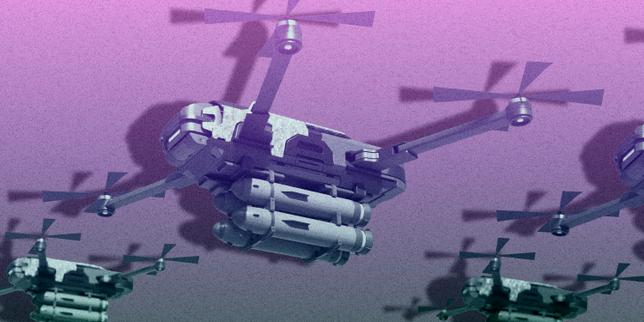
The idea of a "Terminator" robot stalking a battlefield is a distraction. It’s a sci-fi trope that keeps us from looking at the boring, terrifying reality of how software actually functions in modern war. When experts like Laure de Roucy-Rochegonde talk about the marginalization of human decision-making, they aren’t talking about a sudden robot uprising. They’re talking about a slow, quiet erosion. It’s a process where the person pulling the trigger becomes a mere rubber stamp for an algorithm they don’t truly understand.
We’re already there. In recent conflicts, we’ve seen the deployment of systems designed to process vast amounts of surveillance data to "identify" targets. On paper, a human stays "in the loop." In practice, that human has seconds to override a computer’s suggestion. When the machine processes a thousand data points and you only see a blurred drone feed, you aren't the one making the choice. The software is.
The Myth of the Meaningful Human Control
Military leaders love the phrase "meaningful human control." It sounds responsible. It suggests a stoic officer weighing the moral gravity of a strike. But as de Roucy-Rochegonde and other political scientists point out, the speed of modern combat makes this a fantasy. If an incoming missile travels at Mach 5, a human brain is too slow to react. You hand the keys to the defense system.
Once you give the machine the power to defend, the line between "defensive" and "offensive" autonomy starts to blur. If a system can automatically fire at a perceived threat to save a ship, why not let it fire at a perceived threat to "soften" a landing zone? The logic of efficiency is a one-way street.
This isn't just about killer robots. It’s about the "datafication" of the enemy. When we use AI to categorize people as "combatants" based on their cell phone metadata or who they met for coffee, we’ve replaced human intelligence with pattern matching. Patterns aren't people. Patterns don't have rights. They’re just entries in a database that an overworked analyst is pressured to approve so they can move to the next file.
Why Speed is the Enemy of Ethics
War is getting faster. That’s the core problem. Military AI is sold as a tool to reduce "fog of war," but it actually creates a new kind of blindness. We call it automation bias. It’s the tendency for humans to trust the output of an automated system even when it contradicts their own senses.
If the screen says "Target Confirmed," most operators will hit the button. They don't want to be the one who hesitated and let a high-value target escape. This pressure turns the human into a bottleneck. In a high-intensity conflict between two tech-heavy powers, the side that pauses to think is the side that loses. This creates a "race to the bottom" where both sides feel forced to remove human oversight just to keep up.
The Problem of Black Box Targeting
Most advanced AI today uses neural networks. These are "black boxes." Even the programmers who build them can't always explain why the system identified a specific van as a mobile rocket launcher instead of an ambulance.
- Data Poisoning: If an adversary knows your AI is trained on certain visual patterns, they can manipulate those patterns to trick the system.
- Algorithmic Drift: A system trained in a desert might fail miserably in a forested environment, leading to "hallucinations" where it sees threats that aren't there.
- Accountability Gaps: When an AI makes a mistake and hits a civilian hospital, who goes to jail? The programmer? The commander? The 19-year-old operator?
International law is built on the idea of intent. A machine doesn't have intent. It has code. By shifting the "decision" to the software, we’ve effectively laundered the responsibility for war crimes through a series of subroutines.
The Political Cost of Invisible War
When war becomes automated, it becomes politically easier to start. If you don't have to send thousands of "boots on the ground" and risk "body bag" headlines, the barrier to using force drops. AI-driven drone swarms and long-range autonomous systems allow states to project power without the domestic political friction that usually keeps aggression in check.
De Roucy-Rochegonde argues that this marginalization of the human element isn't just a technical shift; it's a democratic one. If the public doesn't feel the cost of war, and if the decisions are buried in classified algorithms, how can there be any real oversight? We’re moving toward a state of "permanent low-level conflict" managed by software.
Breaking the Feedback Loop
We need to stop treating AI as an inevitable force of nature. It’s a choice. If we want to keep war "human," we have to be willing to accept tactical disadvantages. That means establishing "no-go" zones for autonomy.
- Mandatory Human-in-the-Loop: Systems should be hard-coded to require a positive human identification based on visual evidence, not just metadata patterns.
- Standardized Testing: Just like we don't allow a new jet to fly without years of safety checks, military AI should face rigorous, transparent testing for bias and error rates.
- New Treaties: We need an international ban on "latent" autonomy, where systems can be switched to fully autonomous mode with a simple software toggle.
The goal isn't to stop technology. That's impossible. The goal is to ensure that the person who decides to end a life is a person who can feel the weight of that choice. Machines don't feel. They just calculate. And a world where life and death are reduced to a calculation is a world where nobody is truly safe.
Start by demanding transparency from defense contractors about the "error rates" of their targeting software. Look past the marketing speak of "precision" and ask about the false positives. The less we talk about the math, the more we surrender our humanity to it. Stop accepting the "efficiency" argument as the final word. Efficiency in killing isn't a virtue; it's a danger. Narrow the scope of what machines are allowed to "suggest" before the suggestion becomes the only reality we have left.