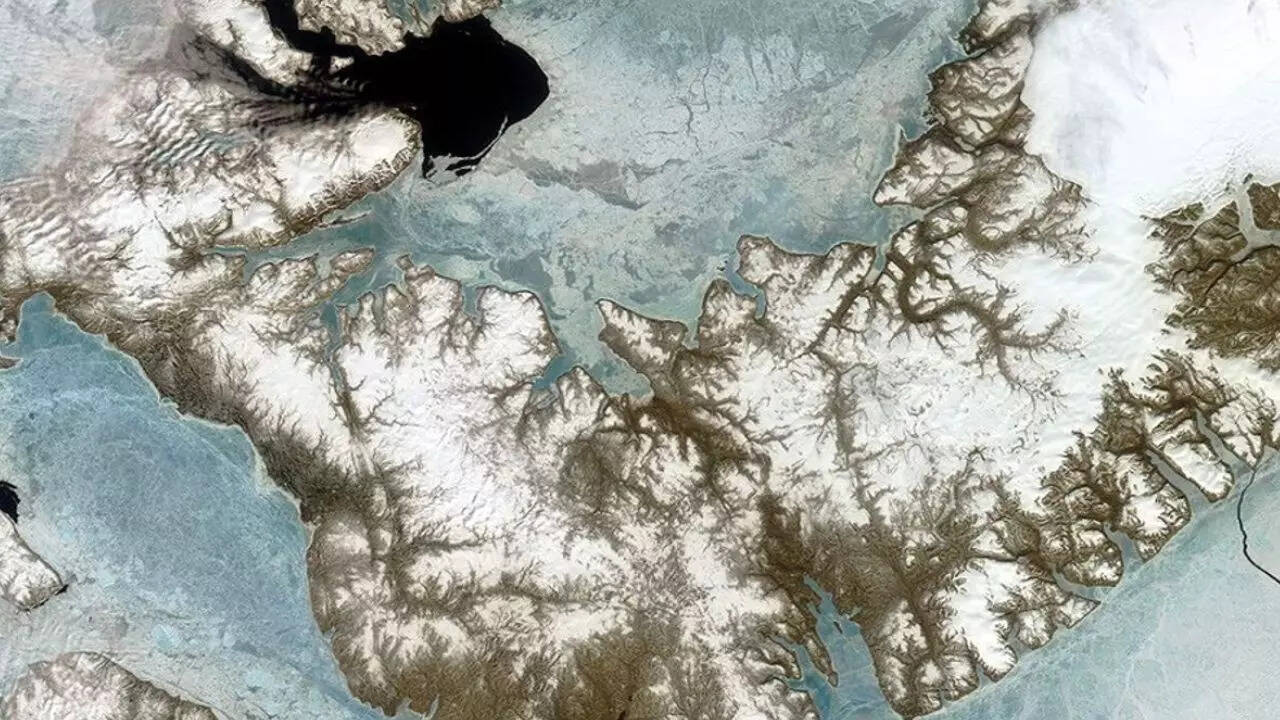
NASA does not spend millions of dollars sending teams to a desolate, polar bear-infested rock in Nunavut just for the scenery. Devon Island, the largest uninhabited island on Earth, serves as a brutal, unforgiving proxy for the Red Planet. This is the Haughton-Mars Project (HMP). It exists because the Haughton Crater, a 23-kilometer-wide scar from an ancient meteorite impact, offers a geological and thermal environment that almost perfectly mimics the Martian surface. If a piece of technology can survive the jagged, permafrost-locked terrain of Devon Island, it might just stand a chance on the plains of Utopia Planitia.
The site is more than a simple testing ground. It is a biological and mechanical pressure cooker. On Devon, the temperature rarely climbs above freezing, the air is dry, and the ground is a mix of shattered rock and ice. Researchers use this isolation to solve the most terrifying problem of space travel: human error. When you are 225 million kilometers away from home, a broken drill or a software glitch isn't an inconvenience. It is a death sentence. By operating in the Canadian High Arctic, NASA and its partners can simulate the delay in communication, the physical exhaustion of EVA (Extra-Vehicular Activity) suits, and the psychological strain of total confinement.
The Haughton Impact and the Martian Mirror
Geology is the primary draw. Approximately 39 million years ago, a massive object slammed into Devon Island. The resulting Haughton Crater remains remarkably well-preserved because the Arctic climate prevents the kind of rapid erosion seen in tropical or temperate zones. This preservation creates a "time capsule" effect. The crater is filled with impact breccia—shattered rock fused together by intense heat—which is nearly identical to the rubble found in Martian craters.
Scientists focus on the "active layer" of the soil. This is the thin sliver of earth that thaws and refreezes annually above the permanent ice. On Mars, similar structures suggest the presence of water ice just beneath the surface. By studying how meltwater flows through the Haughton Crater, hydrologists can predict where water might have moved on Mars billions of years ago. They aren't just looking at rocks; they are reading a map of a dead world written in the language of the Arctic.
Testing the Machines of the Future
If you see a bizarre, multi-wheeled rover crawling over a ridge on Devon Island, it isn't a film set. It is likely a prototype for the next generation of autonomous explorers. NASA uses the island to test "hazard avoidance" software in real-time. In a lab, you can program a robot to avoid a predictable obstacle. In the High Arctic, the ground shifts. Rocks that look solid might be loose scree. Mud can turn into a trap.
Testing here has led to specific design changes in rover wheel durability. Early designs that worked perfectly in the sandy pits of California failed miserably on the sharp, flint-like edges of Devon’s polar desert. The island forced engineers to rethink the grip and material composition of tires, moving away from rigid structures toward more flexible, compliant materials that can "swallow" a rock rather than being punctured by it.
The Human Element and Isolation
Living at the Haughton-Mars Project Research Station is not a vacation. The crew lives in small, interconnected modules. They must wear heavy, pressurized suit simulators when they step outside. They eat freeze-dried food. They deal with the constant threat of polar bears. This environmental stress is a vital data point.
Psychologists monitor how these teams interact under pressure. They look for "third-quarter phenomenon," a well-documented dip in morale that happens after the midpoint of a mission. On Mars, where a return trip takes months, maintaining team cohesion is as important as maintaining the life support system. Devon Island provides a low-stakes environment to fail. It is better to have a breakdown in Nunavut, where a Twin Otter plane can eventually evacuate you, than in the vacuum of space.
The Problem of Contamination
One of the biggest hurdles in searching for life on Mars is the risk of "forward contamination." This happens when Earth-bound microbes hitch a ride on a spacecraft and are accidentally introduced to a new environment. Devon Island is a "clean" environment in the sense that it is sparsely populated, but it is far from sterile.
Researchers use the island to develop sterilization protocols. They practice taking core samples from deep within the permafrost without introducing surface bacteria into the hole. This involves a complex dance of specialized drills and chemical cleaners. If they can’t keep a sample clean on Devon Island, they have no hope of doing it on Mars. The island serves as the ultimate laboratory for perfecting the "leave no trace" philosophy required for planetary protection.
Why the Private Sector is Moving In
NASA is no longer the only player in the Arctic. Private aerospace companies are increasingly using Devon Island to stress-test their own hardware. The shift toward commercial spaceflight means that reliability must be balanced with cost.
These companies are looking for ways to build cheaper, lighter habitats. Traditional space modules are heavy and expensive to launch. On Devon, engineers experiment with inflatable structures and 3D-printed buildings using local materials. If you can build a shelter using Devon’s crushed rock and a binding agent, you can theoretically do the same with Martian regolith. This concept of "In-Situ Resource Utilization" (ISRU) is the holy grail of space colonization. It turns the destination from a hostile void into a source of raw materials.
The Logistics of the High Arctic
Getting to Devon Island is a feat of engineering in itself. Everything—fuel, food, medical supplies, and heavy machinery—must be flown in on small bush planes. There are no roads. There are no power lines. The research station must be entirely self-sufficient, relying on solar arrays and generators.
This logistical nightmare is exactly what a Mars mission looks like. Every kilogram of weight must be justified. Every liter of water must be recycled. The HMP team has become experts in "extreme MacGyvering," fixing complex electronics with limited tools and high stakes. This culture of self-reliance is the blueprint for the first human colonies.
The Hidden Cost of Research
Operating in the Arctic is expensive and politically complex. The research must be conducted with respect for the local Inuit communities and the territorial government of Nunavut. Environmental impact assessments are rigorous. Critics sometimes argue that the money spent on these simulations would be better used on direct satellite observations.
However, satellite data only provides a top-down view. You cannot feel the texture of the soil or the resistance of the wind from an orbit. The ground truth found on Devon Island fills the gaps that cameras miss. It provides the tactile, messy reality of exploration that no computer simulation can replicate.
A Training Ground for the Unexpected
The most valuable thing Devon Island teaches us is that things will go wrong. During one mission, a violent windstorm damaged a communication dish, forcing the crew to find a way to realign it using only the parts they had on hand. This kind of "unscripted failure" is the best training possible.
The island strips away the comforts of the modern world. It forces researchers to think in terms of basic survival and fundamental physics. When a rover gets stuck in a gully on Devon, it isn't a simulation error. It is a physical problem that requires a physical solution. That grit is what will eventually put footprints in the Martian dust.
The Mars of Earth is a place of silence and cold. It is a landscape that doesn't care if you live or die. By conquering the challenges of Devon Island, we are not just practicing for another planet. We are proving that the human spirit of exploration can thrive in the most hostile corners of our own. The lessons learned in the Haughton Crater are the quiet foundation of a multi-planetary future.
Watch the weather patterns over the Haughton Crater during the next summer season. The way the mist clings to the valley floor isn't just a weather event; it's a preview of the morning frost on a world we haven't yet reached.