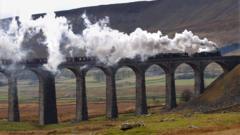
The West Highland Line is not a museum piece. While travel brochures and social media influencers paint a picture of a static, romantic journey through the Scottish Highlands, the reality for those who operate it is a relentless battle against geography and aging infrastructure. It is frequently voted the most scenic railway journey on the planet, stretching from Glasgow to Mallaig and Oban, but its beauty is a direct byproduct of its isolation. This isolation makes it one of the most expensive and difficult stretches of track to maintain in the global rail network.
To understand the West Highland Line, one must look past the steam-engine nostalgia of the Jacobite and the towering arches of the Glenfinnan Viaduct. The line serves as a vital artery for remote communities that would otherwise be cut off from the mainland economy. However, the surge in global tourism—driven largely by the "Harry Potter" effect—has created a friction point between the railway’s role as a public utility and its status as a bucket-list attraction. This isn't just a train ride; it is a high-stakes logistical operation that defies modern engineering logic.
The Geography of a Logistical Nightmare
The West Highland Line exists where a railway probably shouldn't. When the West Highland Railway Company pushed the track through the "Green Bridge" of the Gairraidh in the late 19th century, they weren't building for speed. They were building for survival. The route traverses Rannoch Moor, a fifty-square-mile expanse of peat bog, heather, and granite.
Engineers could not find a solid foundation for the tracks across the moor. Instead, they had to float the railway on a mattress of tree roots, brushwood, and thousands of tons of earth and ashes. If the drainage systems fail today, the track quite literally begins to sink into the bog. This is not a hypothetical concern. Maintenance crews are in a constant cycle of monitoring water levels and structural integrity on a section of track that has no road access for miles. If a piece of heavy machinery breaks down in the middle of Rannoch Moor, getting a replacement there is a feat of mountain rescue proportions.
The Iron Road to the Isles
The extension to Mallaig, completed in 1901, represents the peak of Victorian concrete engineering. Use of "Mass Concrete" was pioneering at the time, but a century of Scottish weather—horizontal rain, freeze-thaw cycles, and gale-force winds—takes a toll. The Glenfinnan Viaduct, with its 21 arches, requires constant laser scanning and manual inspections to ensure that the Victorian concrete isn't developing internal fissures.
For the drivers and guards who work these shifts, the "scenery" is a series of hazards to be managed. Red deer on the tracks, rockfalls in the deep cuttings near Loch Eilt, and the ever-present risk of "leaves on the line"—which, on these steep gradients, can turn a thousand-ton train into a giant sledge—are the daily realities.
The Tourist Trap and the Capacity Ceiling
The popularity of the line has become its greatest operational challenge. The "Harry Potter" association brought a global audience to a rural branch line that was never designed for those volumes. During peak season, the demand for tickets on the Mallaig extension far outstrips the physical capacity of the trains.
You cannot simply add more carriages. The platforms at many of the remote stations, like Royale or Ardlui, are too short to accommodate longer trains. Extending these platforms would require massive capital investment in locations where the ground is either solid rock or sinking peat. Furthermore, the line is predominantly single-track. Trains can only pass each other at specific loops, meaning the entire timetable is a fragile house of cards. If the northbound train from Glasgow is delayed by twenty minutes, the ripple effect can stall southbound traffic for hours, as there is nowhere else for the trains to go.
The Struggle for the Local Commuter
This brings us to a significant counter-argument to the "scenic" narrative. For the people living in Fort William or Mallaig, this is their commute. When the carriages are packed with tourists focused on getting the perfect photo of the viaduct, the local student or worker is often squeezed out. There is a growing tension between the railway as a profitable tourist asset and the railway as a subsidized public service.
The Scottish Government heavily subsidizes these rural routes because they are not commercially viable on their own. The revenue from the high-end sleeper berths and the seasonal steam specials helps offset the costs, but it doesn't solve the fundamental issue of overcrowding. We are seeing a shift where the "experience" of the journey is beginning to degrade because of the sheer density of people trying to have it at the same time.
Safety Regulations and the Steam Conflict
Recent years have seen a bitter dispute between heritage operators and safety regulators. The Office of Rail and Road (ORR) has pushed for modern safety standards, specifically regarding central door locking on older carriages. For decades, the vintage carriages used on the Jacobite steam service allowed passengers to open doors while the train was moving—a hallmark of old-school rail travel but a significant liability in the 21st century.
The cost of retrofitting these vintage fleets is astronomical. Some operators argued that the requirements would make the business unfeasible, threatening the very existence of the steam specials that bring millions of pounds into the Lochaber economy. This is the brutal truth of the West Highland Line: the more we try to preserve its "authentic" feel, the more it clashes with the non-negotiable mandates of modern safety and efficiency. A compromise was eventually reached involving expensive upgrades, but it served as a wake-up call. The line cannot live in the past forever.
Environmental Volatility and the Future
Climate change is the silent killer of highland infrastructure. Scotland is getting wetter, and the intensity of rainfall is increasing. For a railway built on peat and tucked under steep mountainsides, this is catastrophic.
Landslips are no longer "once in a generation" events. In the last decade, we have seen multiple instances where the line was severed by debris flows. The cost of "hardening" the line—installing rock netting, improving culverts, and stabilizing slopes—is a multi-billion pound headache for Network Rail.
The Electrification Question
There is constant talk about decarbonizing the Scottish rail network. While the main lines between Edinburgh and Glasgow are electrified, the West Highland Line remains the domain of diesel. The sheer distance and the harsh terrain make overhead wires a logistical and aesthetic nightmare. Battery-powered trains or hydrogen fuel cells are often proposed as the "green" solution, but the weight of batteries and the lack of charging infrastructure in the wilderness remain massive hurdles.
For now, the heavy scent of diesel and the chug of the Class 156 Sprinters remain the soundtrack of the Highlands. It is a stubborn, mechanical persistence against a landscape that wants to reclaim the tracks.
The Human Element Behind the View
The staff who work this line are a breed apart. To be a signaller at Corrour, the highest and most remote station in the UK, is to embrace a life of solitude and meteorological extremes. There is no road to Corrour. You arrive by train, and you leave by train.
These workers are the institutional memory of the Highland rail system. They know exactly which culvert is likely to block during a storm and which sections of track will expand too much in a rare Scottish heatwave. Without this boots-on-the-ground expertise, the digital monitoring systems would be useless.
Investing in the Long Game
If the West Highland Line is to survive another century, it requires more than just tourist revenue. It needs a fundamental shift in how we value rural infrastructure. We have to stop viewing it as a holiday excursion and start treating it as a critical piece of national heritage that requires aggressive, proactive engineering.
The "scenic" label is a double-edged sword. It attracts the money needed to keep the lights on, but it masks the fragility of the operation. Every time a passenger looks out the window at the white sands of Morar, they are seeing the result of a thousand small daily victories by engineers and operators fighting a war of attrition against the elements.
The real story isn't the view; it's the fact that the train is moving at all. Demand for this experience shows no sign of slowing down, but the physical limits of the Victorian footprint have been reached. The next decade will determine if the line remains a functioning railway or if it eventually becomes a very long, very beautiful hiking trail. To keep the wheels turning, the investment must match the ambition of the original builders, who saw a bog and decided to lay iron across it.


