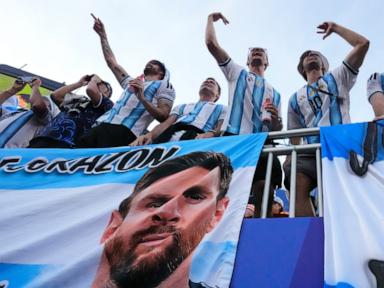
The blue paint on the curb of Calle Defensa is chipping. It has been there since December 2022, a hurried, joyful slash of acrylic dried under a brutal Buenos Aires summer sun. If you walk past it today, you will see a man named Mateo scrubbing the sidewalk outside his small kiosk. He does it every morning. He wears a faded jersey with three embroidered stars over the crest. The fabric is thinning at the shoulders. The white stripes are yellowing from sweat and exhaust fumes.
Mateo does not buy new clothes anymore. Inflation in Argentina hit over 200 percent, a staggering number that turns grocery shopping into an exercise in high-stakes mathematics. But last week, Mateo spent a significant portion of his monthly income on a ticket to see the national team play a qualifying match.
To an outsider, this looks like madness. It looks like a dangerous, financial irresponsibility. When foreign news outlets report on Argentina defending its world title, they use words like "obsession" or "frenzy." They point cameras at the roaring crowds, the flying confetti, the tears streaming down the faces of grown men, and they treat it like a collective psychological anomaly. They see a distraction. They think a football match is a temporary painkiller for a country enduring a brutal economic winter.
They are completely wrong.
Understanding Argentina right now requires looking past the stadium lights. It requires understanding that the national team is not an escape from reality. For forty-six million people, that team is reality. It is the only anchor in a sea of shifting ground.
The Mathematics of Devotion
When Argentina won its third World Cup in Qatar, the country experienced a rare moment of absolute alignment. Five million people poured into the streets of Buenos Aires. Total strangers wept on each other’s shoulders. The economy did not miraculously fix itself the next morning, but something fundamental shifted in the national psyche.
Consider the mechanics of hope. In daily life, hard work does not always guarantee a reward. You can save your pesos, only to watch their value halve by Tuesday. You can follow every rule and still lose. But on the pitch, under the watchful eye of Lionel Scaloni, a different set of laws applies. There, effort translates directly into merit.
The national team operates as a functioning meritocracy in a world that often feels deeply unfair. When people buy tickets they cannot afford, they are not paying to watch eleven millionaires kick a ball. They are purchasing a share of certainty. They are investing in an institution that actually delivers on its promises.
This devotion is measurable. Ticket sales for national team matches do not dip when the economy tanks. They skyrocket. Bars that face dwindling weekend crowds see their registers ring only when the sky-blue and white shirts are on the television. It is a hyper-inflation of the soul. The scarcer resources become, the more valuable the few sources of genuine joy become.
The Ghost in the Jersey
There is a unique pressure that comes with defending a title, a psychological weight that most sports franchises never truly comprehend. Winning once is an explosion. Defending that win is a slow, agonizing grind against gravity.
Every opponent treats a match against the champions as their own personal final. The intensity is suffocating. For the players, the burden is immense. They are no longer just athletes; they are custodians of the national mood. A defeat does not just mean dropped points in a standings table. It means a quieter morning commute in Rosario. It means a tenser atmosphere at the dinner tables in Córdoba.
But the fans do not view this defense with dread. They view it with a fierce, almost defensive possessiveness. The obsession has evolved since 2022. It is no longer just about the euphoria of winning; it is about protecting the feeling that winning gave them.
Imagine holding something incredibly fragile in a storm. You do not loosen your grip. You tighten it until your knuckles turn white. That is the current state of Argentine fandom. The chants in the stadium are louder now, sharper, tinged with an edge of defiance. They are singing to remind the world—and perhaps themselves—that they are still at the summit.
The Generational Handshake
Spend an afternoon in any park in San Telmo, and you will notice a distinct pattern. The children playing rough matches on the concrete are not wearing club jerseys. They do not care about Boca Juniors or River Plate the way their parents did. They wear the national colors.
This represents a massive structural shift in football culture. For decades, club loyalty was tribal, fierce, and often violent. It divided families and neighborhoods. Today, the national team has swallowed that club identity whole. The current generation of teenagers has grown up watching a team that represents unity rather than division.
A local youth coach, who has spent thirty years watching kids kick balls into chain-link fences, notes that the style of play has changed. The kids do not try to emulate individual showmanship anymore. They try to pass like Rodrigo De Paul. They try to defend with the frantic, sacrificial energy of Cristian Romero. The national team has codified a specific behavioral ideal: collective suffering for a shared reward.
This is the logical deduction that outsiders miss. The obsession is not a form of stagnation. It is a forward-looking cultural transmission. Parents are passing down the memory of December 2022 to children who were too young to fully grasp it, using the current matches as a living textbook on resilience.
The Last Dance Dilemma
Every story has an expiration date, and the current era of Argentine football is staring directly at its own conclusion. The talismanic figures who anchored the transformation are entering the twilight of their careers. The realization is bittersweet, filtering through every conversation in the cafes.
There is a quiet panic beneath the songs. Everyone knows that the current peak cannot last forever. The transition from the old guard to the new generation is already underway, but transitions are notoriously volatile.
This impending scarcity is what drives the current mania. The fans know they are living in the "good old days" right now, in real-time. Usually, people only realize they were happy after the moment has passed. Argentina is acutely, painfully aware of its current privilege. Every match is treated as if it might be the last time the magic works.
That is why Mateo scrubs his sidewalk with that specific, thinning jersey on his back. It is why people skip meals to afford a seat in the upper tiers of the Estadio Monumental. They are buying memories to store against the lean years they know will eventually return.
The sun begins to dip behind the high-rises, casting long, dark shadows across Calle Defensa. Mateo finishes his work, wipes his brow with the sleeve of his shirt, and looks down at the chipped blue paint on the curb. He touches the three stars on his chest, a quick, unconscious gesture, like a traveler checking for his passport in a crowded station. The paint is fading, but the concrete underneath remains completely solid.


