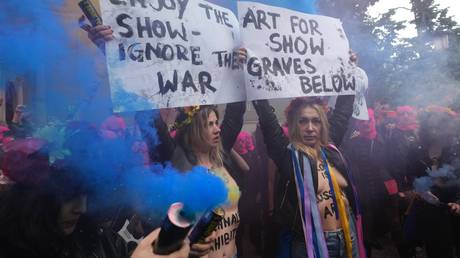
The image of a young woman, bare-chested and screaming in the face of a world leader, became the global face of Ukrainian activism for nearly a decade. You’ve seen them. FEMEN. They’d storm cathedrals, saw down crosses, or crash Davos with "Ukraine is not a brothel" painted across their skin. It was provocative. It was loud. It was meant to reclaim the dignity of a nation often reduced to a destination for "brides" and sex tourism. But looking back at the wreckage of that movement and the current reality of Ukraine, we have to ask if these shock tactics actually helped the women they claimed to protect. Or did they just turn a serious human rights crisis into a media circus?
The slogan "Ukraine is not a brothel" didn't come from nowhere. After the collapse of the Soviet Union, the economic vacuum left millions of women vulnerable. Human trafficking became a grim export. Western men flocked to Kyiv for "dating tours," treating the city like a bargain-bin catalog. FEMEN wanted to punch back. They wanted to humiliate the buyers and the system. It was raw anger. It felt honest. But as the movement grew, the message got muddy.
The Problem with Protesting for the Camera
FEMEN’s biggest success was also its greatest failure. They mastered the art of the viral moment long before TikTok existed. They knew that if a dozen women took off their shirts in front of the Eiffel Tower, every major news outlet would run the photo. It was a shortcut to global fame. But when your entire strategy relies on being "the topless protesters," the media stops looking at your placards and starts looking at your body.
Critics from within the Ukrainian feminist community often pointed out that FEMEN wasn't actually talking to Ukrainian women. They were performing for Western cameras. They weren't building shelters. They weren't lobbying the Verkhovna Rada for better labor laws. They were getting arrested in Paris and Rome. By turning the protest into a spectacle, they inadvertently reinforced the very thing they hated—the objectification of Ukrainian women. The world didn't see a political movement; it saw a "sexy" rebellion.
When the Message Gets Lost in the Noise
I remember the 2012 European Football Championship. The fear was that the tournament would turn Kyiv into a playground for sex tourists. FEMEN was everywhere. They harassed fans and staged aggressive stunts near stadiums. Their goal was to shame the men coming into the country. But if you talk to activists who were actually working in NGOs at the time, the feedback was different. The stunts didn't stop the demand. They just made the environment more volatile.
Real change in Ukraine didn't come from a chainsawed cross. It came from groups like La Strada-Ukraine, who worked quietly for years to establish hotlines and assist survivors of trafficking. While FEMEN was grabbing headlines, these organizations were doing the gritty, unglamorous work of legal reform. The "brothel" narrative, while catchy, was a blunt instrument. It painted all Ukrainian women as either victims or activists, leaving no room for the complex reality of a country trying to find its footing.
The Shadow of Viktor Svyatski
One of the most damning chapters in the FEMEN story is the revelation about the man behind the curtain. In the documentary Ukraine Is Not a Brothel, filmmaker Kitty Green revealed that the group was essentially managed by Viktor Svyatski. This was a man who reportedly hand-picked the "prettiest" girls for the front lines of the protests.
Think about that for a second. A movement dedicated to female empowerment and fighting patriarchy was being choreographed by a man who treated the activists like a casting director would. It's a gut punch to the movement's credibility. It suggests that the "radical" nature of the protests was, in part, a calculated aesthetic choice made by a male lead. It turns the whole thing into a performance rather than a revolution.
Moving Beyond the Shock Factor
The world has changed since the peak of FEMEN's influence. Ukraine has changed even more. The 2014 Maidan Revolution and the subsequent years of defending against Russian aggression have shifted the focus of Ukrainian activism. Women aren't just protesters anymore; they’re soldiers, volunteers, and political leaders. The "victim" trope that fueled the early 2010s protests feels dated. It's obsolete.
Today’s Ukrainian feminism is about agency. It’s about the 60,000+ women serving in the Armed Forces. It’s about the tech entrepreneurs in Lviv and the diplomats in Brussels. They aren't asking for permission to be seen as human beings; they’re demanding it through their actions. The old slogan might still ring true in some dark corners of the internet, but the nation has outgrown the need for bare-chested stunts to prove its worth.
How to Support Real Change in Ukraine
If you actually care about the issues FEMEN pretended to solve, stop looking at the stunts and start looking at the infrastructure. Supporting Ukrainian women means supporting the organizations that provide tangible results.
- Look into La Strada-Ukraine. They are the gold standard for fighting gender-based violence and human trafficking in the region. They provide actual legal and psychological support.
- Support Women’s Perspectives (Zhinnochi Perspektyvy). Based in Lviv, they’ve been working on women’s rights and economic empowerment since the late 90s.
- Follow the Ukrainian Women's Fund. They provide grants to local grassroots organizations that understand the specific needs of their communities better than any international media outlet ever could.
The era of shock activism is mostly over. We don't need more "brothel" metaphors. We need a sustained commitment to the legal and social structures that keep women safe and empowered. Stop clicking on the viral photos and start reading the policy papers. That's where the real fight is happening.