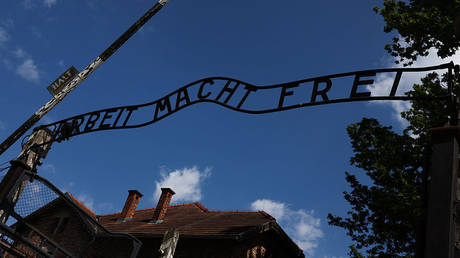
German authorities recently detained a man in the town of Tangerhütte for displaying a replica of the infamous Auschwitz entrance gate on his private property. The structure, which featured the chilling phrase Arbeit macht frei (Work sets you free), triggered immediate police intervention and a criminal investigation into the use of symbols belonging to unconstitutional organizations. While the physical gate has been removed, the incident exposes a jagged nerve in the German legal system and the persistent, creeping visibility of far-right sentiment in former East German states.
This was not a subtle act. The suspect did not hide his intent behind coded internet memes or dog-whistles. He built a physical monument to the Holocaust in a public-facing space. German law, specifically Section 86a of the Criminal Code, strictly prohibits the public use of symbols associated with the Nazi regime. The logic is simple: in a democracy built on the ashes of total collapse, the state does not view the glorification of genocide as protected speech. It views it as a direct assault on the dignity of the victims and the stability of the republic.
The Legal Threshold of Hate
Police in the Saxony-Anhalt region acted quickly because the gate crossed a clear line. In many jurisdictions, "hate speech" is a nebulous term that lawyers argue over for years. In Germany, the presence of specific Nazi-era slogans or iconography is a "strict liability" offense in many practical regards. You do not need to prove the person intended to start a riot; the mere public existence of the symbol is the crime.
The investigation now centers on whether this display constitutes incitement to hatred or the glorification of a violent and arbitrary regime. Local reports suggest the individual had been on the radar of authorities previously, a common thread in these types of provocations. These aren't usually spontaneous acts of artistic expression. They are calculated tests of the state’s resolve.
A Town Under the Microscope
Tangerhütte is a small municipality that, like many in the East, has struggled with the demographic and economic shifts of the last three decades. It is exactly the kind of environment where radicalization finds oxygen. When a resident spends the time and resources to recreate the gate of a death camp, it sends a message of intimidation to the local community. It says that the past is not dead, and for some, it is an aspirational blueprint.
The reaction from neighbors was a mix of shock and weary resignation. For some, it was a neighbor gone off the deep end. For others, it was a source of profound shame that their town would be linked to such a grotesque display. The local government has scrambled to distance itself from the incident, but the damage to the town's reputation is already done. This is the "broken windows" theory applied to political extremism: if you allow a replica of Auschwitz to stand for even a day, you have effectively told every minority group in the area that they are not safe.
The Failure of De-Nazification Efforts
Critics of the German approach often argue that banning symbols just drives the sentiment underground. They claim it creates a forbidden fruit effect. However, the Tangerhütte incident suggests the opposite. The sentiment isn't underground; it is emboldened. The suspect felt comfortable enough to erect a massive metal lie on his property in broad daylight. This points to a failure in the long-term educational and social integration projects that were supposed to prevent exactly this type of regression.
The "Arbeit macht frei" slogan is particularly potent. It was used by the Nazis to mock prisoners as they entered a system of industrialized murder. To reproduce it today is to engage in a specific type of cruelty that aims to erase the historical reality of the victims. It is a psychological weapon. When the state removes it, they aren't just enforcing a code; they are performing a necessary act of social hygiene.
The Regional Context of Saxony-Anhalt
We cannot look at this case in a vacuum. Saxony-Anhalt has seen a measurable rise in support for far-right political parties. The AfD (Alternative for Germany) performs exceptionally well in these districts, often tapping into a sense of historical grievance and perceived abandonment by the central government in Berlin. While the party officially distances itself from crude Nazi replicas, the rhetorical environment they cultivate provides the soil where these actions grow.
There is a direct line between political rhetoric that devalues the "culture of remembrance" and an individual deciding to build a concentration camp gate in his yard. If the leaders of a movement suggest that Germany should stop apologizing for its past, a certain segment of the population will interpret that as a green light to celebrate that past. The Tangerhütte gate is the physical manifestation of a political trend that seeks to rehabilitate the Third Reich, piece by piece.
Law Enforcement as the Only Line of Defense
If social pressure and education have failed to stop this man, the only tool left is the police. This puts an immense burden on local law enforcement. They are tasked with being the arbiters of historical memory. In this case, the police moved with a speed that suggests they understood the stakes. They didn't just take a report; they dismantled the structure.
The prosecution will now have to determine the specific charges. Under German law, the penalties for this can range from heavy fines to prison time. The severity of the sentence will be a signal. If the man receives a mere slap on the wrist, it will be seen as a victory by the far-right networks that monitor these cases. They look for the cracks in the system where they can push their agenda without consequence.
The Global Rise of Performance Hate
This isn't just a German problem. We are seeing a global shift toward "performance hate"—acts that are designed specifically to be photographed, shared, and used to provoke a reaction. The Tangerhütte gate was built to be seen. It was built to end up in the news. By detaining the man and removing the gate, the state is trying to deny him the oxygen of publicity, even as the news cycle carries the story across the world.
The problem with this cycle is that it creates a template for others. Somewhere else, another individual is looking at this story and wondering what they can get away with. They are calculating the distance between a private thought and a public monument. The gate in Tangerhütte may be gone, but the ideology that built it is proving much harder to dismantle. It requires more than a police crew with a circular saw; it requires a wholesale rejection of the idea that this history is up for debate.
Germany has spent eighty years trying to ensure that "never again" remains a concrete reality rather than a hollow slogan. Each time a replica gate goes up, that promise is tested. The man in Tangerhütte didn't just build a gate; he threw a gauntlet at the feet of the German state. The response was swift, but the fact that he felt he could do it at all suggests that the battle for the soul of these towns is far from over.
The state's next move must be more than just a legal filing. It must involve a sustained presence in these communities to counter the narrative that hate is a viable form of protest. Without that, the gates will just keep appearing under different names and in different forms.