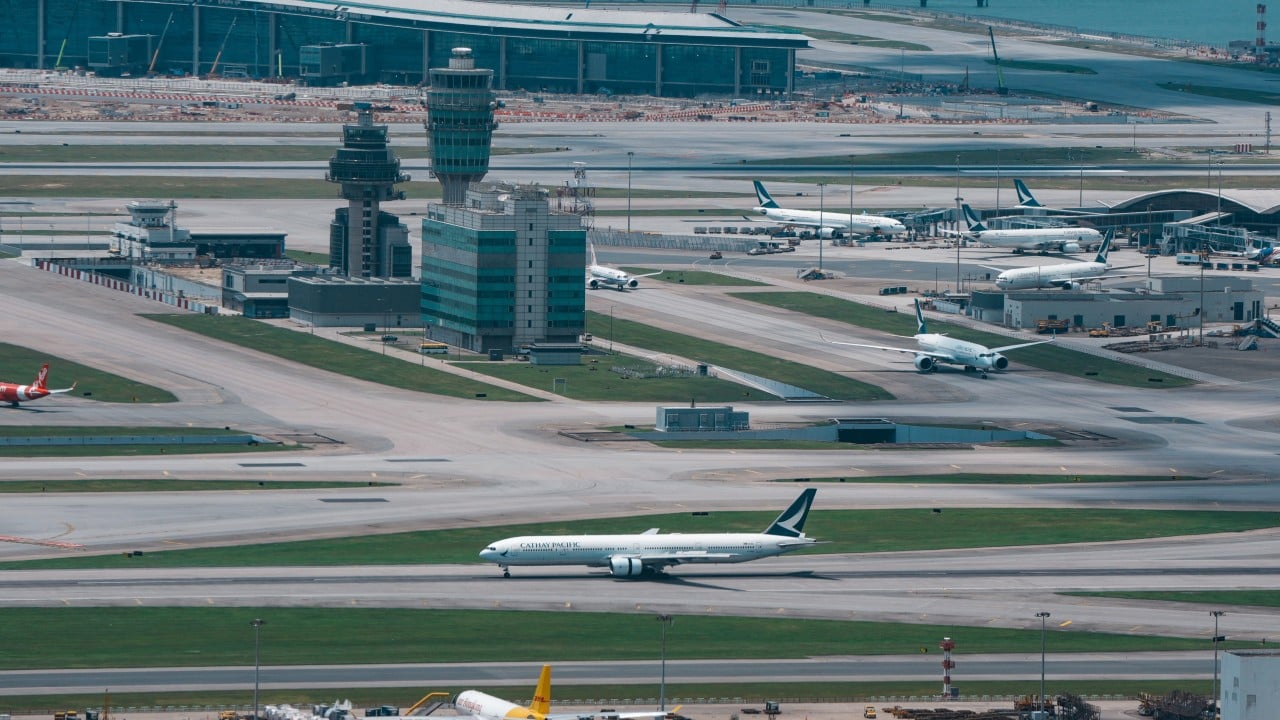
The ground halt began quietly with a handful of cancellations to Okinawa and Taipei, but within twelve hours, the regional aviation network linking Hong Kong to the rest of North Asia imploded. Super Typhoon Bavi, packing sustained winds of 195 kilometers per hour, did not even need to make a direct hit on Chek Lap Kok airport to paralyze the territory’s aviation hub. By Saturday morning, more than 130 flights scheduled to connect Hong Kong to mainland China, Taiwan, and Japan were erased from the departure boards. The quick collapse exposed the deep systemic vulnerability of a regional hub that operates on razor-thin scheduling margins, where a storm hundreds of miles away triggers a multi-day commercial crisis.
Mainstream reporting focuses on stranded vacationers and empty terminal gates. The real story lies in the fragile realities of modern airline fleet rotation and network interconnectedness. When a super typhoon sits directly on the high-density air corridors between Hong Kong, Taipei, and Tokyo, it does not just cancel isolated flights. It traps aircraft in the wrong cities, breaks crew rest cycles, and chokes off time-sensitive belly cargo operations that underpin the global tech supply chain.
The Cascade Effect of Regional Grounding
Airlines do not make money when their planes sit on the tarmac. To maximize profitability, regional carriers like Cathay Pacific, HK Express, Hong Kong Airlines, and Greater Bay Airlines utilize tight hub-and-spoke scheduling patterns. A single single-aisle aircraft might fly from Hong Kong to Taipei, turn around to head back, run a quick rotation to Kaohsiung, and finish the day with an evening run to mainland China.
When a storm like Bavi closes airports across Taiwan and the Ryukyu Islands, that entire chain of flights breaks down instantly.
Normal Aircraft Rotation:
[Hong Kong] -> [Taipei] -> [Hong Kong] -> [Kaohsiung] -> [Hong Kong] -> [Zhejiang]

Typhoon Interruption:
[Hong Kong] -> [Taipei (CANCELLED)] -> Rest of the chain collapses instantly.
The resulting logistical nightmare is cumulative. If an aircraft cannot land in Taipei on Friday night, it cannot perform the early morning flight back to Hong Kong on Saturday. This leaves hundreds of passengers stranded at both ends of the route without an aircraft even being in the vicinity.
Airlines face a brutal mathematical puzzle. They must balance the cost of operating near-empty positioning flights against the mounting operational penalties of leaving multi-million-dollar airframes idle in high-risk zones.
During this disruption, Cathay Pacific pulled back 13 flights to Taipei and four to Kaohsiung. Its low-cost subsidiary, HK Express, took an even harder hit due to its reliance on high-frequency leisure routes, wiping out its entire Saturday schedule to Taipei and pulling the plug on flights to Taichung and Okinawa. The immediate loss of revenue from ticket sales is only the baseline. The true financial damage involves parking fees, passenger re-accommodation bills, and delayed freight contracts.
The Hidden Freight Crisis in the Belly of Commercial Jets
Aviation analysts understand that passenger numbers are only half the ledger. The air corridor between Hong Kong, Taiwan, and eastern mainland China is the industrial artery of the global electronics industry. Semiconductors, high-value components, and prototype hardware move almost exclusively via air freight, and a massive portion of this cargo travels in the underbelly holds of standard passenger aircraft rather than dedicated freighters.
When 130 flights disappear from the schedule over a 48-hour period, hundreds of tons of high-priority freight get backed up in cargo terminals.
The timing could not be worse for regional supply chains. Electronics manufacturers working on autumn product rollouts operate on rigid scheduling frameworks. A two-day delay in shipping microchips from Taiwan Semiconductor Manufacturing Company facilities to assembly plants in mainland China or distribution hubs in Hong Kong causes production line halts downstream.
Dedicated cargo operators can sometimes reroute around a storm system, taking longer, fuel-heavy paths through western airspace. Commercial passenger flights do not have that luxury. Their economics depend on direct routes and predictable flight times. Taking a three-hour detour around the expanding outer bands of Super Typhoon Bavi burns through the narrow profit margins of a short-haul ticket, making cancellation the only viable financial option for operators already squeezed by high fuel costs and intense regional competition.
The Failure of Flexible Rebooking Policies
In an effort to manage public relations, airlines quickly announced comprehensive waiver policies. Cathay Pacific offered fee-free rebooking for travel windows extending through late August, while HK Express permitted destination swaps within the same region, allowing passengers to switch an Okinawa ticket for an Ishigaki flight if conditions allowed.
These corporate policies look generous on paper, but they obscure a harsh operational reality. Regional flights during the peak summer travel season run at over 85 percent capacity.
An airline cannot easily absorb thousands of displaced passengers from 130 cancelled flights when subsequent flights are already full. The math simply does not work. Displaced travelers find themselves stuck in a multi-week backlog, waiting for sporadic empty seats to open up. The offer to waive rebooking fees means little when the actual availability of alternative seats is virtually non-existent for days or weeks.
+------------------+-----------------------+-------------------------+
| Carrier          | Cancelled Destinations| Rebooking Window Offer  |
+------------------+-----------------------+-------------------------+
| Cathay Pacific   | Taipei, Kaohsiung     | Open until late August  |
| HK Express       | Taipei, Okinawa       | Strict 2-week window    |
| Greater Bay Air  | Taipei, Zhoushan      | Case-by-case evaluation |
+------------------+-----------------------+-------------------------+
Furthermore, the operational strain extends beyond the airlines to the civil aviation infrastructure itself. Hong Kong’s Chek Lap Kok airport has long prided itself on extreme efficiency, but handling the sudden influx of thousands of rescheduled flights requires intense coordination with regional air traffic control authorities in Taipei and Shanghai.
With mainland railway departments simultaneously cancelling 18 high-speed rail journeys between Hong Kong West Kowloon and major mainland cities like Shanghai and Fuzhou, alternative overland escape routes evaporated at the exact same moment the skies closed.
Infrastructure Resilience Under Pressure
The broader issue exposed by Super Typhoon Bavi is the shifting nature of North Asian weather patterns and its long-term impact on aviation infrastructure. Cyclones in the region are becoming more volatile, intensifying rapidly over warm ocean waters before hitting major coastal hubs. The National Meteorological Centre on the mainland was forced to issue an orange alert as the storm sustained wind speeds exceeding 200 kilometers per hour while tracking toward the southern coast of Zhejiang province.
This reality forces an uncomfortable conversation about airport design and hub strategy. Hong Kong spent billions on its third-runway system to boost daily flight movements, yet all that concrete becomes useless when regional weather patterns disconnect the hub from its primary destinations.
If the primary routes to Taiwan and Japan can be severed by a storm passing hundreds of miles away, the economic rationale of a centralized mega-hub begins to show cracks. Airlines must consider structural changes, such as diversifying their regional point-to-point networks or investing in longer-range aircraft that can bypass disrupted zones entirely, even if it means sacrificing the efficiency of short-haul hub-and-spoke models.
The Operational Reality of the Cockpit
To understand why these cancellations happen so far ahead of a storm's actual arrival, one must look at the decisions made inside airline operations centers. Modern flight planning software evaluates a complex mix of crosswind limitations, terminal Doppler weather radar data, and diversion airport availability. A flight from Hong Kong to Taipei is short, meaning the aircraft carries a tightly calculated fuel load to minimize weight and maximize efficiency.
If a typhoon creates unstable wind shear conditions at the destination airport, the flight crew requires significant extra fuel to hold in the air or divert to an alternative airfield like Hong Kong or Guangzhou.
Carrying that extra fuel reduces the allowable passenger and cargo weight, directly damaging the flight's profitability before it even leaves the gate. If the risk of a missed approach or a forced diversion rises above a specific threshold, the airline’s automated risk management systems indicate that cancellation is safer and more cost-effective than taking off and hoping for a break in the weather.
The financial damage of an aircraft stuck at an outstation during a typhoon is immense. If a Cathay Pacific Airbus A350 is trapped on the ground in Taipei when the storm hits, it is exposed to potential airframe damage from flying debris, while its scheduled long-haul flights out of Hong Kong the following day must be scrubbed or operated by leased aircraft at exorbitant spot rates.
Airlines choose to cancel regional flights early not out of panic, but as a calculated defensive maneuver to shield their core assets and keep their wider global networks functioning.
The Long Road to System Recovery
Rebuilding a broken flight schedule takes twice as long as the initial collapse. Long after Super Typhoon Bavi makes landfall on the eastern coast of mainland China and weakens into a tropical depression, the aviation sector will still be cleaning up the mess. The complex web of crew scheduling, aircraft maintenance cycles, and slot allocations at congested airports means that normal service metrics will not return the moment the sun comes out.
The immediate commercial lesson from this week's disruption is clear. The regional aviation sector has optimized for maximum efficiency and peak asset utilization at the absolute expense of network resilience.
When everything goes right, the system generates strong profits and moves millions of people across Asia with remarkable precision. When a single super typhoon disrupts the delicate balance of the North Asian air corridor, the entire apparatus stalls, leaving businesses, supply chains, and passengers to figure out the true cost of operating a global hub on a knife-edge.