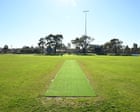
You lace up your boots on a crisp Saturday morning, ready for a standard game of local footy. You worry about a pulled hamstring or maybe a sore shoulder. You don't think about the fact that you're running at full speed toward a thinly disguised block of concrete.
But that's exactly what thousands of grassroots Australian rules football players do every single weekend.
The tragic death of Nathan Fitzgerald, a 27-year-old Melbourne high school teacher, stripped away any illusions about suburban ground safety. While playing for the Epping Football Netball Club at Lalor Recreation Reserve, Fitzgerald attempted a tackle, suffered a brutal sequence of head impacts, and landed head-first on the covered cricket pitch in the center of the oval. He died in the hospital days later.
This wasn't an unavoidable twist of fate. It was a structural failure. For decades, community sports clubs across Australia have shared ovals between winter football and summer cricket. In the middle of these grounds sits a hard, concrete-based cricket wicket. Before the footy season starts, councils throw a multilayered synthetic turf strip over the top and declare it safe.
It isn't safe. It never has been. We've just been incredibly lucky until now.
The Illusion of Shared Use Standards
Local councils and sporting bodies love bureaucracy. It helps shift liability. Following the tragedy, the City of Whittlesea noted that the pitch covering met the relevant safety standards set out by the AFL and Cricket Australia.
When a standard allows a thin sheet of synthetic grass to cover solid concrete where athletes are routinely tackled, the standard is broken.
Think about the physics of a modern footy tackle. You have two grown adults, often weighing anywhere from 80 to 100 kilograms, colliding at high speed. If that momentum drives a player's skull into ordinary turf, the soil and grass compress, absorbing at least some of the kinetic energy.
When that same impact happens on a covered cricket pitch, there's zero absorption. Dr. Alan Pearce, a neurophysiologist and sports concussion expert, point-blank compared hitting these covered wickets to getting king-hit on a city pavement. Concrete doesn't give. The brain takes the full force of the blow.
Local players have known this for years. Ask anyone who has played suburban footy and they'll tell you the same thing: you actively try to avoid getting tackled in the center square. Cuts, bad grazes, and rolled ankles are just part of playing on the "hard strip." We accepted it as a quirk of grassroots sport. Now we know the cost of that complacency.
Why Grassroots Safety Falls Behind the AFL
The AFL talks a big game about player welfare. They mandate concussion spotters, implement strict 21-day protocols at the elite level, and invest millions into research. But go down to your local park on a Saturday afternoon and that elite safety net completely vanishes.
- No independent doctors: Volunteer trainers with basic first-aid certificates are left to make complex medical assessments on the boundary line.
- Substandard infrastructure: Elite AFL matches happen on pristine, purpose-built stadiums. Grassroots games happen on hard, multi-purpose fields baked dry by the sun and compromised by concrete wickets.
- Cultural resistance: At the community level, we still hear coaches tell players to "shake it off" after a heavy knock.
Annitta Siliato, executive director of the Concussion Legacy Foundation Australia, made it clear that these concrete-based pitches are totally unsafe and need to become a thing of the past. The issue is that fixing them requires money, coordination, and an admission that the current system fails local players.
We also need to stop using the phrase "head knock." It's a garbage term that softens reality. A head knock sounds like bumping your skull on a kitchen cupboard. What happened on that suburban oval was a severe traumatic brain injury. If we don't use honest language, we won't fix the underlying culture.
How to Fix Community Footy Right Now
We can't wait for another coroner's report or a five-year council feasibility study. Change needs to happen before the next bounce.
First, the AFL and local governments must co-fund the removal of concrete cricket wickets from premier football ovals. Drop-in pitches or alternative synthetic compositions that actually absorb impact exist. They cost more, but you can't put a price on a schoolteacher's life.
Second, if an oval has a concrete pitch that cannot be removed, the covering system must be drastically upgraded. A thin layer of synthetic turf isn't enough. We need high-density impact-absorbing underlays specifically rated for high-velocity human impacts, not just heavy lawnmowers.
Finally, regional leagues need to mandate independent concussion advocates at every match. Expecting a local club volunteer to override an aggressive coach or an eager player who wants to stay on the field is unrealistic. Take the decision out of their hands entirely.
The line between enjoying a weekend hobby with your mates and ending up in an intensive care unit shouldn't be this thin. It's time to tear up the concrete.