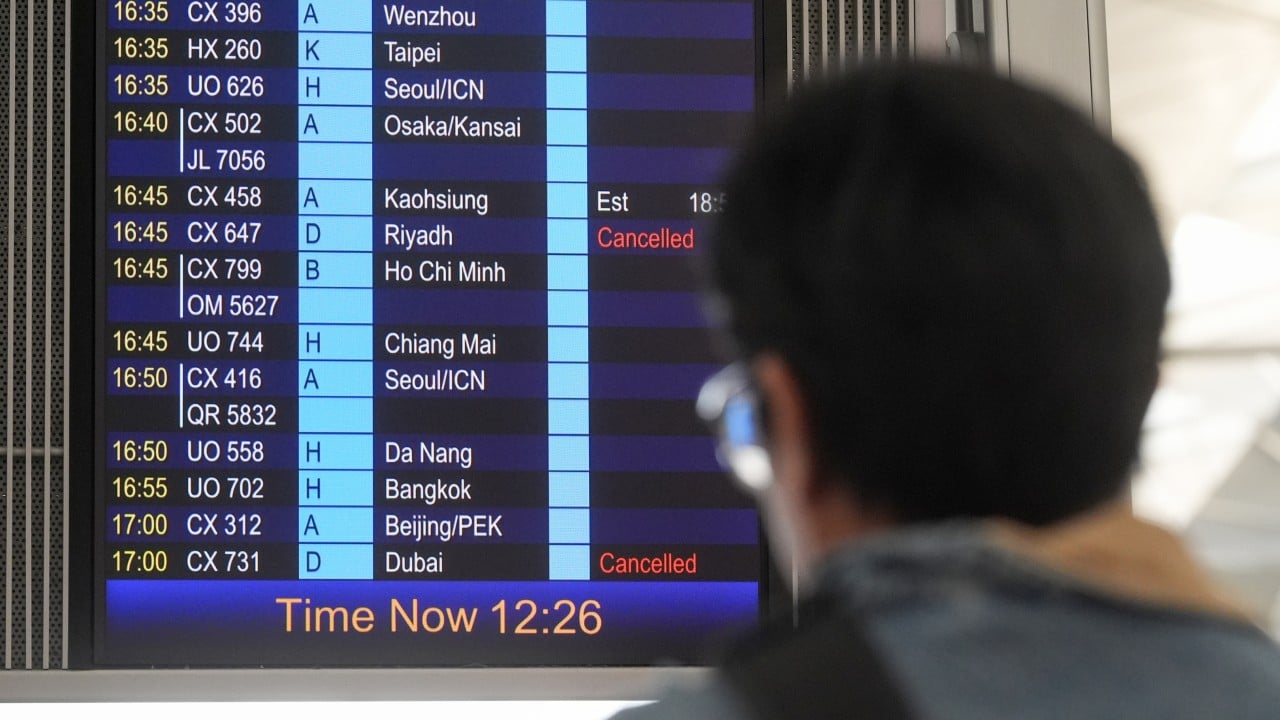
Hong Kong’s aviation sector currently operates within a price-supply disequilibrium that renders historical fare benchmarks obsolete. The observed surge in airfares—stretching across long-haul routes to Europe and the Americas, and increasingly infecting short-haul Asian corridors—is not a random fluctuation. It is the mathematical output of a constrained supply chain meeting an inelastic demand curve. To understand why a flight to London or New York now commands a premium of 50% to 150% over 2019 levels, one must look past "inflation" and analyze the three specific friction points: structural capacity deficits, the collapse of Sixth Freedom transit competition, and the escalation of non-discretionary operational overhead.
The Triad of Capacity Constraints
The primary driver of elevated pricing is the physical inability of the hub to return to 2019 seat-kilometer availability. This isn't merely a matter of "opening up"; it is a systemic bottleneck involving three distinct layers of the aviation ecosystem.
1. Ground Handling and Labor Elasticity
Airlines do not fly in a vacuum. The speed at which an airline can resume frequencies is dictated by ground-side support: baggage handlers, catering crews, and engineering staff. During the protracted quarantine period, Hong Kong’s aviation workforce saw a significant exodus of skilled labor. Because these roles require high-level security clearances and specialized training, the "ramp-up" period is non-linear. When demand returns at 100% but ground handling is capped at 70%, the resulting scarcity allows carriers to yield-manage their remaining seats with aggressive pricing strategies.
2. The Pilot Recency Debt
Flight deck crews must maintain "recency"—a specific number of take-offs and landings within a rolling window—to remain legally current. The mass grounding of fleets meant that thousands of pilots fell out of currency. Re-certifying a workforce through limited simulator hours creates a training bottleneck. This "recency debt" prevents airlines from simply pulling aircraft out of long-term storage and putting them into the air the following day.
3. Airframe Utilization and Maintenance Cycles
Aircraft stored in arid environments or humid hangars require "C-checks" and "D-checks"—heavy maintenance intervals—before returning to service. Global supply chain disruptions in the aerospace sector mean that spare parts for engines and avionics now have lead times 3x longer than pre-2020 averages. An aircraft stuck in a hangar is a zero-revenue asset that increases the amortized cost of the active fleet.
The Geopolitical Redirection of Long-Haul Economics
For routes connecting Hong Kong to Europe and the US East Coast, the cost function has been fundamentally altered by the closure of Russian airspace. This is a permanent shift in the physics of the route that travelers often overlook when complaining about ticket prices.
Direct flights from Hong Kong to London or Frankfurt must now fly a more southerly trajectory. This adds between 1 and 2.5 hours of flight time. In aviation, time is the most expensive variable.
- Fuel Burn: A Boeing 777-300ER burns approximately 7,000 to 8,000 kg of fuel per hour. An extra two hours of flight time adds 16 metric tons of fuel weight, which itself requires more fuel to carry.
- Crew Rotation: Longer flight times often push crews over their legal duty limits, necessitating an extra pilot or cabin crew member, or forcing longer layovers in expensive outstations.
- Payload Penalties: To carry the extra fuel required for the longer route, the aircraft may have to leave 20 to 40 seats empty or reduce cargo weight to remain under the Maximum Take-Off Weight (MTOW).
When an airline loses 10% of its sellable capacity due to weight restrictions while its fuel bill rises by 15%, the "break-even" ticket price shifts upward by a margin that far exceeds standard inflation.
The Collapse of the Sixth Freedom Buffer
Historically, Hong Kong’s high direct-flight prices were kept in check by "Sixth Freedom" carriers—airlines like Emirates, Qatar Airways, or Singapore Airlines that would offer cheaper, one-stop connections to undercut Cathay Pacific’s direct monopoly.
This competitive buffer has eroded. These transit hubs are facing their own capacity constraints. When Singapore or Dubai is also operating at near-peak capacity with their own local demand, they have no incentive to offer "distressed inventory" pricing to Hong Kong travelers. The "price floor" that used to be set by indirect carriers has risen, giving the dominant home carrier the "price ceiling" room to hike fares without losing market share.
The Regional Contagion: Short-Haul Logic
The "sky-high" jump isn't limited to the 12-hour hauls. Regional flights to Tokyo, Taipei, and Bangkok have seen similar percentage increases. This is driven by a different set of variables: the "revenge travel" density vs. narrow-body availability.
- Narrow-body Shortages: Many airlines retired older, less efficient narrow-body jets during the downturn. The replacement aircraft (like the A321neo) are being delivered behind schedule due to manufacturing delays at Airbus and Boeing.
- Slot Constraints: Airports like Tokyo-Narita and Osaka-Kansai are facing their own staffing shortages, limiting the number of "landing slots" they can grant to Hong Kong-based carriers. When an airline can only fly three times a week instead of three times a day, they must extract maximum margin from every seat.
- The High-Yield Pivot: Airlines have realized that after years of restricted movement, the "VFR" (Visiting Friends and Relatives) and leisure segments are less price-sensitive than they were in 2019. This temporary inelasticity allows for "skimming"—pricing the product for the top 20% of the market who will pay any price to travel, rather than the bottom 80% who shop on budget.
The Yield Management Algorithm Shift
Modern airline pricing is governed by "Expected Marginal Seat Revenue" (EMSR) models. In the pre-pandemic era, these models were trained on decades of stable historical data. Those models are now broken.
Airlines are currently in a "discovery phase," testing the absolute limits of what the Hong Kong market will bear. Because there is no historical precedent for a three-year total shutdown followed by a rapid reopening, the algorithms are biased toward high opening prices. As long as load factors (the percentage of seats filled) remain above 80%, there is zero mathematical incentive for an airline to lower its fare structure.
Strategic Hedging for the Corporate and Private Traveler
The current pricing environment requires a move away from "last-minute" flexibility, which was a hallmark of the Hong Kong business traveler. The premium for booking 7 days out versus 60 days out has widened from a 30% gap to a 200% gap.
The only viable mechanism for price mitigation is "Lifting and Shifting" the booking window.
- Identify Non-Symmetry: Prices to "Tier 2" hubs in Europe (e.g., Milan or Zurich) often lag behind the price increases of "Tier 1" hubs (London or Paris).
- Corporate Block-Booking: For businesses, the shift must move toward negotiated corporate fares with fixed "caps," moving away from the "best-buy-of-the-day" model which exposes the firm to the volatility of the spot market.
- The Point-Arbitrage Opportunity: With cash prices high, the value-per-point for frequent flyer programs has reached an all-time high. A seat that costs $20,000 HKD but can be bought for 60,000 miles represents a 33-cent-per-mile valuation—nearly triple the historical average.
The equilibrium will not return through government intervention or "calls for fairness." It will return only when the "Cost of Operations" (fuel, labor, parts) stabilizes and the "Supply of Seats" (airframe availability, pilot recency) exceeds the current "Release of Pent-up Demand." Until the labor market in ground handling reaches 95% of 2019 levels, expect the "floor" of Hong Kong airfares to remain structurally elevated. Organizations should budget for a permanent 25% increase in T&E (Travel and Expense) costs compared to 2019 baselines, as the era of subsidized, high-capacity, low-margin aviation has effectively ended.


