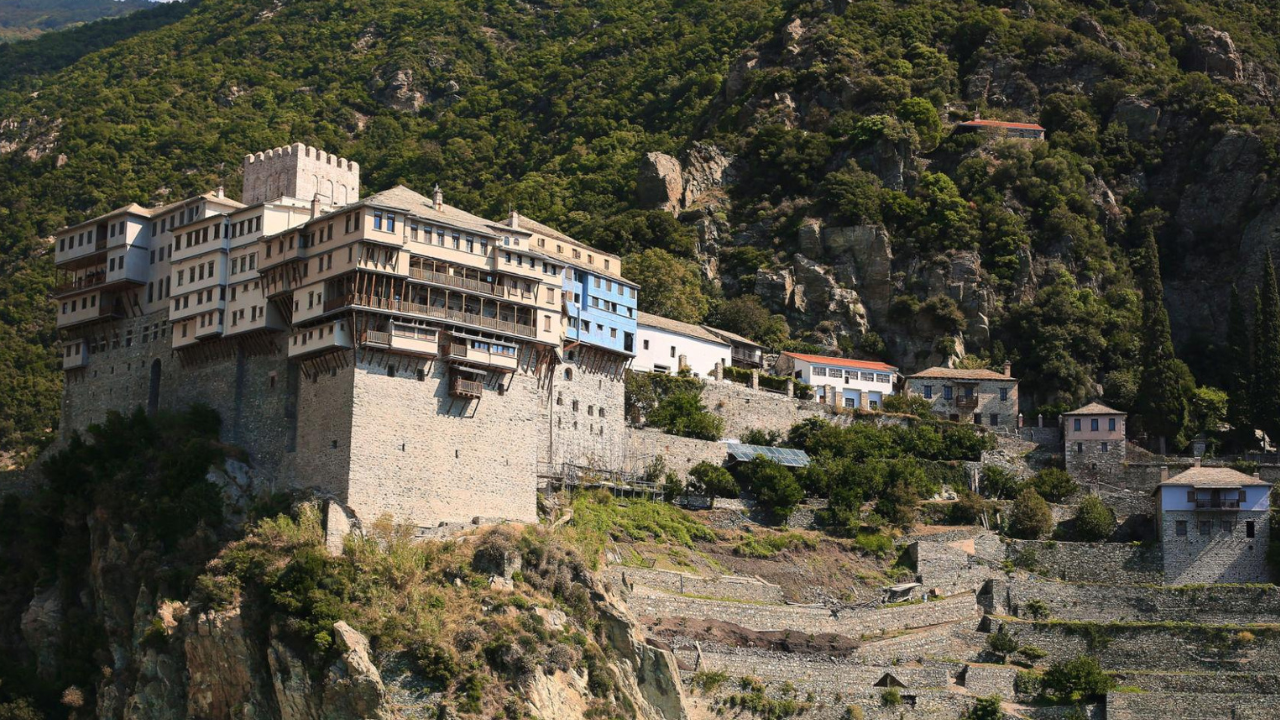
For more than ten centuries, a unique legal anomaly has persisted on a narrow peninsula in northern Greece. Mount Athos, an autonomous monastic state under Greek sovereignty, enforces a strict ban on women, female domestic animals, and even unauthorized male visitors. This ancient prohibition is known as the avaton. It is not merely a quaint religious tradition or a localized monastic rule. Instead, it is a constitutionally protected geopolitical arrangement that challenges modern frameworks of international law, human rights, and European integration. While casual travel accounts focus on the exoticism of this isolated community, the true story lies in how twenty Eastern Orthodox monasteries maintain absolute border control in the twenty-first century.
The exclusion zone operates under a complex web of theological mandate, national constitutional law, and international treaties. To understand Mount Athos, one must look past the cliffside architecture and examine the raw mechanics of its autonomy.
The Legal Architecture of a Monastic State
The peninsula enjoys a special status codified in Article 105 of the Greek Constitution. This legal framework recognizes Mount Athos as a self-governing part of the Greek State. Political administration is handled by a Holy Community composed of representatives from the twenty chief monasteries, while the Greek state appoints a governor to oversee public order and security.
This is where the political reality gets complicated. Greece is a member of the European Union and a signatory to the Schengen Agreement. Under standard EU law, discrimination based on gender is strictly prohibited, and the free movement of citizens is a foundational principle. Yet, when Greece acceded to the European Community, it secured a specific, legally binding joint declaration that acknowledged the special status of Mount Athos.
The European Union effectively halted its legal reach at the borders of the monastic peninsula. This exemption creates a fascinating paradox. A territory inside the EU completely bypasses the Charter of Fundamental Rights. Human rights lawyers have repeatedly challenged this status in international forums, arguing that the ban violates freedom of movement and gender equality principles. The European Parliament has even passed non-binding resolutions criticizing the restriction.
The monasteries remain entirely unmoved. Their legal defense rests on property rights and state sovereignty. The entire peninsula is private property, divided among the twenty sovereign monasteries. In the eyes of Greek and international law, the monks possess the right to determine who enters their land, much like a private homeowner can bar visitors at their front door.
The Logistics of Separation
Maintaining an exclusion zone for a millennium requires more than faith. It demands rigorous bureaucratic and physical enforcement.
[Mainland Greece] ---> Checkpoint at Ouranoupolis ---> Passport & Diamonitirion Control ---> Ferry Boarding ---> Monastic Ports
Access to Mount Athos is restricted by geography and bureaucracy. The peninsula is connected to the rest of Macedonia by a narrow strip of land, but this land border is heavily guarded and fenced off. Entrance by foot is forbidden for everyone. The only way to reach the monastic state is by boat from the gateway towns of Ouranoupolis or Ierissos.
The entry process functions like a strict international border crossing.
- The Permit: Every visitor must obtain a diamonitirion, a special visa issued by the Holy Executive of Mount Athos.
- The Quota: The authorities enforce a strict daily cap on visitors. Usually, only 110 men are permitted entry per day—100 Orthodox Christians and 10 non-Orthodox.
- The Screening: Passports are thoroughly checked at the pilgrims' bureau before boarding the ferry. Women are denied boarding passes at the pier.
The ban on female domestic animals serves a specific purpose in monastic theology, aimed at preventing any disruption to the monks' vow of celibacy. There are exceptions. Feral cats roam the monastery courtyards freely to control the rodent population, and wild birds fly over the borders without visa checks.
The enforcement of the avaton is treated as a criminal offense under Greek law. Anyone attempting to cross the land border or land a boat illegally faces fines and imprisonment. Over the decades, a few individuals have broken the perimeter. Fleeing refugees during the Greek Civil War found temporary shelter here, and occasional political protesters have made landfall. Each breach is treated as a severe security violation rather than a simple trespass.
Wealth Power and the Russian Influence
Mount Athos is not a collection of impoverished hermits cut off from the global economy. It is an economic powerhouse with vast landholdings, significant forestry operations, and substantial political leverage.
The financial reality of the mountain changed dramatically after the fall of the Soviet Union. Wealthy Eastern European oligarchs and political elites began pouring hundreds of millions of dollars into the peninsula. This influx of capital was not just philanthropy; it was a calculated move to secure geopolitical influence within the spiritual heart of Eastern Orthodoxy.
The St. Panteleimon Factor
The monastery of St. Panteleimon, often called the Russian monastery, became the focal point of this geopolitical alignment. Massive restoration projects transformed the aging structure into a grand complex capable of housing hundreds of monks. High-ranking Russian officials, including state leaders, made high-profile pilgrimages to the mountain, signaling a close tie between church and state power.
The Schism with Constantinople
This financial and political patronage created deep rifts. Mount Athos falls under the spiritual jurisdiction of the Ecumenical Patriarchate of Constantinople, not the Patriarchate of Moscow. When the Ecumenical Patriarch granted independence to the Orthodox Church of Ukraine, a bitter ecclesiastical schism erupted. Moscow severed communion with Constantinople, turning Mount Athos into a quiet theological battleground. Some monasteries aligned with the Greek perspective, while others remained dependent on Russian funding, splitting the holy mountain along modern geopolitical fault lines.
The Daily Grind of Survival
Behind the grand geopolitical maneuvers sits the grueling daily routine of the roughly 2,000 monks who inhabit the peninsula. The lifestyle is designed to break down the ego and enforce a rhythm that has changed little since the Byzantine Empire.
Time itself operates differently here. Most monasteries still use Julian time and Byzantine time, where the day begins at sunset rather than midnight. This means the clocks must be adjusted weekly to match the changing seasons.
A monk's day is split into three equal parts: eight hours of prayer, eight hours of work, and eight hours of rest. The spiritual services begin in the dark of the early morning, lasting for hours in candlelit churches where singing is done without instruments. The work, or diakonema, involves physical labor: farming the rocky soil, harvesting timber, painting icons, or cooking massive communal meals for the resident monks and visiting pilgrims.
Accommodation for travelers is basic but free. Visitors are given a bed in a communal dormitory, a plate of simple vegetarian food, and an expectation to attend the lengthy church services. There are no hotels, restaurants, or commercial shops outside of a small administrative center in the capital of Karyes.
The isolation is real, but it is increasingly punctured by the modern world. While internet access is heavily restricted and television is banned, many monks utilize smartphones for administrative tasks, managing timber sales, or coordinating medical supplies with the mainland. This creates a striking visual contrast: a monk dressed in centuries-old black robes, standing beneath a Byzantine fresco, replying to an email on a mobile device.
The Sustainability of Isolation
The enduring question facing Mount Athos is whether its absolute exclusion zone can survive the pressure of global transparency and legal standardization. The monastic state relies entirely on the protection of the Greek government to shield it from international human rights mandates. If political shifts in Athens ever weaken that support, the legal wall protecting the avaton could begin to fracture.
For now, the mountain remains a sovereign redoubt, a living fossil of the Byzantine world preserved via constitutional exemptions and maritime border controls. The monks view their isolation not as an act of hostility toward the outside world, but as an indispensable condition for their spiritual survival. They argue that without the strict boundaries of the avaton, the unique spiritual ecosystem of the peninsula would dissolve into standard commercial tourism within a generation. The border controls remain tight, the ferries leave the docks daily with tightly vetted passenger manifests, and the thousand-year-old wall shows no immediate signs of cracking.