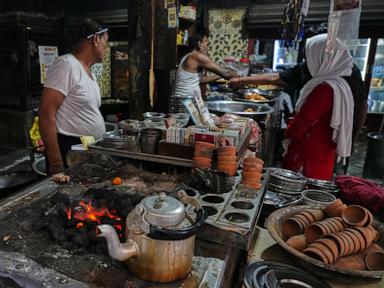
Amina wakes up at 4:00 AM because the silence of the forest is heavy, and the weight of the day is heavier. In her village on the outskirts of Nairobi, the morning isn't heralded by birdsong but by the sharp, rhythmic thwack of a rusted machete against wood. This isn't a romantic return to nature. It is a desperate calculation. Every branch she gathers is a minute stolen from her daughter’s education; every lungful of woodsmoke is a down payment on a future respiratory infection.
For billions of people across Africa and South Asia, the global energy crisis isn't a fluctuating number on a stock ticker in London or New York. It is a physical, suffocating presence in the kitchen.
We talk about "energy shocks" in the West as a matter of gas prices at the pump or the cost of heating a suburban home during a cold snap. But for the three billion people who rely on biomass—wood, charcoal, and dung—to cook their daily meals, the shock is visceral. When the price of "clean" fuels like Liquefied Petroleum Gas (LPG) spikes due to geopolitical instability or supply chain collapses, people don't just pay more. They retreat. They move backward in time, returning to the primitive, soot-stained methods that the modern world claimed to have outgrown.
The Invisible Inflation of Breath
Consider the math of a meal. In a stable economy, a family in a peri-urban area of India might use a small LPG cylinder. It’s fast. It’s clean. It allows a mother to start a small business or a child to study under a light that doesn't flicker. But when global prices surge, that cylinder becomes a luxury item, as unattainable as a private jet.
The fallback is charcoal.
Charcoal is the ghost of a forest. To produce it, vast swathes of woodland are razed and burned in oxygen-poor pits. It is inefficient, carbon-intensive, and increasingly expensive as the forests recede further from the villages. When Amina can no longer afford the charcoal, she turns to "three-stone fires."
This is the most basic form of cooking known to humanity: three large stones supporting a pot over an open flame. It is also a slow-motion disaster. The thermal efficiency of a three-stone fire is abysmal—roughly 10% to 15%. The rest of that energy? It escapes as heat and thick, black smoke containing carbon monoxide, nitrogen oxides, and particulate matter.
For a woman standing over that pot, the health impact is equivalent to smoking two packs of cigarettes a day. This isn't a choice made out of tradition. It is a choice made because the alternative—starvation—is more immediate.
The Forest’s Vanishing Act
As millions of families are forced back toward wood and charcoal, the pressure on local ecosystems reaches a breaking point. We often hear about "deforestation" as a corporate sin—loggers in the Amazon or palm oil plantations in Indonesia. While those are massive drivers of change, there is a quieter, more fragmented erosion happening across the African savannah and the South Asian foothills.
It is the erosion of the "domestic forest."
When energy prices rise, the radius of search for firewood expands. Women and children walk five, ten, fifteen kilometers a day. They aren't looking for ancient hardwoods; they are scavenging for anything that will burn. This leads to the "degradation" of land—a process where the soil loses its ability to hold water, the local temperature rises, and the biodiversity that sustains the community vanishes.
The forest doesn't disappear all at once. It thins. It becomes a skeleton of itself.
This creates a vicious feedback loop. Fewer trees mean more labor to find fuel. More labor means less time for agriculture or education. Less education means less opportunity to escape the poverty trap that necessitated the wood-gathering in the first place. The energy shock isn't just a ripple; it's a whirlpool.
The Broken Promise of the Grid
Why not just plug in?
In many parts of the Global South, the "grid" is a fickle god. Even where wires reach, the power often doesn't. In Nigeria or Pakistan, "load shedding" is a way of life, a scheduled darkness that makes electric cooking nearly impossible for a family that needs to eat at a specific time.
Moreover, the infrastructure required to support high-wattage electric cooking—like induction stoves—is often absent in rural circuits. The wires would literally melt. So, even if a family can afford the stove, the system can't support the burden.
This leaves a massive "missing middle" in the global energy transition. We celebrate the decline in the cost of solar panels and wind turbines, but we forget that you cannot easily cook a pot of beans for six people using a small solar home system designed to charge a phone and run two LED bulbs. The energy density required for heat is a different beast entirely.
The Gendered Burden of the Flame
If you want to understand the true cost of an energy shock, look at the hands of the women in these regions. You will see the callouses from the machete and the burns from the spitting embers.
In traditional households, the responsibility for fuel collection and food preparation falls almost exclusively on women and girls. When the cost of fuel rises, it is their time that is sacrificed. A girl pulled from school to help her mother gather wood is a loss of human capital that will be felt for decades.
There is also the matter of safety. As women are forced to travel further into unfamiliar territory to find fuel, the risk of physical and sexual violence increases. The search for a bundle of sticks becomes a gamble with their lives.
This is the human element that data points often miss. A "10% increase in LPG prices" sounds like a dry economic statistic. In reality, it is a policy that increases the rate of sexual assault in rural provinces. It is a policy that keeps a generation of girls out of the classroom.
The Ethanol and Biogas Mirage
We are told there are solutions. Improved Cookstoves (ICS) are designed to burn wood more efficiently, venting smoke outside through a chimney. They are a step up, certainly. But they are often culturally mismatched. A stove designed in a lab in Europe might not accommodate the size of the pots used for communal meals or the specific heat needed for local staples like ugali or roti.
Then there are the "modern" biofuels—ethanol and biogas. Biogas, captured from decomposing organic waste, is a miracle in theory. It turns waste into wealth. But the capital cost of installing a biodigester is high, and it requires a consistent supply of water and dung. For a family struggling with drought or a dwindling herd, the biodigester becomes a concrete monument to a failed promise.
The tragedy is that the technology exists. We know how to solve this. We can create circular economies where agricultural waste is turned into clean-burning pellets. We can subsidize "pay-as-you-go" LPG or electric cooking. But these solutions require more than just engineering; they require a shift in how the world values the labor and the lungs of the poor.
The Cold Reality of a Hot World
We are currently obsessed with "Net Zero" and "Decarbonization." These are noble and necessary goals. But if our climate strategies do not account for the immediate energy needs of the three billion people currently cooking with fire, we are building a green future on a foundation of human suffering.
If a mother in Malawi has to choose between cutting down a tree to feed her children today and "preserving the carbon sink" for the planet's health tomorrow, she will choose her children every single time. And she should. The failure isn't hers; it belongs to a global system that has made survival and sustainability mutually exclusive.
The energy shock isn't just about the scarcity of fuel. It is about the scarcity of dignity.
When the sun sets over the hills of South Asia, a haze begins to settle. It isn't mist. It is the collective exhalation of millions of hearths. It is a gray shroud that blurs the stars and fills the houses. Inside, a mother coughs as she stirs the pot. She is tired. The wood was damp today, and the smoke is thick.
She doesn't care about the price of Brent Crude or the latest climate summit in a glittering coastal city. She only cares that the fire stays lit long enough to soften the grain. She is the one paying the ultimate price for a world that has forgotten how to keep its most basic promises.
The smoke rises, invisible to the satellites but heavy in the throat, a silent witness to the cost of being left behind.