A young man named Mykola sits in a basement in eastern Ukraine, miles from the jagged remains of the front line. He isn't holding a rifle. He isn't wearing heavy ceramic plates. Instead, his eyes are locked onto a cheap plastic tablet, his thumbs dancing over joysticks that look like they belong to a teenager’s bedroom. Outside, the world is a chaotic symphony of heavy artillery, but inside this damp concrete box, the only sound is the frantic whir of a cooling fan.
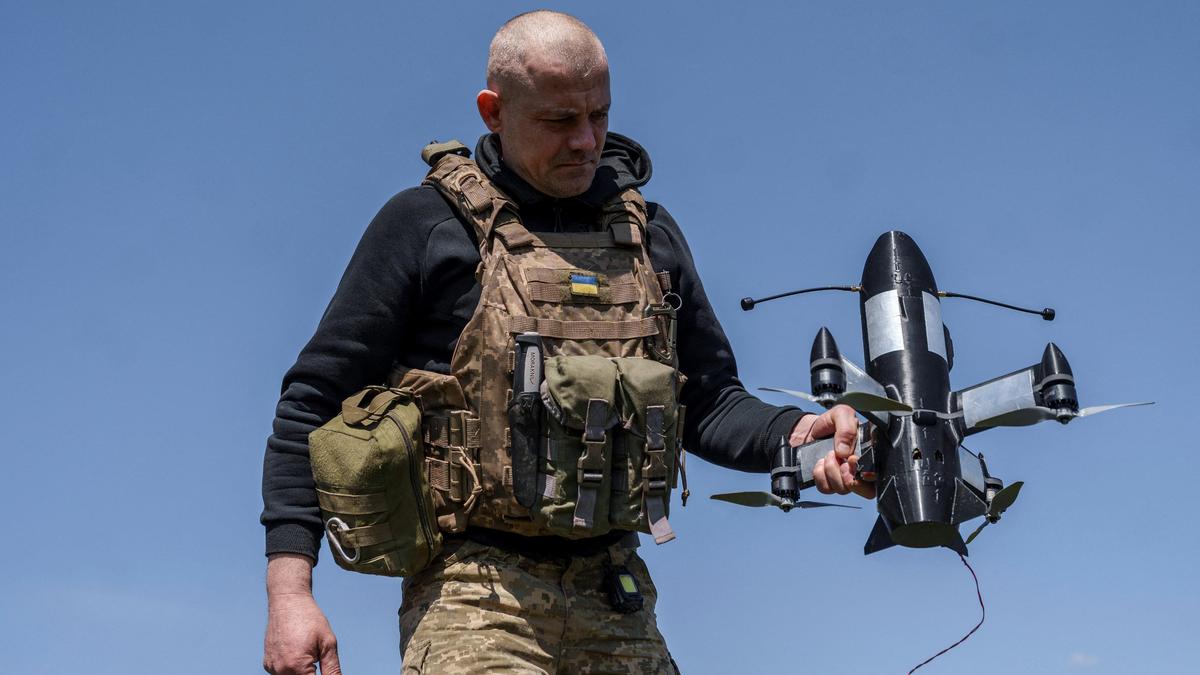
On Mykola’s screen, a grainy, high-definition feed reveals a Russian trench system. He sees a soldier heating a tin of soup. He sees the steam rising. With a flick of his wrist, Mykola sends a three-pound piece of plastic—an FPV (First Person View) drone carrying a strapped-on RPG warhead—screaming toward that steam.
The screen goes to static. The soup, the soldier, and the drone are gone.
We are witnessing the end of the era of the invisible soldier. For a century, the primary goal of a grunt was to find cover, to blend into the dirt, and to wait for the right moment. Today, cover is a myth. The sky has become a predatory ecosystem where the hunter is often a $500 toy bought off a hobbyist website, and the prey is a $5 million main battle tank.
The Democratization of Death
Modern warfare used to be a gated community. If you wanted to project power from the air, you needed a multi-billion dollar aerospace industry, a fleet of Reaper drones the size of small planes, and a satellite network that spanned the globe.
That wall has been kicked down.
In the rugged hills of Lebanon and the scorched deserts of Yemen, groups like Hezbollah and the Houthis have realized that they don't need a traditional air force to paralyze global trade or threaten state-of-the-art navies. They are using "kamikaze" drones—simple, fixed-wing aircraft powered by lawnmower engines—to strike targets with surgical precision.
Consider the math. A Patriot missile battery, a marvel of Western engineering, costs roughly $4 million per interceptor. The drone it is designed to shoot down might cost $20,000. It is a war of attrition where the side with the bigger wallet is actually at a disadvantage. If you spend millions to stop thousands, you eventually go broke.
This is the "asymmetric squeeze." It’s a reality where a rebel group can shutter the Red Sea shipping lanes not with a fleet of destroyers, but with a swarm of flying lawnmowers. It creates a terrifying parity. Suddenly, the technical gap between a superpower and a militia has shrunk to the width of a microchip.
The Psychological Toll of the Buzz
War has always been loud. It’s the roar of jets, the whistle of incoming shells, the rhythmic thud of machine guns. But there is a new sound defining the 2020s: a high-pitched, mosquito-like hum.
Veterans returning from the Donbas describe a specific kind of trauma. They talk about "drone sickness." It’s a state of constant, neck-straining hyper-vigilance. You can’t look at a blue sky without searching for the tiny black speck that signifies your life is about to end. You can’t sleep because the hum of a distant refrigerator sounds too much like a quadcopter.
In previous conflicts, if you were behind a wall or inside a bunker, you were relatively safe from direct fire. Now, drones are flown through open windows. They are chased down chimney flues. They are navigated under the eaves of porches. They are persistent, curious, and incredibly personal.
Imagine a hypothetical scenario: a squad of soldiers is pinned down in a farmhouse. In 2004, they would worry about a sniper or a mortar. In 2026, they watch a drone hover outside the window like a mechanical ghost. It doesn't attack immediately. It just watches. It waits for one of them to panic. It waits for the signal to drop a grenade. It is a psychological siege that never takes a break for breath.
The Factory in the Living Room
The shift isn't just happening on the battlefield; it’s happening in the supply chain. In Kyiv, there are "invisible factories" scattered throughout residential neighborhoods. These aren't massive industrial complexes with smokestacks. They are apartments filled with 3D printers.
Volunteers spend their weekends soldering circuits and printing plastic fins. They are bypassing the sluggish, bureaucratic "military-industrial complex" that takes a decade to develop a new weapon system. In this new world, software updates are pushed to the front lines every forty-eight hours. If the enemy figures out how to jam a specific radio frequency on Tuesday, the drone pilots have a workaround coded and deployed by Thursday.
This rapid evolution makes traditional procurement look like a relic of the Stone Age. We are seeing a "Silicon Valley" approach to killing. It’s iterative. It’s fast. It’s cheap. It’s terrifyingly efficient.
The Ghost in the Machine
As we move deeper into this decade, the human element—the Mykolas behind the tablets—is slowly being phased out. Electronic warfare is the current bottleneck. Both sides are using massive "jamming" towers to sever the link between the pilot and the drone.
The solution? Artificial Intelligence.
We are seeing the birth of "terminal guidance" systems that don't need a human hand. Once a pilot identifies a target, the drone’s onboard AI locks on. Even if the radio signal is cut, the drone continues its flight, using computer vision to recognize the shape of a tank or a person.
The moral weight of this is staggering. We are moving toward a reality where the decision to take a life is made by a set of algorithms running on a cheap processor in mid-air. There is no "warrior's code" for a line of code. There is no mercy in a motherboard.
This isn't a future possibility. It's a Tuesday afternoon in Ukraine.
The Vanishing Front Line
The concept of a "front line" is dissolving. Drones have expanded the "kill zone" by dozens of miles. Long-range strike drones, like the ones hitting oil refineries deep inside Russian territory or the ones launched from Iran toward Israel, mean that no one is truly "in the rear."
The safety of distance has evaporated.
In West Asia, this has created a new kind of "gray zone" warfare. You can strike a target three hundred miles away without ever putting a pilot at risk or declaring an official invasion. It’s plausible deniability with a propeller. It allows states to bleed one another in a state of perpetual, low-boil conflict that avoids a "Big War" but ensures that peace is never actually achieved.
The Weight of the Plastic Sky
We like to think of technology as a ladder, something that always climbs toward progress and ease. But in the theater of war, technology is a circle. We have gone from the individual prowess of the archer to the massive, impersonal carnage of industrial artillery, and now back to a form of individual, guided precision—only this time, the "arrow" has a camera and an explosive heart.
The human element remains at the center, but it is being hollowed out. The soldier is no longer a physical presence on the field; they are a ghost in a headset, disconnected from the smell of the mud and the heat of the fire, yet more intimately involved in the act of killing than ever before.
The horror of the drone isn't just its efficiency. It’s its intimacy. It’s the fact that the last thing a person might see is a child’s toy, hovering ten feet away, staring at them with a wide-angle lens, waiting for the command to stop being a toy and start being a tombstone.
Somewhere in a field, a drone sits in the tall grass, its battery low, its motors silent. It looks like litter. It looks like a piece of discarded junk from a future that arrived too fast. But then, a signal pings. The propellers twitch. The hum begins. The sky is awake again, and it is looking for something to break.