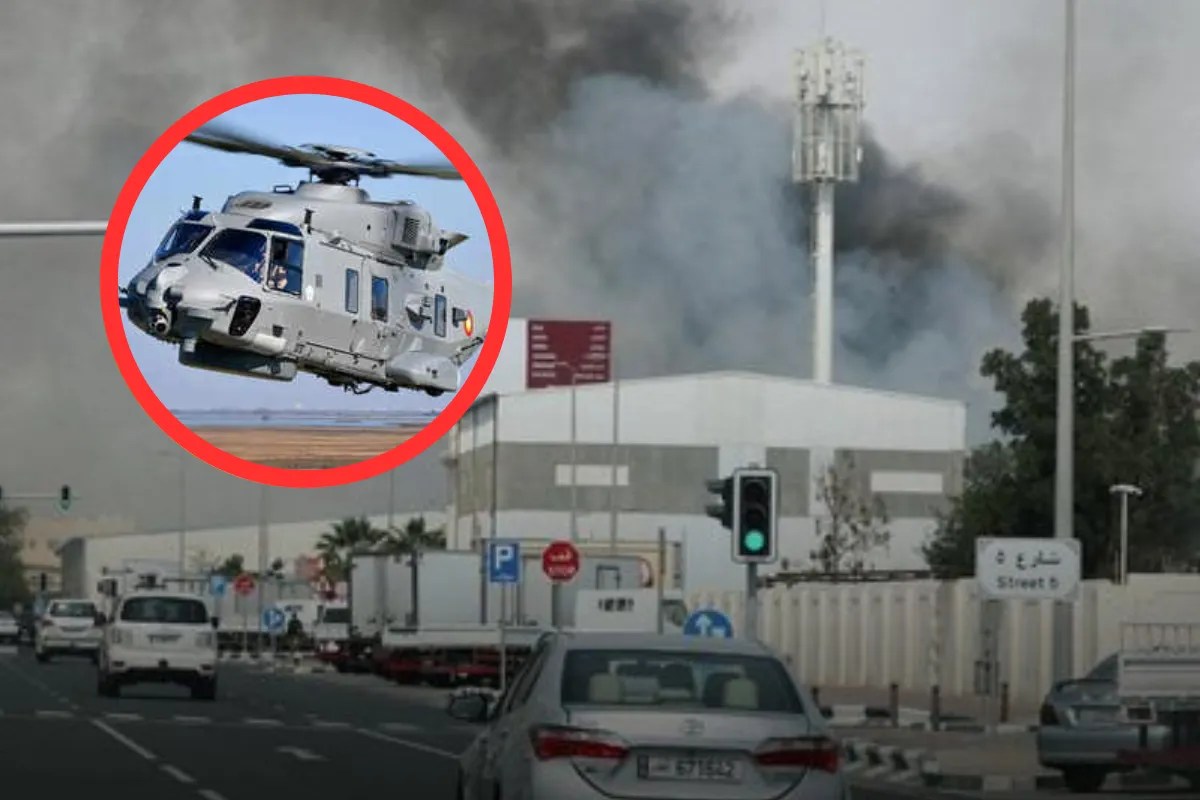
When an Iranian military or government helicopter disappears from radar, the narrative follows a weary, predictable script. State media first reports a "hard landing" due to poor visibility. Hours later, the wreckage is found on a jagged mountainside, and the casualty list reveals the loss of high-ranking officials or military commanders. The recent crash involving a Bell 212 during a period of heightened regional tension is not an isolated tragedy. It is a mathematical certainty.
For decades, Iran has operated a fleet of aircraft that would be relegated to museums in any other nation. The primary reason these birds fall out of the sky isn't just "fog" or "pilot error." It is the systemic failure of a supply chain choked by forty years of sanctions, forcing a reliance on "cannibalization"—the practice of stripping parts from one aging airframe to keep another marginally flight-worthy. This isn't just a transport crisis. It is a national security vacuum that leaves the Iranian leadership vulnerable to the very machines meant to protect them.
The Mechanical Anatomy of a State Crisis
The Bell 212 is a workhorse, a twin-engine evolution of the Vietnam-era "Huey." In a vacuum, it is a reliable platform. However, the models currently flying in Iran are largely relics from the pre-1979 era, purchased during the reign of the Shah. These airframes are pushing fifty years of service.
Maintaining a helicopter requires a precise schedule of component replacements. Rotors have life cycles. Gearboxes have expiration dates. When a country cannot buy these parts from the original manufacturer (Bell Textron, an American company), it turns to the black market or domestic reverse-engineering.
Domestic "cloning" of aerospace parts is a gamble. Metallurgy is an exact science. If a turbine blade is off by a fraction of a millimeter or cannot withstand specific thermal stresses, it will disintegrate. This often happens during high-load maneuvers, such as navigating the unpredictable downdrafts of the Alborz or Zagros mountain ranges. When one engine fails in a Bell 212, the second is supposed to compensate. But if both engines are running on "Frankenstein" parts, the redundancy is a myth.
Beyond the Sabotage Theory
Whenever a high-profile crash occurs in the Middle East, the immediate instinct is to look for a shadow war. Given the ongoing friction between Tehran and its regional adversaries, the "dangerous attack" theory carries weight in the coffee shops of Tehran and the halls of intelligence agencies. Electronic warfare is a potent tool. If a GPS signal is spoofed or an altimeter is jammed, a pilot flying through "soupy" weather can be tricked into thinking they have a thousand feet of clearance when they are actually seconds away from a ridge line.
However, the investigative reality is often more mundane and more damning.
Iran’s VIP transport protocols are frequently bypassed by the "bravado" of the political class. Commanders often insist on flying despite weather warnings that would ground a commercial airliner. When you combine an aging, poorly maintained airframe with a culture that views safety regulations as bureaucratic hurdles, you don't need a missile to bring down a helicopter. Gravity and neglect are far more efficient assassins.
The Sanction Trap and the Black Market
The Iranian aviation industry survives on a "ghost" network. To keep these Bell and Agusta-Bell helicopters in the air, Iran utilizes front companies based in Southeast Asia and the Middle East to acquire "dual-use" components. This creates a massive quality control gap.
The Risks of Non-Certified Components
- Traceability: There is no paper trail for black-market parts. A "new" part might actually be a refurbished unit from a crashed aircraft in a different part of the world.
- Material Fatigue: Without factory-grade diagnostic tools, Iranian engineers cannot always detect microscopic stress fractures in the airframe.
- Avionics Mismatch: Integrating modern navigation systems into a 1970s cockpit requires "bridging" technology that is often unstable and prone to short-circuiting in high humidity or extreme cold.
This reliance on the illicit market has created a tiered safety system. The most critical military units get the best parts, while government transport fleets—often carrying the very politicians who oversee these policies—are left with the scraps.
The Strategic Cost of a Crashing Fleet
Every time a helicopter goes down, Iran loses more than just a piece of hardware. It loses human capital that takes decades to replace. The "who was on board" question matters because the Iranian power structure is deeply hierarchical and personality-driven. The sudden removal of a general or a minister creates a power vacuum that rivals can exploit.
Furthermore, these crashes project an image of internal frailty. For a nation that prides itself on its indigenous missile and drone programs, the inability to safely move its leaders from point A to point B is a glaring contradiction. It suggests that while the "high-tech" offensive capabilities are real, the "low-tech" foundational maintenance of the state is crumbling.
The Geographic Reality
The terrain of northern and western Iran is some of the most treacherous for rotor-wing aviation. Micro-climates can change in minutes. A clear valley can become a death trap of thick fog and high winds without warning.
In modern aviation, Synthetic Vision Systems (SVS) and Terrain Awareness and Warning Systems (TAWS) allow pilots to "see" through the clouds. These systems require constant software updates and high-resolution satellite data—things Iran struggles to access legally. Flying a Bell 212 in these conditions is essentially flying blind, relying on "dead reckoning" and local knowledge. It is a 1940s solution to a 21th-century problem.
A Pattern of Failure
Look back at the history of Iranian state aviation over the last two decades. The list of accidents involving the C-130 Hercules, the Fokker 100, and various Tupolev models paints a picture of a nation pushing its machinery far past the breaking point. The helicopter crash is not a fluke; it is a symptom of a broader industrial atrophy.
The military often tries to hide the specifics of these crashes to avoid showing weakness. They blame the weather because the weather is an act of God, whereas a failed hydraulic pump is a failure of the state. But the wreckage speaks for itself. Burn patterns and debris fields usually tell the story of an engine that quit long before the impact, or a rotor head that sheared off because a bolt—costing less than fifty dollars—was used for five thousand hours too many.
The Pivot to Russian and Chinese Hardware
Recognizing the dead end of Western aviation maintenance, Tehran has increasingly looked toward the East. The Mi-17, a Russian-made heavy-lift helicopter, is now the preferred choice for many elite units. However, even this transition is fraught with difficulty.
Russian hardware requires its own specific supply chains and maintenance philosophies. While Russia is a strategic partner, it has its own supply issues due to the conflict in Ukraine. China, meanwhile, offers modern alternatives, but integrating Chinese avionics into an Iranian military infrastructure built on American and European bones is an engineering nightmare.
This leaves the Iranian fleet in a state of "technological schizophrenia." A single hangar might contain an American helicopter, a Russian transport plane, and a French-designed airliner, all competing for the same limited pool of skilled mechanics and hard currency.
The Human Factor in the Cockpit
We must also consider the pilots. Iran’s flight schools are world-class in terms of theory, but flight hours are expensive. Fuel isn't the issue—parts are. To preserve the life of the engines, training hours are often cut. A pilot who hasn't spent enough time practicing emergency "autorotation" procedures is less likely to save the aircraft when the engines inevitably stall over a mountain peak.
When the alarms finally sound in the cockpit, the pilot has seconds to react. In an aging Bell 212, those seconds are spent fighting heavy, non-boosted controls and looking at analog gauges that might be vibrating too hard to read. It is a high-stress environment where the equipment is actively working against the human.
The next time a report emerges of a "mishap" in the Iranian mountains, skip the speculation about missiles and look at the tail number. Check the age of the airframe. The most dangerous enemy the Iranian military faces isn't always across the border; sometimes, it's the metal fatigue in the very seat they are sitting in.
If you are tracking the stability of the region, stop looking only at the rhetoric and start looking at the maintenance logs. A government that cannot maintain its own transport is a government that is constantly one mechanical failure away from a succession crisis. Check the recent tail numbers of the Iranian VIP fleet and compare them against known pre-1979 deliveries to see exactly how many "flying ghosts" are still in operation.