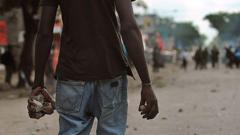
Juma wakes up before the sun has even considered touching the jagged skyline of Nairobi. In the Mathare Valley, the air tastes of charcoal smoke and the metallic tang of open sewers. He is twenty-four, with shoulders broadened by years of hauling water jugs, but his eyes carry a weary wisdom that shouldn't belong to a young man. He isn't thinking about policy white papers or GDP growth. He is thinking about the "shifter"—the local recruiter who offered him five thousand shillings to stand in the back of a truck, hold a wooden club, and look "formidable" at a political rally later that afternoon.
Five thousand shillings is a month of survival. It is also the price of a soul in a season of tension.
Kenya is currently caught in a suffocating embrace between its democratic aspirations and a darker, more primal machinery. While international headlines focus on the "goons and guns" narrative, the reality on the ground is far more intimate and terrifying. It is a story of how poverty is weaponized by the elite, transforming the vibrant energy of Kenyan youth into a volatile currency used to purchase political leverage.
The Economics of Anger
To understand why young men like Juma say yes, we have to stop looking at political violence as a breakdown of order. Instead, we must see it as a perverse market. In this market, the "goon" is not a monster; he is a gig worker. The recruiters—often middle-level operatives with deep pockets and shallow morals—scour the informal settlements where unemployment sits like a heavy fog. They don't look for criminals. They look for the desperate.
The logic is brutally simple. A hungry man is an angry man, and an angry man is easy to direct. When political rhetoric begins to sharpen, it isn't just words hitting the airwaves. It is a signal to the grassroots level that the "hustler" vs. "dynasty" divide is no longer a metaphor. It is an instruction manual for confrontation.
Consider the "Men in Black," the infamous informal security details that have historically disrupted party primaries. They aren't an official branch of any government. They are a shadow. They exist to provide plausible deniability to those at the top. If a rally turns into a riot, the politician can blame "uncontrollable elements." But those elements were fueled by the very fuel the politician provided: cash, alcohol, and a promise of belonging.
The stakes are invisible until they aren't. They are hidden in the quiet conversations in the back of Matatus (minibuses). They are tucked into the pockets of the "area boys" who control the street corners. We often talk about the risk of civil unrest as a statistical probability, a percentage in a risk assessment report. For a mother in Kisumu or a shopkeeper in Eldoret, the risk is a physical weight. It is the sound of a shutter slamming shut. It is the silence of a street that should be busy.
The Mechanics of the Mob
Violence in this context is rarely spontaneous. It is orchestrated with the precision of a stage play.
First, there is the priming. This happens through digital whispers—WhatsApp groups and TikTok videos where disinformation spreads like a virus. Hypothetically, imagine a video of a politician’s motorcade being pelted with stones. It might be three years old. It might be from a different country. But in the heat of an election cycle, it is a call to arms. It validates the fear that "the other side" is already attacking.
Next comes the mobilization. The shifters distribute the uniforms—often just plain t-shirts or specific colors—and the "facilitation" money. This is where the guns enter the equation. While the foot soldiers carry sticks and stones, the specialized units, often linked to organized crime syndicates or rogue elements within the security apparatus, provide the lethal edge. This isn't just about winning an election; it's about making the cost of losing too high for the opponent to even consider.
The tragedy is that the "goon" is the most expendable piece on the board. When the dust settles and the politicians shake hands in a "handshake" deal or a power-sharing agreement, the young men who fought in the streets are left with their scars and their criminal records. The five thousand shillings are long gone. The systemic poverty that made them vulnerable remains.
The Heavy Silence of the Middle Class
There is a specific kind of dread that settles over Nairobi’s suburbs during these times. It is the dread of the "what if." People who work in shiny glass towers in Westlands or Upper Hill begin to stock up on dry maize and bottled water. They talk about "taking a holiday" to the countryside until the results are announced.
This internal migration is a silent vote of no confidence in the state’s ability to protect its citizens. When the wealthy flee and the poor are paid to fight, the social fabric doesn't just tear; it dissolves.
I remember a conversation with an old man in Nakuru. He had lived through 1992, 2007, and 2017. He sat on a wooden bench, his hands shaking slightly, not from age, but from the memory of the smoke. He told me that the problem isn't the guns. The problem is the "empty bellies and the full lies." He saw the same patterns repeating—the same families at the top, the same sons of the soil dying at the bottom.
We make a mistake when we view this through a purely ethnic lens. While tribal identity is frequently used as a rallying cry, it is often a mask for class struggle. The "goons" are almost always from the same economic bracket, regardless of their last names. They share more in common with each other than they do with the men who hire them. But the rhetoric is designed to ensure they never realize that.
Breaking the Cycle of the Shifter
How do you stop a machine that has been decades in the making? It isn't just about "more police" or "stricter laws." In fact, a heavy-handed police response often provides the very spark the recruiters need to turn a protest into a martyrdom.
The real battle is for the Jumas of Kenya. It is about providing an alternative to the five thousand shillings. When a young man has a job that pays a living wage, he is much less likely to risk his life for a politician's ego. When a community feels that the justice system works for them, they don't feel the need to seek "justice" through a mob.
But there is a deeper, more emotional requirement. It is the need for a national narrative that is more compelling than the one offered by the goon-masters. It is the belief that the person across the street—the one who speaks a different language or supports a different party—is a neighbor first and an adversary second.
The international community often looks at Kenya as a "beacon of stability" in East Africa. This creates a dangerous complacency. We see the malls and the tech hubs and assume the foundation is solid. But the foundation is made of people, and right now, many of those people feel forgotten.
The "goon" is a symptom of a deep, unhealed wound. Every time a politician uses a private militia to settle a score, they are pouring salt into that wound. They are telling the youth that power is not something you earn through service, but something you take through intimidation.
The Invisible Stakes
As the sun sets over the Rift Valley, the golden light masks the tension for a moment. But then you see the police Land Rovers patrolling the highways. You see the groups of young men huddled on the corners, watching, waiting. The air is thick with the anticipation of a storm.
The stakes aren't just about who sits in the State House. They are about whether a child can walk to school without fear. They are about whether a farmer can plant his crops without wondering if he will be there to harvest them. They are about the dignity of a nation that refuses to be defined by its darkest moments.
Juma stands in the back of the truck now. He wears a red cap and holds a rungu. He looks tough, just like the shifter told him to. But under the cap, his brow is damp with sweat. He isn't a warrior. He is a guy who wants to buy medicine for his mother. He is a guy who wants to believe that one day, he won't have to be a goon to survive.
The truck pulls away, disappearing into a cloud of red dust.
We watch the dust settle, knowing that the real tragedy isn't the violence that might happen, but the fact that we have made violence a viable career path for our children.
The shadows in the dust are growing longer. They reach out from the slums to the suburbs, reminding us that in a house divided by fear, no room is truly safe. The guns are loud, but it is the quiet desperation that should truly terrify us. It is the sound of a generation being told their only value is in their ability to strike a blow.
Until we change that story, the trucks will keep rolling. The money will keep changing hands. And the red dust will continue to rise, obscuring the path to the Kenya that was promised but has yet to arrive.
The shifter is already looking for his next recruit. He is looking for someone just like you would be, if you had nothing left to lose but your life.