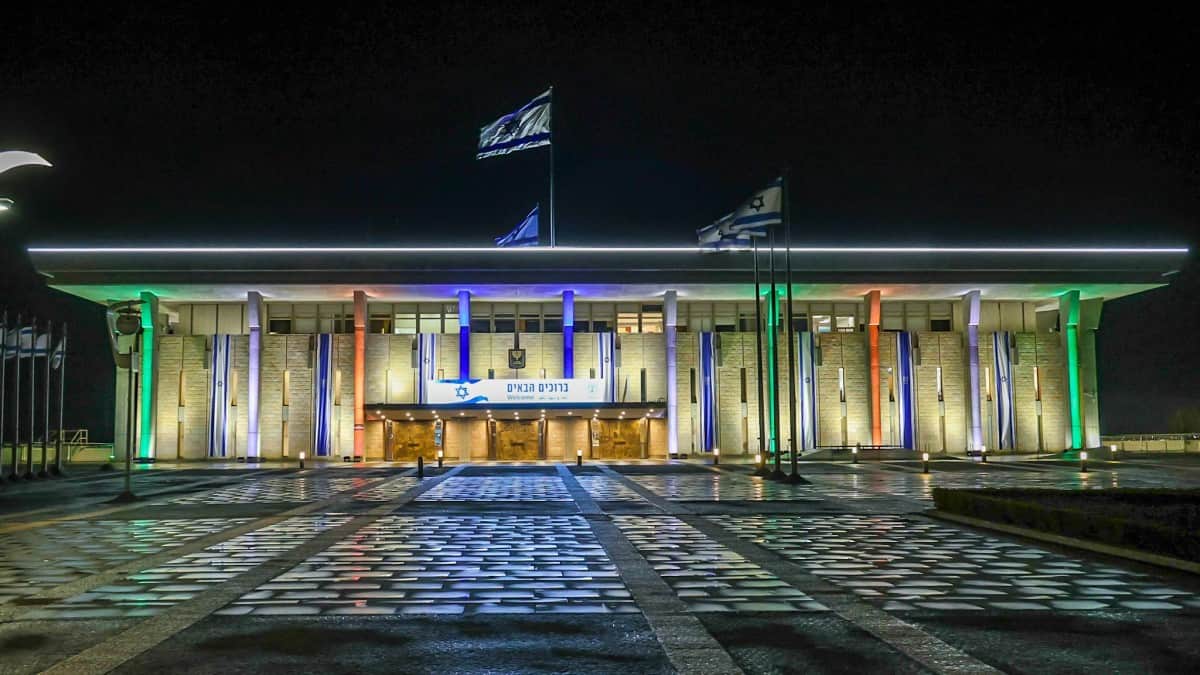
When the Israeli Knesset bathed its limestone walls in the saffron, white, and green of the Indian tricolour this week, it wasn’t just a greeting for a visiting dignitary. It was a funeral for India’s decades-old policy of "strategic ambiguity." For nearly half a century, New Delhi treated Israel like a mistress—useful for arms and intelligence, but never to be seen with in public for fear of offending the Arab world or domestic voting blocs. Those days are over.
Prime Minister Narendra Modi’s arrival in Jerusalem on February 25, 2026, marks the second time he has bypassed the traditional balancing act of visiting Ramallah on the same trip. In the world of high-stakes diplomacy, the absence of a stop is as loud as a shout. By illuminating the seat of Israeli democracy in Indian colours, the Netanyahu government has signaled that India is no longer just a "buyer" of Israeli hardware. It is now a primary pillar of Israel’s dwindling list of global allies.
The upgrade to a Special Strategic Partnership is not merely a semantic promotion. It represents a hard-nosed calculation. India is currently the world’s largest purchaser of Israeli weapons, accounting for roughly 42% of Israel’s total arms exports. But the current agenda goes far beyond shipping crates of Tavor rifles or Heron drones. The real story lies in the "secrecy mechanism" buried in the new Memorandums of Understanding (MoUs), designed to facilitate the transfer of technology that was previously restricted even among Israel’s closest European partners.
The Silicon Shield
Security analysts in Tel Aviv and New Delhi are focusing on a specific, high-stakes development: the integration of India into Israel’s Or Eitan (Iron Beam) laser-based air defence system. While the world watched the Iron Dome intercept rockets over the last two years, the high cost per interceptor—roughly $50,000 per missile—has proven unsustainable in long-war scenarios. The laser system reduces that cost to about $2 per "shot."
For India, facing two nuclear-armed neighbors and a persistent drone threat along the Line of Control, this technology is the ultimate prize. The "Special" in this new partnership means Israel is moving toward co-development rather than just off-the-shelf sales. This allows India to bypass the "Make in India" hurdles by embedding Israeli intellectual property directly into Indian manufacturing hubs.
The Gaza Elephant in the Room
The optics of this visit are jarring to those who remember India as the first non-Arab state to recognize the Palestine Liberation Organization (PLO). As Modi addressed the Knesset, he spoke of "wisdom and humanity" and endorsed the UN-backed Gaza Peace Initiative. However, the ground reality tells a different story.
During the height of the recent Gaza conflict, Indian firms continued to supply explosives and critical components to the Israeli Defense Forces (IDF). This "pragmatism" has come at the expense of India’s historical standing in the Global South. While New Delhi still pays lip service to a two-state solution, its actions suggest it has prioritized a civilisational alignment. Both the BJP and Likud leadership frames their struggle through the lens of defending "ancient democracies" against "radical extremism."
This alignment has created a friction point with Iran. New Delhi’s cooling relationship with Tehran—once a vital energy partner—is the price of admission for the closer embrace of Jerusalem. The India-Middle East-Europe Economic Corridor (IMEC), mentioned prominently in the visit, is intended to bypass Iranian influence entirely, linking Indian ports to Haifa and then to Europe.
Beyond the Battlefield
While the headlines focus on missiles, the quietest part of the visit might be the most consequential for the average citizen. Israel has banned thousands of Palestinian workers following the October 7 attacks. To fill this vacuum, thousands of Indian laborers have been fast-tracked into the Israeli construction and nursing sectors.
This labor export is a calculated gamble. It provides a pressure valve for India’s domestic unemployment but places Indian citizens in an active war zone. It also cements a demographic link that makes the bilateral relationship harder to "undo" by future governments.
The Knesset’s tricolour display was a visual confirmation of a shift that has been ten years in the making. India has decided that its future is better served by the high-tech, high-security architecture of Israel than by the ideological ghosts of the Non-Aligned Movement. The relationship is no longer a secret; it is a centerpiece.
Keep a close eye on the specifics of the upcoming "Quantum Computing Accord." If Israel begins sharing its encryption-breaking research with New Delhi, it will signal that this partnership has moved from tactical defense to a shared intelligence architecture that could redefine security in the Indo-Pacific for the next thirty years.