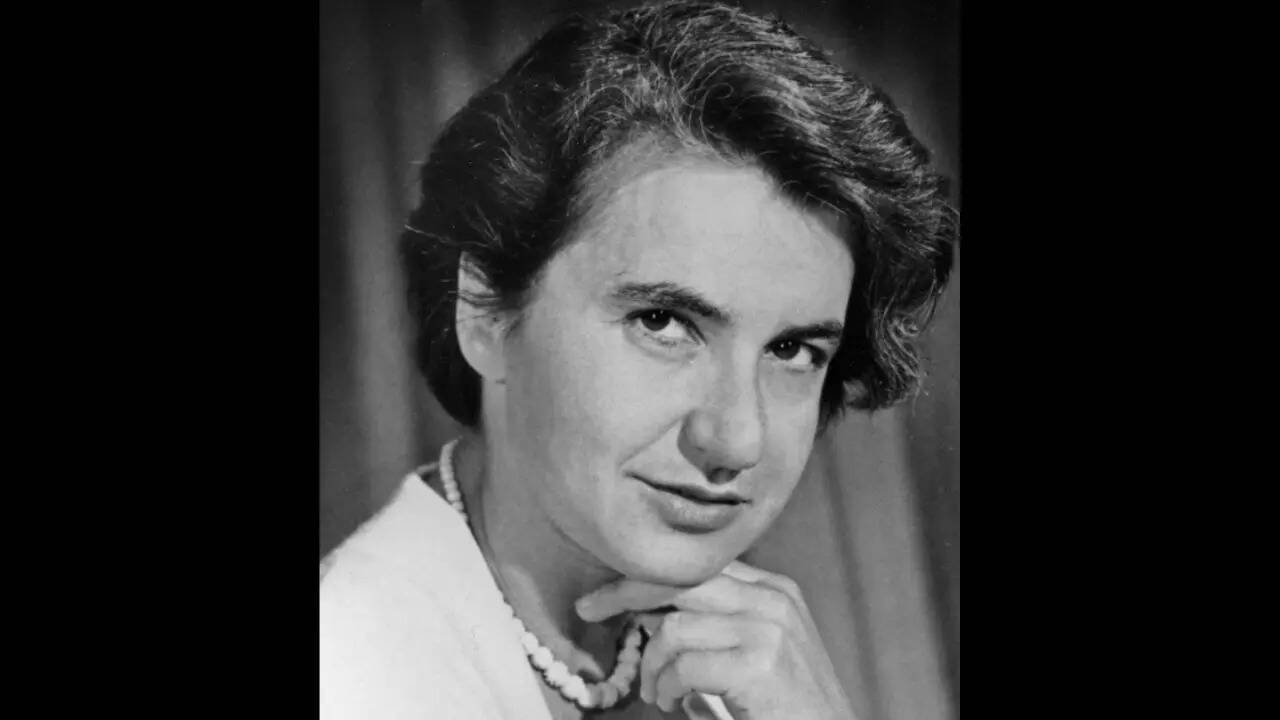
The standard narrative surrounding Rosalind Franklin is a mix of tragic victimhood and secular sainthood. We love to frame her as the "Wronged Woman of DNA," the martyr whose data was pilfered by Watson and Crick while she occupied a moral high ground so lofty it made her peers look like toddlers. We cling to her famous 1940 letter to her father—the one where she calls his faith "selfish" while painting her own dedication to "the future of our successors" as the ultimate act of selflessness.
It’s a beautiful story. It’s also a total fantasy that fundamentally misunderstands how progress actually happens.
By canonizing Franklin’s brand of austere, data-driven "successionism," we have built a cult of the humble researcher that actively slows down modern discovery. We’ve been told that being "right" in the dark is better than being bold in the light. We’ve been lied to.
The Arrogance of the Long View
Franklin’s letter to her father, Ellis, wasn't just a defense of atheism or science; it was a manifesto for a specific kind of intellectual elitism. She argued that personal faith is a crutch for the ego, whereas science is a gift to an anonymous future.
On the surface, that sounds noble. In practice, it’s a recipe for stagnation.
When you claim to work only for "successors," you remove the immediate accountability of the present. You become obsessed with the perfection of the data set rather than the utility of the discovery. This is the "Franklin Trap": the belief that if you just gather enough evidence, the truth will eventually reveal itself to a grateful world a hundred years from now.
In the real world—the one where people die of pathogens and hunger—waiting for the "successors" to figure it out is the ultimate selfishness.
I’ve seen this play out in modern R&D labs. I’ve watched brilliant engineers sit on breakthrough code for eighteen months because they were "polishing" it for the next generation of the stack. They weren't being altruistic. They were terrified of being judged by their peers today. They used the "future of the industry" as a shield to hide their lack of courage.
Why Watson and Crick Were Right (and it Hurts to Admit It)
James Watson and Francis Crick were loud, messy, and arguably unethical in how they obtained "Photo 51." They were also obsessed with being first.
The "lazy consensus" of the history books tells us their ambition was a flaw. In reality, their ambition was the engine. While Franklin was meticulously documenting every angle of the B-form of DNA, refusing to speculate until every decimal point was checked, Watson and Crick were building cardboard models. They were guessing. They were failing. They were moving.
Science is not a museum of facts; it is a competitive sport.
If Watson and Crick hadn't "stolen" the fire, how much longer would the double helix have remained a mystery? Two years? Five? A decade? Think about the biological revolution that followed. Think about the lives saved by mapping the human genome, the advancements in CRISPR, and the development of mRNA vaccines.
Every day Franklin spent "perfecting" her data instead of publishing a bold (if slightly flawed) hypothesis was a day the world stayed in the dark. If we value the "successors" as much as Franklin claimed to, we should prioritize the speed of the breakthrough over the purity of the process.
The False Dichotomy of Faith and Science
Franklin’s critique of her father’s faith was that it centered on the "individual," making it selfish. She believed her science was better because it was impersonal.
This is a fundamental misunderstanding of human psychology. You cannot strip the individual out of the innovation.
The greatest leaps in human history didn't come from people who viewed themselves as nameless cogs in a multi-generational machine. they came from individuals with massive egos who wanted to see the world change within their lifetime.
- The Wright Brothers didn't invent flight for the "successors" of 2026. They wanted to fly.
- Steve Jobs didn't build the iPhone to help people in the 22nd century. He wanted to win the market.
- Elon Musk (love him or hate him) isn't building rockets for the sake of a dry textbook. He wants to go to Mars.
When we pretend that "real" science or "noble" work must be divorced from personal ambition, we filter out the very people capable of making it happen. We trade the frantic energy of the pioneer for the slow, grinding bureaucracy of the archivist.
The Productivity Tax of Being Right
We need to talk about the "Rightness Tax." This is the cost incurred when a researcher or founder refuses to move until they have 100% certainty.
Imagine a scenario where a biotech startup is developing a new diagnostic tool. The "Franklin Approach" dictates that they should spend five years in clinical trials to ensure the error rate is exactly zero before announcing a single result. The "Watson Approach" suggests they release a version that is 90% accurate after one year, saving thousands of lives while they iterate toward 100%.
Who is more selfish?
The person who lets people die while they protect their academic reputation, or the person who risks being "wrong" to provide an immediate benefit?
Franklin was a genius, but she was an institutionalist. She believed in the system. But systems are where ideas go to die a slow death of a thousand committee meetings. To disrupt the status quo, you have to be willing to be "selfish" enough to demand that the future happens now.
Dismantling the Victim Narrative
The tragedy of Rosalind Franklin isn't that she was "robbed" of a Nobel Prize. The tragedy is that she has been turned into a mascot for the "quiet worker."
We use her story to tell young scientists and creators: "Just put your head down. Do the work. Don't worry about the credit. The future will appreciate you."
This is toxic advice. It’s the kind of advice that keeps the most talented people in the room from taking the lead. It’s the advice that allows the loud, the bold, and the "selfish" to dominate the landscape while the "successors" wait for data that never arrives.
If you are working on something that matters, it is your moral obligation to be an advocate for that work. You must be aggressive. You must be visible. You must be "selfish" enough to claim the resources and attention required to bring your vision to life.
Franklin’s letter implies that hoping for your own success is a moral failing. I argue the opposite: failing to fight for your own success is a betrayal of the work itself.
The Data is Never Enough
There is a myth in both academia and tech that "the data speaks for itself." It doesn't.
Data is silent. It requires a narrator. It requires a salesperson.
Franklin had the data. She had the most beautiful image of the double helix ever captured. But she didn't have the narrative. She didn't have the audacity to say, "This is it. This is the secret of life."
She was waiting for the data to become so overwhelming that no interpretation was necessary. In science, that moment rarely comes. There is always another variable. There is always more noise to filter.
If you wait for the data to be perfect, you are just waiting to be bypassed by someone who can see the pattern through the noise. Watson and Crick saw the pattern. They were willing to be wrong about the details of the nitrogenous bases to be right about the structure.
Stop Working for the Successors
The "future of our successors" is a ghost. It is a theoretical construct used to justify current inaction.
When we prioritize the "fate of our successors" over the needs of the living, we succumb to a form of secular nihilism. We treat the present as a mere stepping stone, a disposable era that only exists to feed a better tomorrow.
This is the same logic used by every failed utopian movement in history. "Just suffer a little longer," they say. "The successors will thank us."
The successors don't want your data. They want your breakthroughs. They don't want your meticulous notes; they want the tools you should have built but were too "selfless" to rush.
The most "altruistic" thing you can do is to be relentlessly, unapologetically ambitious in the present. If that makes you "selfish" by Franklin’s standards, then wear that label as a badge of honor.
We have enough archivists. We have enough successors. What we need are more people willing to steal the fire and burn the museum down to keep the current generation warm.
Build the model. Publish the hypothesis. Take the credit.
The future can take care of itself.