The rain in Hartlepool does not fall; it drifts sideways, heavy with the salt of a North Sea that no longer supports the docks.
Walk down the high street on a Tuesday morning. You will pass three empty storefronts, a betting shop with a flickering neon sign, and a cafe where the tea costs a pound and the conversation always circles back to the same quiet grievance. People here do not talk in the polished language of political pundits. They do not use terms like "populist surge" or "demographic realignment."
They talk about the bus route that got canceled. They talk about the three-week wait to see a local doctor. They talk about a feeling—heavy and constant—that the people who run the country look straight through them.
For decades, places like this were the bedrock of the British Labour Party. They were known as the Red Wall, a vast industrial belt stretching across the Midlands and the North of England, where voting for anyone other than Labour was unthinkable. It was a matter of heritage, passed down through generations of miners, steelworkers, and shipbuilders.
Then, the factories closed. The mines filled with water. The children grew up and moved to London or Manchester, leaving behind towns that felt less like communities and more like waiting rooms.
In 2024, that waiting room found a new voice.
It did not come from the traditional conservative establishment, nor did it come from a reformed left. It came in the form of Reform UK, a political party that managed to capture over four million votes, securing five seats in Parliament and fundamentally shifting the tectonic plates of British politics. To understand why this happened, you have to leave the television studios of Westminster and stand in the damp air of a forgotten coastal town. You have to understand the anatomy of a betrayal.
The Chemistry of Discontent
Consider a hypothetical voter. Let us call him Arthur.
Arthur is fifty-eight. He worked for thirty years in manufacturing, a job that provided enough for a modest semi-detached house and a summer holiday in Spain. Today, he works in a logistics warehouse. The hours are tracked by a digital bracelet that beeps if he stands still for too long. He is not poor, but he is precarious. He feels the ground shifting beneath his feet every single day.
When Arthur watches the evening news, he sees a country he struggles to recognize. He hears politicians arguing about net-zero targets while his heating bill eats up a third of his weekly take-home pay. He reads about record-breaking immigration figures—over 680,000 net migration in a single year—and looks at the local school, which is struggling to find desks for new pupils.
This is not a matter of abstract ideology for Arthur. It is a matter of math.
The standard media narrative often labels voters like Arthur with quick, dismissive terms. It is easy to write off a movement as merely "far-right" or driven by prejudice. But that diagnosis is lazy. It misses the deeper, more corrosive element at play: a total collapse of trust.
When the British public voted to leave the European Union in 2016, they were promised control. They were told that decisions would be made locally, that borders would be secure, and that the wealth generated by the nation would finally trickle down to the places that built it. Instead, the years that followed brought political gridlock, a cost-of-living crisis driven by soaring inflation, and a sense that the ruling Conservative Party had spent fourteen years managing a decline rather than fixing the foundations.
Reform UK did not create this anger. They simply built a house inside it.
The Pub vs. The Studio
Political communication usually follows a strict script. It is rehearsed, focus-grouped, and delivered by individuals who have spent their entire adult lives within the square mile of central London.
Then there is Nigel Farage.
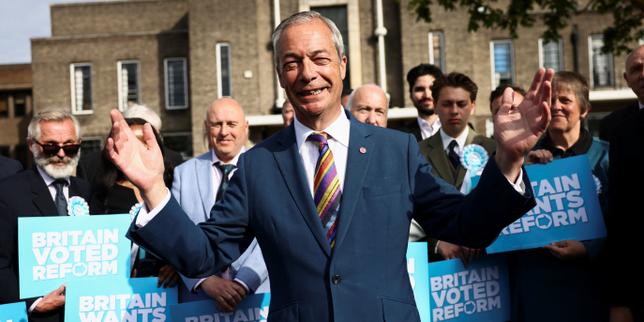
Love him or loathe him—and the British public is violently divided on the matter—Farage possesses a quality that cannot be taught by media trainers. He looks like he belongs in a pub. He holds a pint of bitter with the ease of a regular. He laughs with his mouth wide open, wrinkles creasing around his eyes, looking directly into the camera as if he is sharing a secret with the viewer.
While other party leaders stood behind immaculate podiums delivering curated soundbites, Farage stood on the back of trucks, visited seaside piers, and spoke in short, jagged sentences. He did not talk about macroeconomic indicators. He talked about "common sense."
The strategy was brilliant in its simplicity. Reform UK’s platform was designed to sound like the conversation you hear at the end of a long shift.
- They promised to freeze all non-essential immigration.
- They pledged to lift the threshold for income tax, taking millions of low earners out of the system entirely.
- They demanded the scrapping of green energy levies to instantly lower electricity bills.
To an economist, these proposals might look reckless. They raise massive questions about public finances and the long-term stability of the state. But to Arthur, sitting at his kitchen table with a stack of unpaid bills, they sounded like someone was finally throwing a brick through the window of a locked room.
The established parties responded with statistics. They pointed out that immigration is vital for the National Health Service, which relies heavily on overseas doctors and nurses. They argued that the transition to green energy would create the jobs of the future.
But arguments built on future promises rarely carry weight with people who are struggling to survive the present. A statistical report cannot compete with a lived reality. When a hospital waiting list reaches 7.6 million people, telling a voter that the system is working efficiently because of a specific GDP metric feels less like an explanation and more like an insult.
The Great Realignment
The result of this disconnect was an electoral earthquake that is still rattling the walls of Parliament.
In the 2024 general election, Reform UK did not win the majority. They did not even come close. The first-past-the-post voting system in the United Kingdom is brutal to new parties; it requires concentrated local support to win a seat, meaning millions of votes spread across the country can result in almost no actual representation.
Yet, the raw numbers tell the true story. Reform came second in 98 constituencies across the country. In dozens of traditional Labour heartlands, they secured twenty to thirty percent of the vote, sitting just behind the winners. They did not just pull voters from the right; they sliced directly through the working-class base that the left had assumed would return to them after years of conservative governance.
Imagine a map of Britain. For a century, it was a simple patchwork of blue and red. Now, look closer at the edges. The margins are blurring. The old loyalty is dead.
This change is not a temporary protest. It is the emergence of a new political identity. For years, the political divide was economic: the working class voted for state intervention and public spending, while the middle and upper classes voted for free markets and deregulation.
Today, the fault line has rotated ninety degrees. It is now cultural and geographic. It is a divide between the mobile, highly educated populations of booming metropolitan centers and the rooted, traditional populations of town and coastal regions.
The former group sees change as an opportunity. They view globalization, immigration, and rapid social shifts as exciting chapters in a progressive narrative. The latter group sees change as a threat. They watch their local landmarks disappear, their heritage minimized, and their values treated as outdated relics by a media elite that operates out of a different universe.
The Sound of the Door Closing
On a Friday evening in Clacton-on-Sea—the coastal resort that elected Farage to Parliament with a commanding majority—the amusement arcades blink against the darkening sky. The holidaymakers have gone home. The neon lights reflect in puddles on the concrete promenade.
In a small community center down the road, a meeting has just ended. A handful of local residents walk out into the cold air, pulling their coats tight against the wind. They are not radical activists. They are pensioners, small business owners, and young parents.
One woman stops to light a cigarette, her face illuminated for a second by the flame.
"Everyone kept telling us we were wrong to feel the way we did," she says, her voice quiet but sharp. "They told us we didn't understand the big picture. But we live in the little picture. And the little picture is broken."
That is the true engine behind the rise of Reform UK. It is not a sudden, collective madness. It is the predictable consequence of a political class that forgot how to listen to the people who do the heavy lifting. When you tell people for long enough that their concerns are illegitimate, they will eventually find someone who tells them they are right.
The new government in London may have a massive majority on paper, but the foundation beneath them is dry sand. The millions who turned to Reform are not going away. They are watching, waiting, and testing the weight of their new power.
The rain continues to fall over the coast, washing over the gray pavement, indifferent to the shifts in human affairs. But inside the dark terraced houses, the lights stay on late into the night. People are talking. They are realizing that for the first time in a very long time, their votes caused a shudder in the capital. They have tasted the ability to disrupt the script. And once that door is forced open, it is almost impossible to kick it shut again.

_Biopsy.png?branch=uat_release_3)
