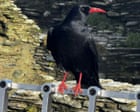
The red-billed chough has officially reclaimed its ancestral seat at Tintagel Castle. After a silence that lasted nearly half a century, the high-pitched, metallic "chee-ow" of this rare crow is once again bouncing off the dark slate cliffs of North Cornwall. This isn't just a lucky sighting for birdwatchers. It is the culmination of a grueling, decades-long battle against habitat loss and agricultural shift. The birds didn't just decide to fly home; they were finally given a home worth returning to.
For years, the chough was a ghost. It lived on in the Cornish coat of arms and in the legends of King Arthur—who, according to local myth, was transformed into a chough upon his death—but the physical bird was extinct in the county by 1973. The return of breeding pairs to the rugged ruins of Tintagel represents a massive shift in how the UK manages its coastline. To understand why they left, and why they are back, one has to look past the feathers and into the dirt.
The Brutal Physics of the Cliffside Pantry
Choughs are specialists. They are not like the versatile carrion crow or the scavenging seagull. They require a very specific, almost manicured environment to survive. They possess a long, curved red beak designed for one purpose: probing short, wind-swept turf for soil-dwelling invertebrates.
During the mid-20th century, the traditional grazing patterns that kept the Cornish cliffs "short" vanished. When cattle and sheep were removed from the coastal fringes, the grass grew long and rank. Gorse and scrub took over. For a chough, this is a death sentence. Their short legs cannot navigate deep vegetation, and their beaks cannot reach the soil through a thick mat of overgrown grass. They were essentially starved out of their own kingdom.
The reappearance at Tintagel is the direct result of a calculated return to "primitive" farming. Organizations like the National Trust and English Heritage had to reintroduce livestock to these vertical landscapes. By bringing back hardy breeds of sheep and cattle to graze the cliff tops, they manually reset the clock. This creates a mosaic of short grass and bare earth, teeming with dung beetles and leatherjackets. Without the cow pat, there is no chough. It is a gritty, unglamorous reality of conservation where success is measured in manure and soil health.
The Legend Versus the Ledger
Tintagel is a site defined by its weight of history. It attracts hundreds of thousands of tourists who come for the ruins and the footbridge. Balancing a high-traffic tourist destination with the nesting requirements of a skittish, rare bird is a logistical nightmare.
Conservationists have had to navigate the fine line between public access and avian privacy. Choughs are cavity nesters. They seek out the deep crevices in the slate cliffs and the hollows within the ancient masonry of the castle itself. These are the same areas where tourists congregate.
The success at Tintagel suggests that the "buffer zone" strategy is working. By managing foot traffic and ensuring that nesting sites remain undisturbed during the critical spring months, the site managers have proven that nature and commerce can occupy the same cliff face. However, this balance is fragile. A single rogue drone or an unleashed dog during the fledging period can wipe out a season’s progress. The "reappearance" is not a permanent victory; it is a temporary lease that must be renewed every year through strict management.
Why Cornwall Matters to the Wider Map
The chough's return to Tintagel isn't just a local feel-good story. It is a critical link in the "Atlantic Arc." These birds are part of a larger, fragmented population that stretches from Ireland and Scotland down to Brittany and Spain.
For decades, the Cornish population was an island, genetically and geographically. When a small group of birds naturally recolonized the Lizard Peninsula in 2001, it was a spark. Tintagel represents the fire spreading north. By establishing a breeding colony here, the birds create a "stepping stone." This allows for genetic exchange between isolated groups, making the entire UK population more resilient to disease and climate shocks.
The Problem with Success
Success brings its own set of complications. As the chough population expands, they move beyond the protected "islands" of National Trust land. They fly onto private farms and into suburban fringes.
The future of the species depends on the "Environmental Land Management" schemes that replaced older EU subsidies. If farmers aren't paid to maintain that difficult, short-turf coastal grazing, they will stop doing it. It is expensive and dangerous to graze cattle on a cliff. If the financial incentive disappears, the scrub returns. If the scrub returns, the choughs vanish again. We are currently in a high-stakes experiment to see if the British government's new green or blue schemes can actually support the heavy lifting of biodiversity.
The Myth of the Easy Win
There is a tendency in environmental reporting to treat these milestones as "nature healing itself." That is a lie. Nature is being dragged back to health by people with mud on their boots and spreadsheets in their hands.
The birds at Tintagel are monitored with obsessive detail. Their leg rings are tracked, their fledglings are counted, and their food sources are analyzed. This is an interventionist's victory. We have created a highly managed, artificial version of the "wild" that mimics the grazing patterns of a century ago.
This brings up a difficult question for the future of conservation. How much of our landscape are we willing to "hand-hold" indefinitely? If the chough requires constant human intervention to exist in Cornwall, are we looking at a wild animal or a free-roaming museum exhibit?
For now, the answer lies in the sheer vibrancy of the birds themselves. Watching a pair of choughs perform their aerial acrobatics over the Island at Tintagel—tumbling through the air in a synchronized display of black and red—makes the philosophical debate feel secondary. They belong there. The jagged skyline of the castle looks incomplete without them.
The return of the chough to Tintagel is a rare instance where the reality of the land has finally caught up to the romance of the legend. The King has returned, but he requires a very specific diet and a lot of help from the locals to stay on his throne.
Watch the skies near the bridge. Look for the flash of red. Listen for the call that hasn't been heard here since the days when the ruins were just becoming ruins. The work isn't over; it has actually just begun.