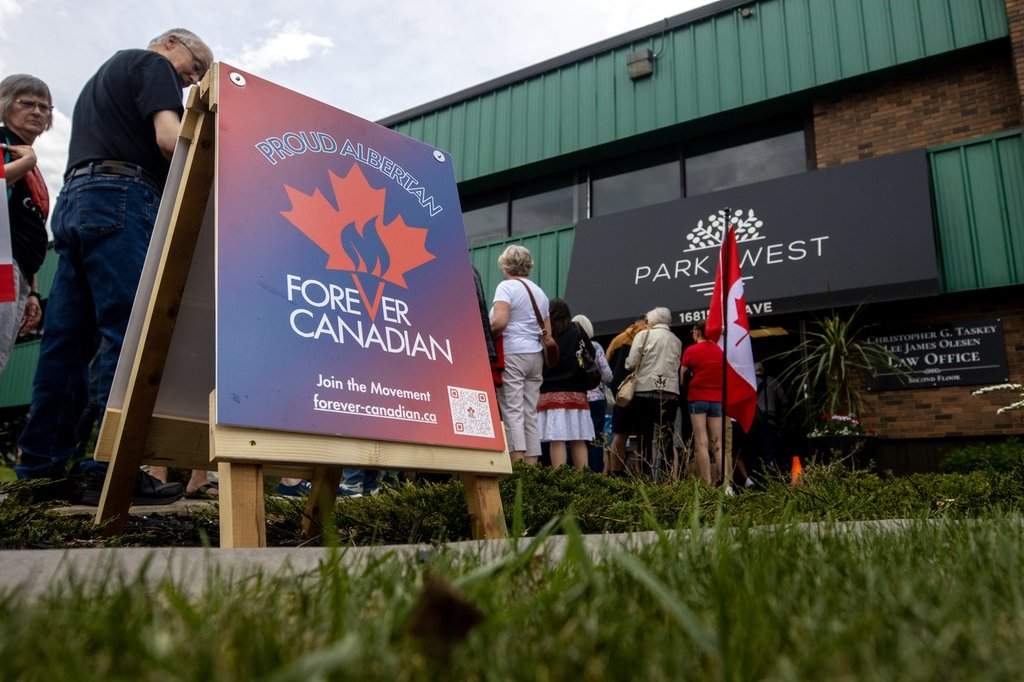
Alberta is heading toward a referendum on its very existence within Canada this October, an extraordinary political escalation triggered by Premier Danielle Smith. In immediate response, the pro-federalist Forever Canadian movement has deployed a provincewide Unity Bus campaign led by former deputy premier Thomas Lukaszuk. The grassroots initiative seeks to mobilize voters to protect Confederation after Smith weaponized rival citizen petitions to justify the ballot question. While separatists view this as a path to independence and federalists view it as an unwelcome existential threat, the underlying reality is a calculated strategy by provincial leadership to force concessions from Ottawa.
The Manufacturing of a Constitutional Crisis
The official narrative coming out of the Premier’s office frames the upcoming October 19 vote as a democratic response to overwhelming public demand. Premier Danielle Smith asserted that the combined weight of two mass petitions—the pro-Canada Forever Canadian petition with over 400,000 signatures and the pro-independence Stay Free Alberta petition with roughly 300,000—proved that Albertans wanted their future on the ballot.
This is a profound distortion of why those signatures were gathered.
Lukaszuk and his organization did not launch their petition to demand a vote on leaving Canada. They launched it as a defensive mechanism to show overwhelming opposition to separatist factions and to convince the government that a referendum was unnecessary. By combining opposing forces into a single statistic, the provincial government inverted a pro-unity movement into justification for an independence ballot question.
The political maneuvering intensified after a Court of King’s Bench ruling legally quashed the separatist petition sponsored by Stay Free Alberta due to verification failures. Unable to use that specific citizen mechanism to legally compel a vote, the government simply bypassed the court hurdle by drafting its own cabinet-approved question.
High Stakes on the Trans-Canada Highway
The Unity Bus is not merely a promotional vehicle. It represents a six-month mobilization strategy designed to contest rural communities and working-class campgrounds where anti-Ottawa sentiment runs deepest. The campaign relies heavily on door-knocking, massive distribution of Canadian flag lawn signs, and targeted distribution of verified economic data regarding the costs of secession.
The strategy targets voter turnout above all else. In a standard provincial election, localized dissatisfaction can be absorbed by the electoral system, but a binary referendum offers no such cushion.
REFERENDUM DYNAMICS: OCTOBER 2026
┌─────────────────────────────────────────────────────────┐
│  Government Strategy: Use ballot to force federal concessions│
├─────────────────────────────────────────────────────────┤
│  Federalist Strategy: Secure a massive majority to crush │
│  the independence movement permanently.                 │
└─────────────────────────────────────────────────────────┘
A narrow victory for the federalist side would not solve the problem. A slim margin of survival would signal to provincial leaders that the independence threat remains a viable political card. To put this issue to rest, the pro-unity campaign requires an indisputable majority that dismantles the separation narrative entirely.
The Fractured Coalition of the Right
The push toward the October ballot has exposed significant friction within the United Conservative Party governance model. The recent abrupt resignation of two provincial cabinet ministers highlighted internal pushback against the escalating sovereignty rhetoric. Moderate conservatives fear that playing chicken with Confederation will drive away international energy investment and destabilize the local economy.
Conversely, the government faces pressure from hardline independence groups who feel betrayed by the phrasing of the referendum question. The current wording asks voters if the province should start a process toward a binding vote, rather than jumping straight to a clean break. Stay Free Alberta has accused leadership of using their movement as a bargaining chip rather than pursuing actual independence.
This leaves the provincial government walking a narrow line. It must keep the nationalist base motivated without triggering a moderate voter backlash that could tank the entire initiative.
Federal Realities and Economic Repercussions
The timing of this constitutional challenge intersects with a shifting federal political landscape. Prime Minister Mark Carney has consistently run on a platform of structural national unity, recently signing significant pipeline and carbon pricing adjustments with western leaders to ease regional tension.
Federal Conservative Leader Pierre Poilievre has ordered his members of parliament to campaign actively for Alberta to remain in Canada. This creates an awkward dynamic where federal conservatives are directly opposing the tactical maneuvers of their provincial counterparts.
The economic risks of this political theater are substantial. Alberta’s energy sector relies on long-term regulatory certainty and access to global capital markets. Even the theoretical possibility of a secession process introduces a risk premium that threatens major infrastructure projects, regardless of the ultimate vote outcome.
The Unity Bus campaign is a direct response to a ballot question that few everyday citizens actively sought. By forcing the issue, provincial leadership has transformed a grievance-based negotiating tactic into a high-risk gamble. Over the next five months, the debate will move through community centers and rural towns, where the outcome will depend on whether voters see the ballot as a harmless protest or an irreversible choice.