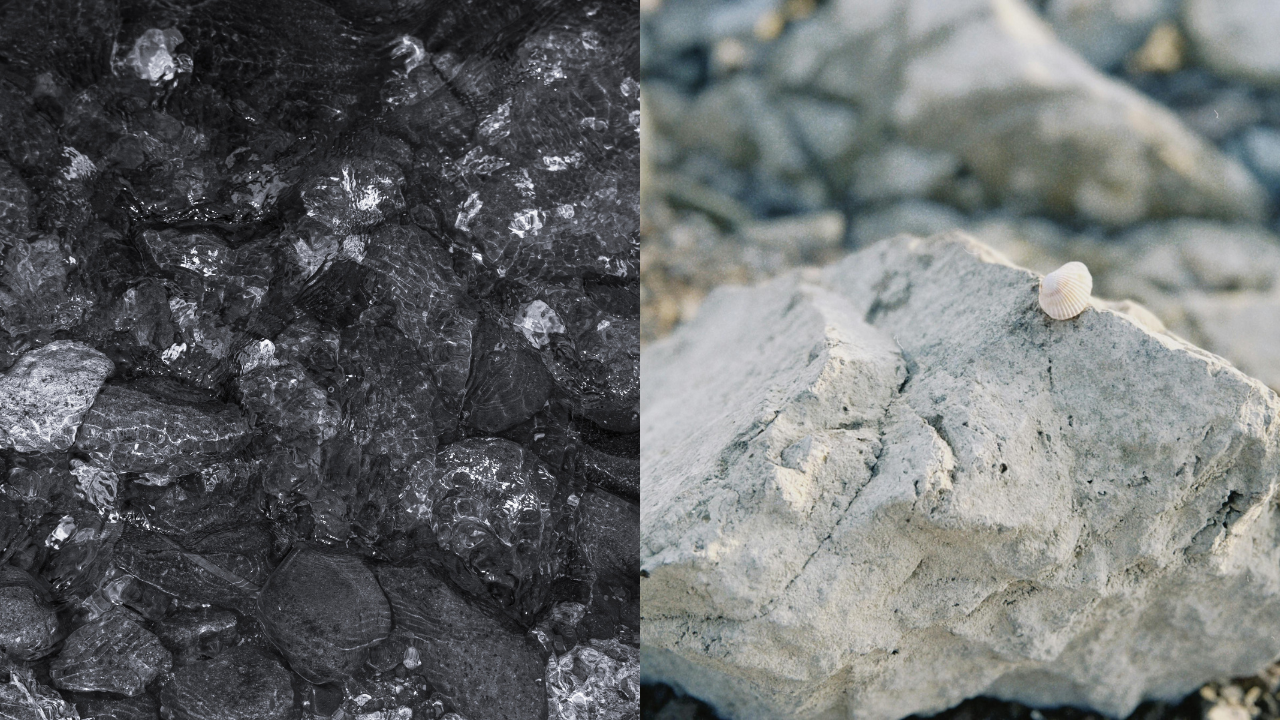
The laboratory in the basement of a quiet university building smells of ozone and floor wax. There are no dramatic light shows here, only the steady hum of air filtration systems and a group of researchers staring at a grey speck that looks, to the untrained eye, like a bit of driveway gravel. But this speck is four and a half billion years old. It is a time capsule from the era before the world had a name, and it holds the secret to why you have a heartbeat.
For decades, we looked at the stars and wondered where the blueprints for life came from. We assumed the Earth was a self-made miracle, a planet that cooked up its own chemistry in the primordial heat. We were wrong.
The story of our existence didn't start in the oceans. It started in the cold, silent void of deep space, carried to us by celestial messengers that survived a fiery plunge through our atmosphere. These are the carbonaceous chondrites—the "black stones"—and they are the reason we aren't just a barren rock spinning in the dark.
The Chemistry of a Ghost
Imagine a chemist trying to bake a cake without any flour, sugar, or eggs. No matter how hot the oven gets, the cake never happens. Early Earth was that empty kitchen. It was a hellish, molten sphere, far too volatile to hold onto the delicate organic compounds required for biology. The heat would have shredded them. The radiation would have bleached them.
Then, the sky began to fall.
When a meteorite strikes the ground, it isn't just a rock hitting a planet. It is a delivery. Inside the porous structures of these meteorites, scientists have discovered something startling: amino acids, the fundamental building blocks of proteins. Not just one or two, but dozens of varieties, many of which don't even occur naturally on Earth today.
Consider the sheer improbability of this. In the vacuum of space, through a process of cold chemistry and ultraviolet radiation, the universe was busy assembling the alphabet of life while our planet was still a glowing coal. These rocks acted as armored safes, protecting their precious cargo from the friction of entry. When they landed in the cooling puddles of a young Earth, they spilled their contents. They provided the flour and the sugar.
The Mystery of the Left-Handed World
There is a strange quirk in your biology that most people never think about. If you look at the molecules that make up your DNA and your muscles, they have a "handedness." In the world of chemistry, many molecules come in two versions that are mirror images of each other, like a left and a right glove.
In a random chemical reaction in a lab, you get a 50-50 split. But life is picky. Every living thing on Earth, from the smallest bacteria to the blue whale, uses "left-handed" amino acids. If you tried to build a human using right-handed versions, the gears of the cells wouldn't turn. The machinery would jam.
For a long time, this was a massive "why" in the scientific community. Why did we choose one side?
The answer was found hiding in the heart of a meteorite that fell near Murchison, Australia, in 1969. When researchers analyzed the organic material inside, they found an excess of—you guessed it—left-handed amino acids. The bias wasn't an earthly invention. It was an interstellar inheritance.
We are left-handed because the rocks that seeded our planet were left-handed. We didn't choose the direction of our evolution; the choice was made for us in a nebula billions of miles away, long before the sun had even ignited.
The High Stakes of a Cold Rock
It is easy to treat this as abstract trivia, the kind of thing you read on a museum plaque and promptly forget. But the stakes are profoundly human. If these meteorites hadn't arrived, or if they had been composed of different materials, the "you" who is reading this wouldn't exist. Not just in a "butterfly effect" sense, but in a literal, structural sense.
We often think of space as a hostile vacuum, a place that kills life. We need to flip that perspective. Space is the nursery. The Earth was merely the garden bed.
The researchers in that ozone-scented lab aren't just looking for rocks; they are looking for our ancestors. They use mass spectrometers to weigh atoms, searching for isotopes that prove these molecules couldn't have been formed here. It is tedious, painstaking work. It involves years of sitting in front of screens, squinting at graphs that look like mountain ranges, looking for the one peak that signifies a specific carbon chain.
But when they find it, the silence of the lab is broken by a realization that should make your skin crawl with awe. We are a part of a cosmic "pay it forward" scheme.
The water in your cells? Likely delivered by icy asteroids. The nitrogen in your DNA? Cooked in the heart of a dying star and transported via meteorite. We are a mosaic of space debris that learned how to breathe.
The Great Filter of Understanding
There is a lingering doubt that haunts many astronomers. If life’s ingredients are scattered so freely throughout the galaxy, why haven't we heard from anyone else? If the mail is being delivered everywhere, why does it feel like we’re the only ones who opened the package?
This is where the story shifts from chemistry to luck.
Seedling a planet is easy. The universe does it constantly. But for those seeds to sprout, the timing has to be perfect. If the meteorites had arrived while Earth was still a molten sea, the ingredients would have been incinerated. If they had arrived too late, the Earth might have been too cold, its oceans locked in ice.
We caught the window. We are the result of a perfectly timed cosmic bombardment.
This realization changes how we look at the search for life on Mars or the moons of Jupiter. We aren't looking for "aliens" in the sense of green men in flying saucers. We are looking for the same chemistry. We are looking for our cousins. When we sent the OSIRIS-REx mission to scrape a handful of dust off the asteroid Bennu, we weren't just doing a science experiment. We were performing a paternity test on the solar system.
The results coming back from these missions confirm the narrative: the universe is "wet" with the potential for life. The ingredients are everywhere. They are floating in the dust between stars. They are trapped in the ice of comets. They are raining down on planets we will never see.
A Legacy Written in Carbon
Think about the sheer resilience required for you to be here.
A molecule formed in the freezing dark, survived the chaotic birth of a star system, hitched a ride on a hunk of iron and silicate, survived a 3,000-degree descent through a nitrogen sky, and landed in a pool of water. Then, it waited. It waited through the cooling of the crust, the shift of tectonic plates, and the rise and fall of a thousand species that never made it.
Eventually, that molecule became a part of a cell. That cell became an organism. That organism became a person who can look back at the stars and recognize them as home.
We aren't separate from the "cold facts" of astrophysics. We are the manifestation of them. Every time you feel the sun on your face, you are feeling the energy that once drove the chemical reactions in those ancient meteorites. Every time you think a thought, you are using the carbon that was delivered by a falling stone.
The grey speck in the university basement isn't a rock. It’s a mirror. If you look closely enough, you can see your own reflection in the dust of the stars.
The next time you see a shooting star, don't just make a wish. Recognize it for what it is: a delivery. The universe is still trying to tell us where we came from, one falling stone at a time. All we have to do is be quiet enough to listen to the story it’s been writing since the beginning of time.
You are not an accident of geography. You are a citizen of the debris.