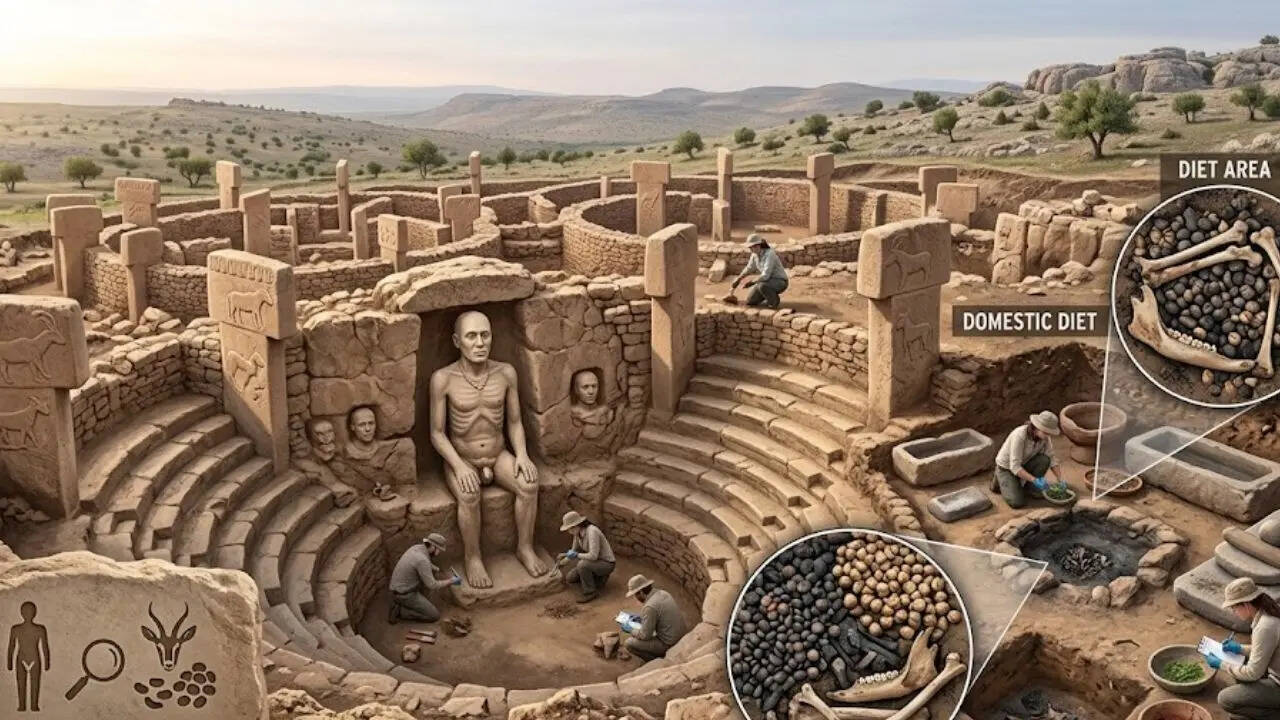
The discovery of Karahantepe has effectively shattered our timeline of human civilization. For decades, the consensus was simple: humans settled down, started farming, and only then built massive monuments. Karahantepe, a sprawling 12,000-year-old complex in southern Turkey, proves that narrative was backward. These hunter-gatherers were engineering monumental stone structures and carving hyper-realistic statues long before they ever planted a single seed of wheat. This isn't just an archaeological find. It is a total forensic reconstruction of how power, ritual, and survival intersected at the end of the last Ice Age.
Recent excavations have pulled back the dirt on a site that rivals and potentially surpasses its famous neighbor, Göbekli Tepe. While Göbekli Tepe gave us stylized animals, Karahantepe gives us the human face. Massive, haunting statues and phallic pillars suggest a culture obsessed with lineage, masculinity, and perhaps a darker form of ritual than we previously dared to imagine. Meanwhile, you can read related stories here: The Esequibo Myth Why Guyana and Venezuela are Both Playing a Losing Game.
The Architecture of Domination
Karahantepe is located in the Tas Tepeler region, a rugged stretch of the High Mesopotamian plains. The site features more than 250 T-shaped megaliths, but the centerpiece is a sunken, circular room carved directly into the bedrock. This wasn't a home. It was a theater of the sacred.
Walking into the main chamber, you are met by a protruding human head carved from the wall, its eyes staring directly at the entrance. Surrounding it are eleven upright pillars shaped like giant phalluses. The engineering required to carve these features out of a single limestone shelf, rather than transporting them from elsewhere, speaks to a level of technical sophistication that shouldn't have existed in 9400 BCE. To explore the bigger picture, check out the detailed analysis by NPR.
These people weren't just surviving; they were managing complex labor forces. To move, carve, and position stones weighing several tons, you need a hierarchy. You need someone to plan the logistics, someone to feed the workers, and a shared belief system to keep everyone from walking away. The sheer scale of Karahantepe suggests that organized religion—or at least organized ritual—was the catalyst for sedentary life, not the result of it.
The Myth of the Starving Hunter
One of the most persistent lies in history books is that prehistoric humans lived on the edge of calorie-induced collapse. The data from Karahantepe tells a different story. Analysis of the refuse pits and animal remains reveals an "unexpected" diet that was actually a masterclass in resource management.
These weren't desperate scavengers. They were elite foragers who hit the jackpot of biodiversity. The site is littered with the bones of gazelles, wild sheep, and goats. But the real revelation is the plant life. Long before "true" agriculture, the inhabitants of Karahantepe were processing wild grains and tubers on an industrial scale. Large stone grinding bowls found in situ suggest they were producing flour and perhaps even primitive ales.
The Meat Paradox
While the diet was diverse, the sheer volume of animal bones suggests massive communal feasts. This wasn't a family dinner; it was a political event. In the world of the Neolithic, if you could provide a mountain of roasted meat for five hundred people, you held the power.
We see evidence of:
- Targeted Culling: They weren't just killing whatever walked by. They were selecting specific age groups of gazelle, indicating a sophisticated understanding of herd dynamics.
- Seasonal Surpluses: The layout of the site suggests it was used most heavily during specific times of the year, likely coinciding with migrations or harvests.
- Advanced Processing: The presence of deep pits suggests large-scale food storage or fermentation, techniques that allowed a "mobile" population to stay in one place for months at a time.
The Human Face of the Stone Age
If Göbekli Tepe was a temple to the wild, Karahantepe is a temple to the self. The shift in iconography is jarring. At Karahantepe, the carvings move away from the abstract spiders, snakes, and foxes of earlier sites and focus intensely on the human form.
The most striking piece is a statue of a man clutching his ribs, his ribs visible through his skin, his expression one of either agony or intense trance. It is a brutal, honest depiction of the human condition. We also see depictions of humans carrying animals on their backs, a clear signal of dominion over the natural world.
This shift represents a psychological revolution. Humans were no longer just another animal in the landscape. They were beginning to see themselves as something apart, something capable of bending the earth to their will. This "human-centric" turn is the true birth of the modern mind. It is where we see the first inklings of the ego being carved into stone.
The Ritual of Burial
Karahantepe wasn't abandoned; it was decommissioned. This is perhaps the most baffling part of the site’s history. At some point, the people who built these magnificent structures decided to fill them in.
They didn't just walk away and let the wind blow the sand over. They meticulously buried the pillars and statues under tons of clean earth and rubble. This was a deliberate act of "killing" the site. By burying it, they preserved it. Why would a culture spend decades, perhaps centuries, building a monument only to bury it?
Some archaeologists argue it was a way of "burying" an era or a specific lineage. Others suggest it was a protective measure. But looking at the precision of the backfilling, it feels more like a funeral for the building itself. The site was treated as a living entity that had reached the end of its life cycle.
A Challenge to the Fertile Crescent Narrative
For a century, we’ve been told that civilization began in the river valleys of Egypt and Sumer. Karahantepe moves the needle north and back in time. It suggests that the hilly flanks of the Taurus Mountains were the true laboratory of the human experiment.
The environment here 12,000 years ago was a Mediterranean paradise. It wasn't the dusty, arid landscape we see today. It was a lush parkland filled with oak forests and teeming with game. The people of Karahantepe didn't "invent" farming because they had to; they likely ignored it for a long time because they didn't need it. They had reached a level of social complexity—including art, architecture, and religion—without the need for the drudgery of the plow.
This forces us to reconsider the "progress" of history. We often view the move to agriculture as an upgrade. But the skeletons from later agricultural periods often show more signs of disease and malnutrition than the hunter-gatherers of Karahantepe. These people had reached a pinnacle of lifestyle that we eventually traded away for the security of the grain store.
The Problem of Interpretation
We must be careful not to project modern sensibilities onto the stones of Karahantepe. When we see eleven phallic pillars and a human head, we think "fertility cult." But to the people of the Neolithic, the symbolism could have been far more nuanced. It could have been about the passage of time, the marking of the stars, or a complex system of ancestor worship that we have no modern equivalent for.
The site is also a logistical nightmare for researchers. Only a fraction of the hill has been excavated. Each summer, as the heat hammers the Harran Plain, teams peel back layers that consistently defy the previous year’s theories. We are currently looking at the tip of an iceberg that spans several miles and at least a dozen similar unexcavated mounds in the region.
The Geopolitics of Archaeology
There is also the matter of the "Tas Tepeler" project, a massive state-sponsored effort by the Turkish government to brand this region as the "Zero Point in Time." While the archaeology is sound, the narrative is being heavily managed. There is a race to turn Karahantepe and its sister sites into a global tourism engine that rivals the Pyramids.
This funding is a double-edged sword. It allows for high-tech scanning and rapid excavation, but it also puts pressure on archaeologists to produce "spectacular" finds that grab headlines. The real story of Karahantepe might not be in the massive statues, but in the microscopic analysis of the soil, the starch grains on the tools, and the DNA of the animal bones.
The pressure to find the "world's oldest" anything often obscures the more interesting "how." How did they coordinate the labor? How did they keep the peace in a settlement of hundreds of people without a standing army or a legal code?
Mapping the Future of the Past
As excavations continue, Karahantepe will likely eclipse Göbekli Tepe in the public consciousness because it is more relatable. It is harder to ignore the humanity of a site that features the faces of our ancestors looking back at us.
We are looking at a society that was capable of immense artistic beauty and intense structural discipline. They were not "primitive." They were a fully realized civilization that simply operated under a different set of rules than the ones we’ve spent the last 5,000 years writing.
The stones are not silent; we have just been deaf to their frequency. Every carved rib, every polished pillar, and every ground-down grain of wild barley is a piece of a puzzle that, once completed, will show us that we have been "civilized" for much longer than we ever suspected.
Stop looking for the beginning of history in the first written word. It began here, in the bedrock of a Turkish hillside, where someone decided that a face deserved to be eternal.