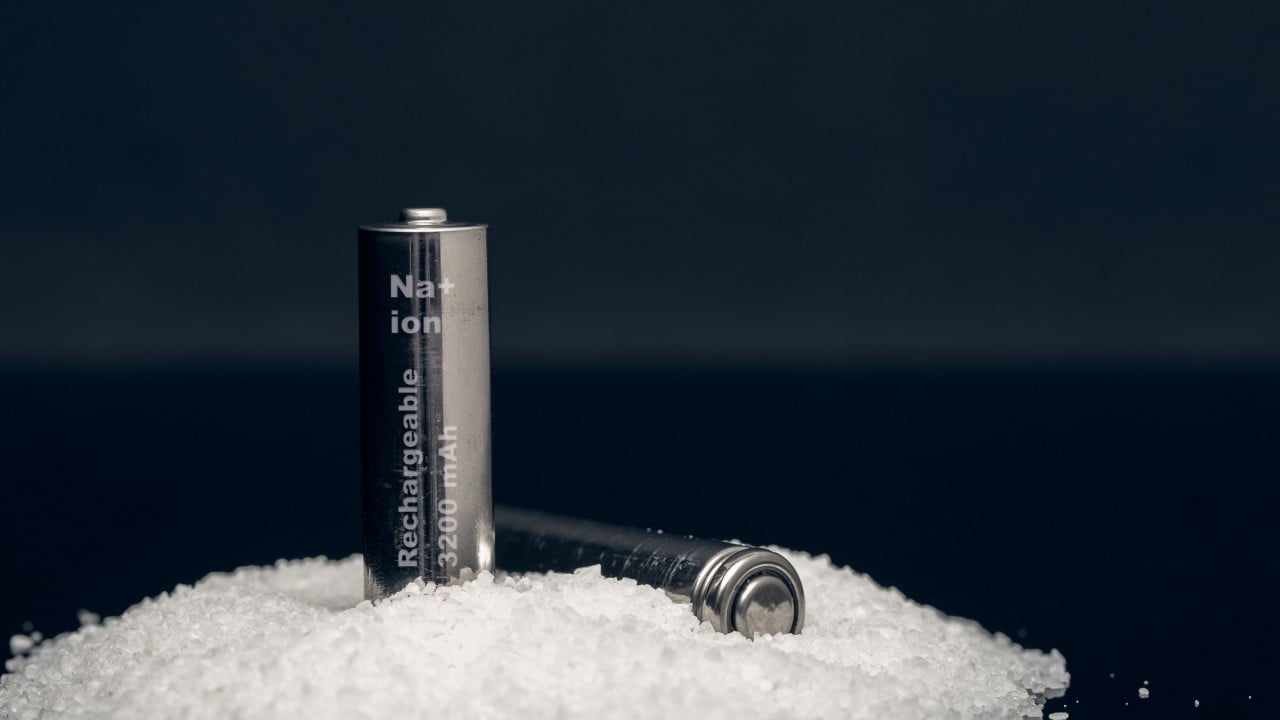
China imports roughly 75% of its lithium. This single metric explains why the nation’s scientific and industrial apparatus has executed a massive pivot toward sodium-ion chemistry. While the physical limitations of sodium—namely its larger atomic radius and lower operating voltage—long relegated it to academic obscurity, recent materials-science interventions and manufacturing scale-up have transformed it into a commercially viable hedge against lithium resource constraints.
By achieving cell-level costs of $0.051 per watt-hour ($51 per kilowatt-hour) at energy densities of 175 watt-hours per kilogram, modern sodium-ion architectures are actively challenging lithium iron phosphate in short-range transportation and stationary energy storage. This analysis deconstructs the thermodynamic, chemical, and economic mechanics driving this structural shift.
The Molecular Bottleneck of Sodium versus Lithium
To understand the engineering hurdles of sodium-ion batteries, one must analyze the fundamental physical differences between the charge carriers. Sodium sits directly below lithium on the periodic table, sharing similar group-one monovalent chemistry but carrying distinct physical penalties.
Atomic Mass and Volume
The atomic mass of sodium ($22.99\text{ g/mol}$) is more than three times that of lithium ($6.94\text{ g/mol}$). Furthermore, the ionic radius of the sodium ion ($Na^+$) is $1.02\text{ \AA}$, compared to $0.76\text{ \AA}$ for the lithium ion ($Li^+$). This size differential yields two immediate physical consequences:
- Volumetric Expansion: Inserting a larger ion into a host crystal structure (intercalation) induces substantial mechanical strain. Electrodes experience volumetric expansion and contraction of up to 400% in certain host frameworks during cycling, causing rapid particle cracking, loss of electrical contact, and accelerated capacity decay.
- Reduced Gravimetric Energy Density: Because sodium is heavier and possesses a lower standard reduction potential ($-2.71\text{ V}$ versus $-3.04\text{ V}$ for lithium), the theoretical energy density of sodium-ion systems is fundamentally capped lower than that of their lithium counterparts.
Mass Transport Kinetics
In liquid electrolytes, the larger ionic radius of $Na^+$ surprisingly works to its benefit in one specific area: solvation energy. Because the charge density of $Na^+$ is lower than that of $Li^+$, its solvation shell (the cluster of solvent molecules surrounding the ion) is less tightly bound. Under certain conditions, this allows for faster desolvation at the electrode-electrolyte interface, facilitating high power output and improved low-temperature kinetics.
The Three Pillar Materials Architecture
Overcoming the structural degradation caused by the $Na^+$ ion required re-engineering every active layer of the battery cell: the cathode, the anode, and the electrolyte.
1. Cathode Stabilization: Transitioning from Prussian Blue to Layered Oxides
Early sodium-ion attempts relied heavily on Prussian Blue analogues—open framework structures capable of hosting large ions. However, these materials are plagued by coordinated water molecules trapped within the crystal lattice, which react with electrolytes to produce hydrofluoric acid, destroying the cell from within.
Commercial-scale designs have shifted toward layered transition metal oxides (typically formulations of sodium, iron, manganese, and nickel or copper). By doping these structures with specific transition metals, researchers have stabilized the oxygen layers during desodiumization (charging).
Recent physical autopsies of mass-produced cells reveal high and deliberately uneven concentrations of copper within the cathode structure. This uneven distribution functions as a structural buffer, halting phase transitions that would otherwise cause the cathode layers to shear and collapse.
2. Hard Carbon Anode Engineering
Lithium intercalates cleanly into graphite. Sodium does not. The spacing between graphite sheets ($0.335\text{ nm}$) is too narrow to accommodate the larger $Na^+$ ion, leading to thermodynamic instability.
To resolve this, sodium-ion batteries utilize hard carbon (non-graphitizable carbon). Hard carbon features highly disordered, curved graphene sheets with a wider interplanar spacing ($>0.37\text{ nm}$) along with localized nanopores. The storage mechanism occurs via a two-step process:
- Adsorption: $Na^+$ ions first adsorb onto the defective active sites on the surface of the disordered carbon sheets.
- Intercalation/Insertion: $Na^+$ ions then insert themselves into the wider interlayer spacings and fill the nanopores at lower potentials close to $0\text{ V}$ versus $Na/Na^+$.
Optimizing this anode requires a precise balance: creating enough defects to maximize sodium storage while minimizing the surface area to limit the formation of the Solid Electrolyte Interphase (SEI) layer, which consumes active sodium during the first charge cycle.
3. Solvation and Electrolyte Engineering for Extreme Temperature Operation
Low-temperature charging in lithium-ion batteries is highly restricted due to the risk of lithium plating (dendrite formation), which can short-circuit the cell. Sodium-ion cells exhibit a much lower tendency to form dangerous dendrites.
By employing highly polar ester-based solvents paired with inorganic sodium salts (such as sodium hexafluorophosphate, $NaPF_6$), engineers have formulated electrolytes that maintain low viscosity at sub-zero temperatures. Cells using these formulations maintain a 90% capacity retention level at -20°C. This performance profile solves the winter range degradation that severely limits lithium iron phosphate (LFP) vehicles in cold climates.
The Manufacturing Cost Function of Sodium-Ion
The primary driver for sodium-ion commercialization is not superior energy density, but rather cost-curve optimization and raw material supply chain security.
Cost/kWh = (Raw Material Index + Processing Cost) / (Energy Density * Yield Rate)
Within this cost function, sodium-ion possesses three distinct structural advantages:
The Aluminum Current Collector Substitution
In lithium-ion cells, the anode current collector must be copper foil because lithium alloys with aluminum at low voltages. Copper is highly dense and expensive.
Sodium, conversely, does not alloy with aluminum at low potentials. This allows sodium-ion manufacturers to use aluminum foil on both the cathode and the anode. Aluminum is approximately three times lighter and up to five times cheaper than copper, immediately removing a significant cost driver and reducing dead weight within the cell.
Abundance of Raw Carbonates
Sodium carbonate ($Na_2CO_3$) is highly abundant, geographically distributed, and cheap to refine, whereas lithium carbonate ($Li_2CO_3$) is prone to extreme price volatility and geopolitical concentration. When comparing raw active materials, the precursor cost for a sodium transition metal oxide cathode is roughly 30% to 50% cheaper than that of an equivalent LFP cathode.
| Metric | Sodium-Ion (Mass Production) | Lithium Iron Phosphate (LFP) |
|---|---|---|
| Cell Cost ($/Wh) | $0.051 | $0.065 - $0.080 |
| Energy Density (Wh/kg) | 150 - 175 | 160 - 200 |
| Anode Current Collector | Aluminum Foil | Copper Foil |
| Capacity Retention at -20°C | ~90% | ~60% - 70% |
| Safety Profile | High thermal stability | Moderate-High thermal stability |
The major headwind for sodium-ion is scale. While the raw material costs are lower, lithium-ion manufacturing benefits from decades of supply chain maturation and massive volume efficiencies. Sodium-ion will only realize its full structural cost advantage of roughly 30% below LFP once gigawatt-hour-scale factories operate at high utilization rates.
Industrial Validation and Manufacturing Parity
The transition of sodium-ion from a laboratory project to a true industrial asset has been validated by rigorous, non-destructive testing of mass-produced cells. Recent academic evaluations of commercial cells produced by Chinese pioneer Hina Battery provide clear data on this manufacturing maturity.
Using impedance spectroscopy and high-resolution X-ray imaging, researchers examined the internal architecture of 120 mass-produced sodium-ion cells. The data revealed an unexpected level of structural and performance uniformity across the batch. This high level of consistency is a direct consequence of a critical manufacturing choice: the utilization of a tabless, double-aluminum current collector design.
This physical layout mimics the geometric and thermal architecture found in premium large-format cylindrical cells (such as Tesla's 4680). By eliminating traditional welded tabs and utilizing a continuous electrical connection along the edge of the electrode roll, the design:
- Minimizes internal electrical resistance, reducing ohmic heating during rapid charge and discharge cycles.
- Ensures highly uniform current density across the entire electrode surface, preventing localized hot spots that accelerate chemical degradation.
- Allows the cells to be manufactured on slightly modified, existing lithium-ion production lines, avoiding the capital expenditure requirements of entirely new factory tooling.
This compatibility with existing production lines means that the scaling timeline for sodium-ion is constrained not by manufacturing equipment availability, but by precursor supply chain scale-up.
The Strategic Dispatch Horizon
The structural properties of sodium-ion batteries dictate a bifurcated deployment strategy rather than a broad, direct replacement of lithium-ion chemistries.
                  [Sodium-Ion Application Matrix]
                              │
         ┌────────────────────┴────────────────────┐
         ▼                                         ▼
[High Spatial Tolerance]                  [Low Temperature Critical]
   - Utility Grid Storage                    - Micro-EVs & Two-Wheelers
   - Commercial Micro-grids                  - Cold-Climate Logistics
   - Server Farm Backup Power                - Shorthaul Urban Delivery
Stationary Grid Storage and Utility Scale Backups
In stationary applications, weight and volume are secondary to cycle life, safety, and capital cost per cycle. CATL’s introduction of its large-scale sodium-ion energy storage systems targets these exact parameters. Because sodium cells possess superior thermal stability and are highly resistant to thermal runaway compared to high-nickel lithium-ion cells, the cost of external fire suppression and thermal management systems at the container level is significantly reduced.
Urban and Commercial Fleet Electrification
While premium passenger vehicles requiring a 600-kilometer range will continue to rely on high-nickel lithium chemistries, urban commuters and commercial delivery fleets represent an immediate target. Commercial transport operations along active shipping corridors, such as the logistics vessels and heavy delivery trucks deployed in central China, benefit directly from sodium's unique blend of lower cell costs and environmental resilience.
For short-haul distribution networks operating in cold climates, a battery chemistry that maintains 90% capacity at freezing temperatures is vastly superior to a slightly denser lithium chemistry that requires energy-intensive active heating to function.
The near-term deployment playbook for energy developers and automotive manufacturers does not involve choosing one chemistry over another. It requires a mixed-fleet approach. By integrating sodium-ion into entry-level vehicles and massive grid installations, industries can insulate their cost structures from lithium commodity super-cycles while securing domestic, resource-independent manufacturing pipelines.