You see it on water filters, face masks, and those tiny packets of silica gel tucked inside your new shoeboxes. Yet, honestly, most people read the word "adsorb" and assume it is just a typo for "absorb."
It is not. One single letter changes the entire chemical mechanism. Confusing these two terms is not just a grammar mistake; it is a fundamental misunderstanding of how the physical world filters, cleans, and processes materials.
If you want to understand how we purify drinking water, pull toxic gases out of the air, or even treat accidental poisoning in emergency rooms, you have to understand adsorption.
The Core Difference is All Surface
To get the mechanics down, think about a sponge and a windowpane.
When you throw a sponge into a puddle of water, the liquid permeates the entire structure. The water penetrates the deep interior volume of the sponge. That is absorption with a "B." It is a bulk phenomenon where a substance is completely soaked into another body.
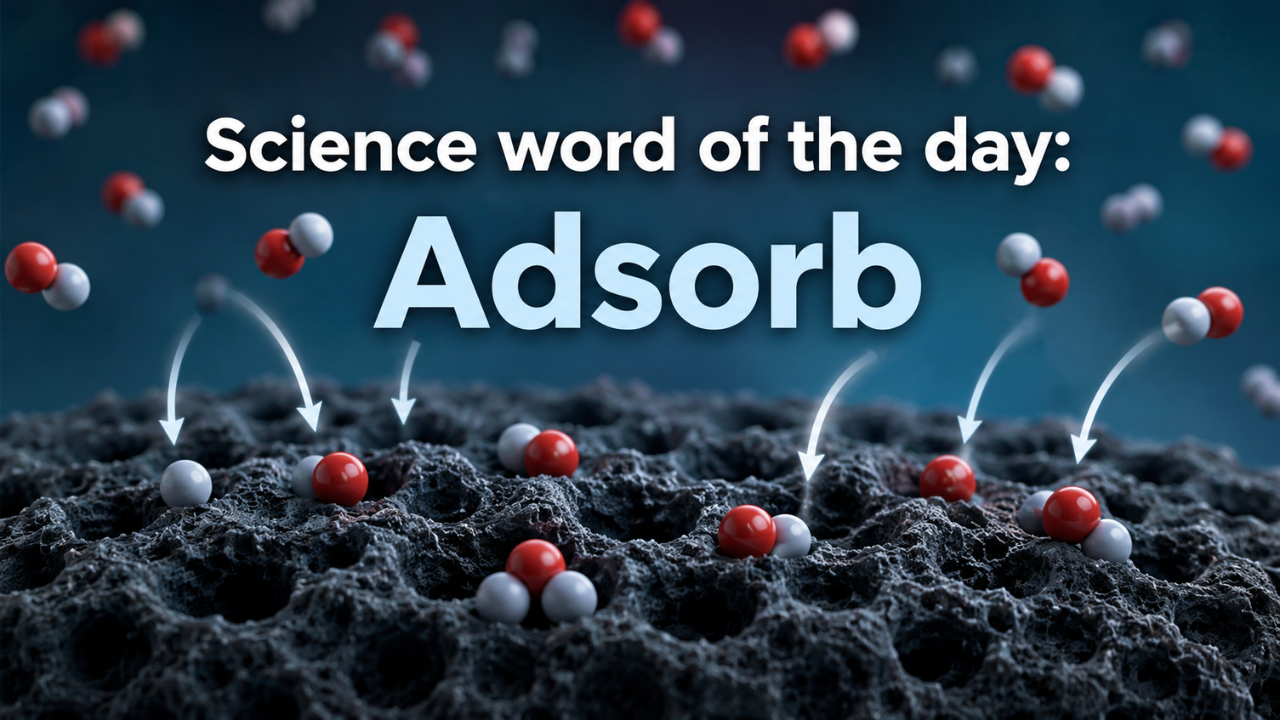
Now imagine driving through a heavy fog or a dust storm. The moisture or dust coats the outside of your windshield. It sticks to the exterior glass but never gets inside the car. That is adsorption with a "D." It is strictly a surface phenomenon. Molecules, atoms, or ions zip through the air or a liquid and get trapped, clinging directly to the solid or liquid surface of a material.
To keep the terminology straight, scientists split the process into two parts:
- Adsorbent: The solid or liquid surface that does the trapping (like the windshield or activated charcoal).
- Adsorbate: The gas, liquid, or dissolved solid that gets trapped on the surface (like the dust or toxins).
Heinrich Kayser and the Birth of a Term
We can thank German physicist Heinrich Kayser for giving us this distinction. In 1881, Kayser was investigating how carbon materials take up gases. He realized the existing vocabulary was sloppy. Scientists were using "absorption" for everything, even when gases were merely clinging to the outer layer of a material rather than sinking deep inside it.
Kayser combined the Latin prefix ad- (meaning "to" or "toward") with sorbere (meaning "to suck in"). He wanted a word that specifically meant a substance was drawn toward a surface and held there. Interestingly, historical records show he actually coined it at the suggestion of prominent physiologist Emil du Bois-Reymond.
By separating the two words, Kayser gave surface chemistry its own identity. Decades later, researchers like Irving Langmuir expanded on Kayser's foundation, winning a Nobel Prize in 1932 partly for figuring out exactly how single layers of molecules coat these surfaces.
The Two Ways Molecules Stick
Molecules do not just sit on a surface by accident. They are pulled in by specific physical or chemical forces. Depending on the strength of that pull, adsorption falls into two distinct buckets.
Physisorption (Physical Adsorption)
This is a weak, reversible attachment. The adsorbate clings to the surface via weak Van der Waals forces—the same chemical static cling that allows geckos to walk up walls. Because the bond is weak, it releases heat easily and can be undone. If you heat up the material or lower the surrounding pressure, the trapped molecules fly right back off. Silica gel packets removing moisture from a camera bag operate on physisorption.
Chemisorption (Chemical Adsorption)
This is a whole different ballgame. Here, the surface and the incoming molecule undergo an actual chemical reaction, forming a chemical bond. It requires energy to start, creates a single layer of highly bonded molecules, and is usually irreversible. If you want to get those molecules off, you practically have to tear the surface apart. An example is oxygen forming an oxide layer on a hot metal surface.
Real World Applications You Depend On Daily
This surface-level attraction is not just an abstract concept for lab coats. It keeps your modern world functioning safely.
- Water Purification: Tap water filters use activated carbon, which is highly porous charcoal. Because it has millions of microscopic pores, a single gram of activated carbon has a surface area of over 1,000 square meters. As water flows through, chemical pollutants, chlorine, and bad odors literally stick to the carbon surface, leaving clean water to pass through.
- Medical Toxicology: When someone accidentally swallows a poison or overdoses on medication, emergency room doctors often administer medical-grade activated charcoal. It does not absorb the poison into the body; instead, the toxins adsorb heavily onto the charcoal surface while inside the stomach, preventing the gut from taking them in until they safely pass through the system.
- Gas Masks and Industrial Safety: Military and industrial respirators rely on specialized adsorbents to scrub lethal chemical agents out of the air before a worker breathes them in.
- Keeping Consumer Goods Dry: Those little "Do Not Eat" packets filled with silica gel are dropped into electronics boxes to grab ambient moisture out of the air, keeping humidity from corroding sensitive circuit boards during shipping.
Next Steps for Practical Use
If you are dealing with moisture control, bad odors, or filtration at home or in a small workshop, stop buying generic odor-masking sprays or basic paper filters. Look specifically for products containing activated carbon, zeolites, or silica gel.
When using these materials, remember they have a finite lifespan. Because adsorption relies strictly on available surface space, those microscopic sticking points eventually fill up completely. Once an activated carbon filter or silica gel pack is entirely coated in adsorbate, it stops working entirely. Check your filters regularly, swap out old carbon media, and bake your saturated silica gel packs in a low-temperature oven to release the trapped moisture and reset the surface for another round of work.