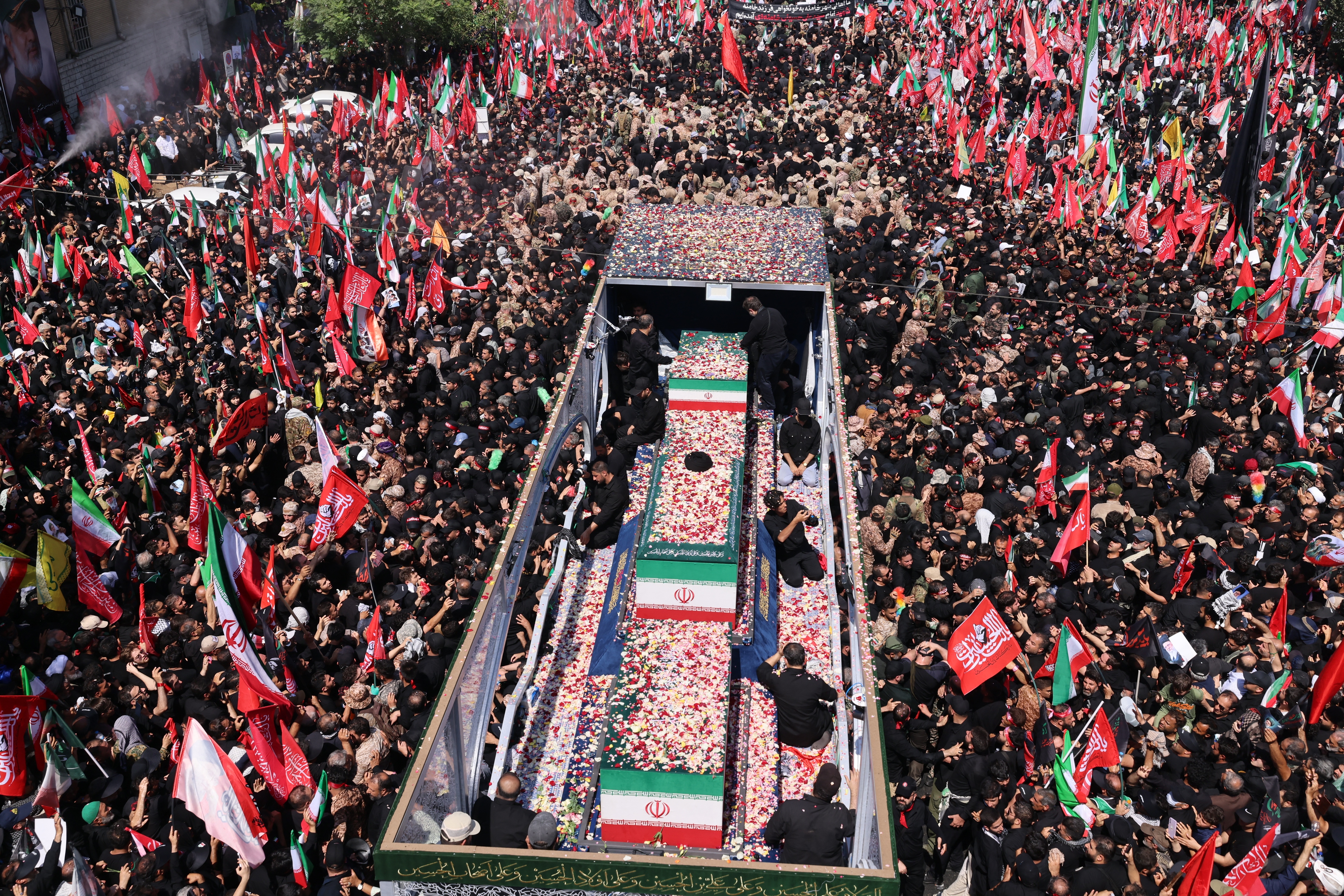
Western media falls for the exact same trap every single time a senior authoritarian figure dies. They look at the sweeping drone shots of choked streets, the sea of black shirts, and the weeping crowds, and they immediately sprint to the same lazy conclusion. They tell you that these massive gatherings are a definitive gauge of genuine domestic popularity or a rock-solid guarantee of regime continuity.
They are completely wrong.
The coverage surrounding the funeral processions in Iran follows a tired, predictable script. It mistakes forced mobilization for authentic consensus. Having spent years analyzing Middle Eastern political structures and state-managed media ecosystems, I can tell you that treating a state-orchestrated funeral as a democratic referendum is one of the biggest analytical failures in modern journalism.
Drone footage does not measure political legitimacy. It measures logistical compliance.
The Logistics of Coerced Mourning
To understand why the "huge crowds" narrative is deeply flawed, you have to understand how a totalitarian apparatus actually functions on a Tuesday morning. Millions of people in the streets does not mean millions of loyal supporters. It means a highly efficient, deeply entrenched system of civil service coercion is operating at peak capacity.
In states with massive public sectors, attendance at these events is not optional. It is a line item in an employment contract.
- The Civil Service Mandate: Government employees, schoolteachers, university students, and military conscripts are routinely bused into city centers. Attendance is taken. Failure to show up can result in lost promotions, docked pay, or expulsion.
- The Economic Incentive: In a sanction-strangled economy, the state frequently distributes free meals, transport, and day-off incentives to participants. For a struggling family, spending four hours in a crowd is a transactional survival mechanism, not an ideological stance.
- The Basij Network: Local paramilitary chapters manage neighborhoods with granular precision. They know who leaves their house, who stays home, and who refuses to wave the mandated flag.
When the alternative to participation is economic ruin or state surveillance, walking in a procession is simply the path of least resistance.
The False Signal of Historical Precedent
The media loves to draw a straight line from past massive funerals to future regime stability. They point to the funeral of Ayatollah Ruhollah Khomeini in 1989 or Qasem Soleimani in 2020 to argue that the sheer volume of humanity proves the enduring strength of the system.
This ignores the fundamental mechanics of political flashpoints.
Let us look at a stark historical counter-example. In 1970, Egyptian President Gamal Abdel Nasser died. His funeral procession drew an estimated five million people into the streets of Cairo. The grief was objectively massive, loud, and seemingly unified. Western analysts at the time declared that Arab nationalism was an unstoppable, permanent force that would dictate regional politics for the next half-century.
What actually happened? Within a few years, Nasser’s successor, Anwar Sadat, completely reversed Egypt’s geopolitical alignment, dismantled Nasser's socialist economic policies, signed a peace treaty with Israel, and pivoted hard toward the United States. The five million people who wept in the streets did not stop the absolute demolition of Nasserism.
Mass funerals are a reflection of a moment, usually manufactured, wrapped in cultural traditions of public mourning. They are never a reliable indicator of what happens when the dust settles and the structural contradictions of an economy begin to tear at the social fabric.
Dismantling the Stabilizing Succession Myth
The core assumption embedded in the competitor's reporting is that a massive funeral signifies a smooth transition of power. The logic goes: if the people are out in droves, the incoming leadership inherits a unified nation.
This is an incredibly dangerous misreading of factional politics.
In highly centralized, authoritarian systems, the real political struggle never happens in front of the cameras. It happens behind closed doors among clerical elites, military commanders, and intelligence chiefs. The public display of unity is actually used as a smokescreen to mask intense, vicious internal power struggles.
| Metric of Regime Health | What the Media Looks At | What Actually Matters |
|---|---|---|
| Public Compliance | Crowd sizes, street chants, state-tv broadcasts | Factory strikes, currency depreciation, capital flight |
| Elite Elite Unity | Joint appearances at the funeral podium | Internal purges, changes in security leadership, budgetary reallocations to the military |
| Security Capability | Paramilitary forces managing the mourners | The operational readiness of anti-riot units when the mourning period ends |
While journalists are busy counting heads in the crowd, they are missing the real story: the shifting balances of power within the Islamic Revolutionary Guard Corps (IRGC) and the quiet positioning of candidates who have no intention of maintaining the status quo once they secure absolute control.
The Flawed Questions We Keep Answering
If you look at the standard search queries and public interest surrounding these events, people constantly ask variations of the same question: "Does this funeral prove the government has the support of the people?"
It is the wrong question entirely.
In a system that does not allow independent polling, free press, or open political opposition, asking if a government has "the support of the people" is meaningless. The correct question is: "Does the state retain the logistical and financial capacity to enforce public compliance?"
Right now, the answer to that is yes. They can still organize transport, they can still clear the streets, and they can still command the bureaucracy. But do not mistake the ability to choreograph a parade with the ability to govern a modern nation facing compounding environmental crises, systemic corruption, and crushing international isolation.
The downside to analyzing politics through this contrarian lens is that it requires patience. It forces you to ignore the loud, colorful, immediate visuals of television news and instead focus on boring, slow-moving metrics like banking liquidity, localized labor strikes, and regional water scarcity. It is not glamorous, and it does not make for a clickable headline about a "nation in mourning."
Stop looking at the street level. Stop counting the flags. The real trajectory of a nation is decided in the quiet boardrooms of the security apparatus, entirely indifferent to the millions of people they forced to march in the heat.