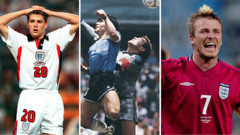
The grass at the Azteca Stadium in 1986 wasn’t just green. Under the blinding Mexico City sun, it baked into a pale, dusty canvas, scarred by studs and slick with the sweat of men who genuinely, deeply disliked each other.
When Diego Maradona walked onto that pitch on June 22, he wasn't just carrying a leather ball. He was carrying the bruised ego of an entire nation. Four years earlier, the Falklands War had ended. Young Argentine conscripts, barely out of boyhood, had frozen and died in the mud of the South Atlantic, defeated by the British military. To pretend that a quarter-final football match was just a game was a luxury only the comfortable could afford. In Buenos Aires, it was something else entirely. It was a chance to rewrite history with a ball at their feet.
Football has a habit of turning geopolitical trauma into theater. But when Argentina meets England, the theater becomes a blood sport. This isn't a rivalry born of proximity or standard athletic envy. It is a generational soap opera fueled by theft, revenge, red cards, and a tiny piece of plastic wrapped around David Beckham’s right ankle.
The Animals of Wembley
To understand why 1986 felt like an exorcism, you have to go back twenty years earlier. It is 1966. Wembley Stadium. The World Cup quarter-final.
England’s manager, Alf Ramsey, was a man of fierce, rigid discipline. Argentina’s captain, Antonio Rattín, was a towering, combative midfielder who viewed the pitch as a territory to be defended by any means necessary. The match was brutal. Slashing tackles, constant shirt-tugging, and a referee from West Germany who spoke no Spanish.
When the referee ordered Rattín off the pitch for what he deemed "violence of the tongue," Rattín refused to leave. He didn't understand the command, or perhaps he chose not to. For several agonizing minutes, play stopped. Rattín demanded an interpreter. He stared down the officials. When he finally walked, he did so with agonizing slowness, deliberately wrinkling a British Royal standard flag on his way out and sitting on the red carpet reserved exclusively for Queen Elizabeth II.
England won 1-0. But the scoreline was a footnote. After the final whistle, Ramsey forbade his players from swapping shirts with the Argentines. He later publicly branded them "animals."
That single word became a permanent fixture in the Argentine dressing room. It wasn't an insult to be forgotten; it was a badge of honor, a symbol of Anglo-Saxon arrogance. The English saw the Argentines as lawless thugs. The Argentines saw the English as cold, colonial imperialists who rigged the system when they couldn't win fairly. The fuse was lit.
The Two Faces of God
Then came Maradona.
If 1966 planted the seeds of resentment, 1986 cultivated a myth that will survive as long as humanity plays with a ball. The first goal Maradona scored that day in Mexico City was an act of pure defiance. He challenged Peter Shilton, a goalkeeper nearly half a foot taller, for a looping mid-air ball. Maradona reached out his fist and punched it into the net.
The English players screamed. The linesman blinked. The referee pointed to the center circle.
Diego later called it La Mano de Dios—the Hand of God. It was a cheat, yes, but to Argentina, it was a beautiful cheat. It was the clever street urchin picking the pocket of the wealthy aristocrat. It was poetic justice for the Falklands.
But a villain cannot truly satisfy a narrative unless he proves he is also a genius. Exactly four minutes later, Maradona took the ball in his own half.
Think about the sheer audacity of what happened next. He turned away from two English midfielders with a pirouette that belonged in a ballet. He began to run. He didn't look at the grass; he looked at the space between the white shirts. Peter Beardsley, Peter Reid, Terry Butcher, Fenwick—they became ghosts, statues in a gallery of his design. He covered 60 meters in ten seconds, touched the ball eleven times, left Shilton flat on his backside, and slid the ball into the empty net.
It remains the greatest goal ever scored in the history of the tournament. In the span of four minutes, Maradona encapsulated the entire Argentine footballing psyche: the cynical survivor who steals what he can, and the divine artist who creates what others can only dream of.
The English felt robbed of their dignity by a handball. The Argentines felt vindicated by a deity.
The Boy with the Sarong
Rivalries need new fuel to survive across generations. By 1998, the memory of Maradona’s hand was fading into grainy VHS tapes. A new protagonist was required.
Enter David Beckham.
In 1998, Beckham was the golden boy of English pop culture. He was talented, spectacularly handsome, engaged to a Spice Girl, and possessed a right foot that could pin a blade of grass from forty yards away. He was also young, fragile, and intensely proud.
The setting was Saint-Étienne, France. Another World Cup knockout match. The game was an instant classic—Michael Owen scoring a breathless individual goal, Gabriel Batistuta hammering home penalties. But the pendulum swung on a moment of petulance.
Diego Simeone, a ruthless Argentine midfielder who embodied the dark arts of the sport, clattered into Beckham from behind. Beckham fell to the turf, face down. As Simeone stood over him, tapping him on the head in a patronizing gesture of dominance, Beckham flicked his right heel upward.
It was a soft kick. It barely grazed Simeone’s shin. But Simeone dropped to the ground as if he had been struck by a sniper.
The red card flashed. Beckham walked off the pitch, his head bowed, his golden locks damp with sweat. England lost on penalties, because England always lost on penalties.
The British tabloids didn't just criticize Beckham; they hunted him. An effigy of the midfielder hung from a noose outside a London pub. The Daily Mirror printed a dartboard with his face in the center. He became the scapegoat for a nation’s collective footballing trauma. Every time he touched the ball during the subsequent domestic season, thirty thousand opposing fans booed his name.
Imagine that weight. You are twenty-three years old, and an entire country blames you for ruining their summer, their history, their pride.
Redemption in Sapporo
True drama requires a third act.
Four years later, the draw for the 2002 World Cup in South Korea and Japan placed England and Argentina in the exact same group. The venue was the Sapporo Dome, a futuristic indoor stadium that felt like a spaceship stranded in northern Japan.
Beckham was now the captain. He had spent four years enduring the vitriol, transforming himself from a flamboyant celebrity into a relentless, hard-working leader.
Late in the first half, Michael Owen burst into the Argentine penalty box. Mauricio Pochettino—who would later manage Beckham’s old clubs—stuck out a leg. Owen went down. Penalty.
The stadium went completely silent. Everyone in the world knew who had to take it.
Beckham walked up to the spot. Standing between him and redemption was the ghost of 1998, the memory of the effigy, the weight of Alf Ramsey’s "animals," and Maradona’s hand. He didn't look at the goalkeeper. He took a short run-up and blasted the ball violently down the middle of the goal.
It wasn't a pretty penalty. It was a release of pure, unadulterated anger.
Beckham ran to the corner flag, screaming, his face contorted in an expression that was less about joy and more about survival. England won 1-0. The curse was broken, or at least, suspended.
The Ghostly Echoes
We like to think that modern football is sanitized. We think that corporate sponsorships, tactical systems, and billionaire owners have washed away the blood and soil of the old rivalries.
But they haven't. Not really.
When an English player lines up against an Argentine shirt, the past is never dead. It isn't even past. The players might play for the same club teams in London or Manchester, they might share agents and sponsors, but the shirt changes a man. It forces him to inherit a legacy he didn't ask for.
The rivalry isn't about points or trophies anymore. It is about a fundamental disagreement on how the world should work. The English still yearn for a clean, fair battle fought by rules they believe they invented. The Argentines still celebrate the beautiful deception, the victory of wit over structure.
The next time these two nations meet on a patch of grass under a stadium light, look closely at the tackles. Look at the way they hold each other’s shirts when the referee isn't looking. Listen to the roar of the crowd. You aren't just watching twenty-two men chase a piece of synthetic leather. You are watching a ninety-minute war that neither side ever wants to win completely, because without the enemy, the story loses its magic.