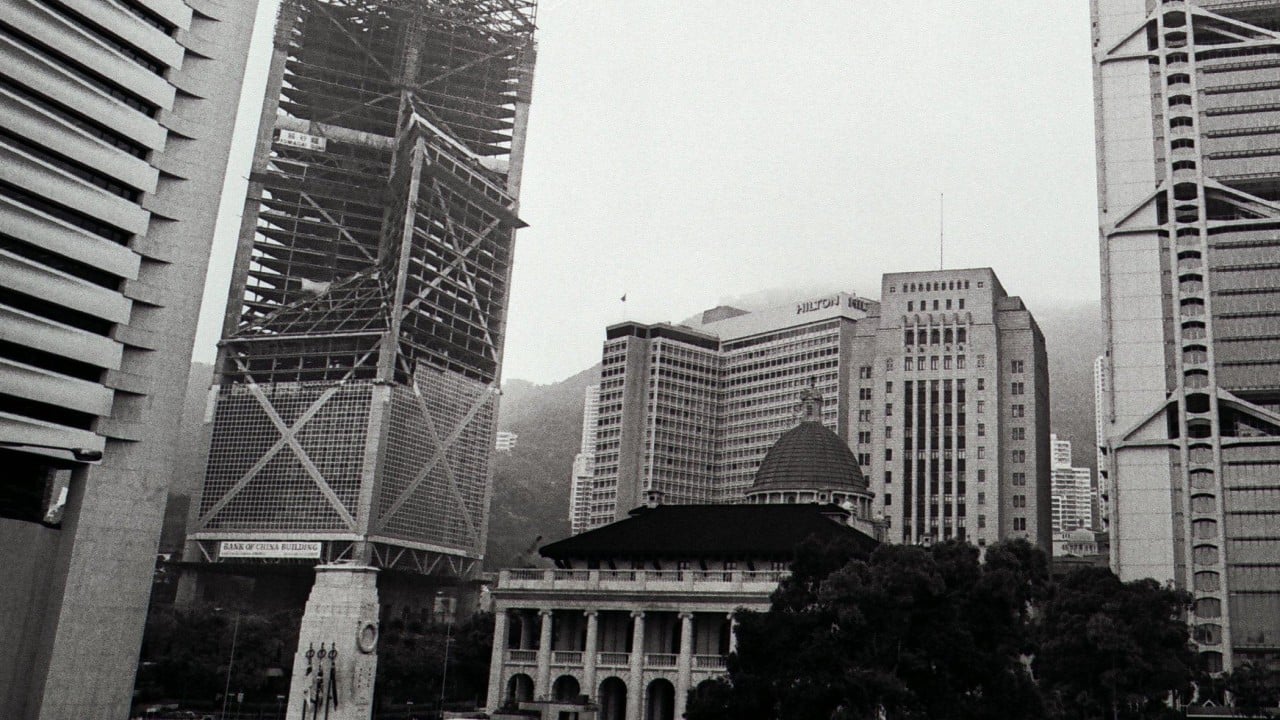
The wind off Victoria Harbour does not care about feng shui. In the late 1980s, if you stood on the mid-levels of Hong Kong Island as the humid dusk rolled in, the air smelled of salt, diesel exhaust, and roasted goose. It was a city living on borrowed time, counting down the years to 1997 when Great Britain would hand the glittering, chaotic colony back to China. Everyone was looking for a sign of what came next.
They got a knife.
When the scaffolding finally fell away from No. 1 Garden Road in May 1990, it revealed a structure that looked less like an office building and more like a silver blade slicing through the low-hanging clouds. The Bank of China Tower did not just join the skyline. It violently rearranged it. For the millions of people crammed into the vertical concrete hives of Kowloon and Central, this seventy-two-story monolith became an overnight obsession, a symbol of shifting power, and, to many, a curse cast in steel and glass.
To understand why a building could terrify an entire metropolis, you have to understand the invisible geometry that dictates life in Hong Kong.
The War of Shadows
In Western architecture, a skyscraper is an exercise in engineering and ego. You build high to prove you can. In Hong Kong, a building is a living organism that must breathe with the earth. For centuries, the practice of feng shui—the art of aligning the built environment with the natural flow of qi, or energy—was not a superstitious afterthought. It was, and remains, a multi-million-dollar line item in corporate budgets.
Imagine a hypothetical local shopkeeper named Wah. For thirty years, Wah has run a small textile business in the shadow of the peaks. He knows that energy flows down from the mountains toward the water, bringing wealth. If you block that flow, you go bankrupt. If you deflect it, people get sick.
Now look at what the legendary architect I.M. Pei designed for the Bank of China.
Pei, a Chinese-American modernist, wanted to evoke the structural strength of a bamboo shoot, a traditional symbol of growth and prosperity. He used a brilliant structural system of triangular frameworks, transferring the building’s immense weight to the four corners of its base. This eliminated the need for internal vertical columns, creating vast, sunlit interior spaces. It was an engineering masterpiece, built on a relatively modest budget of 130 million US dollars.
But the city did not see bamboo. They saw edges.
The building’s triangular facets created sharp, blade-like corners that pointed directly at its neighbors. In the vocabulary of feng shui, these are known as sha qi—killing arrows. One of those sharp corners pointed directly at the Government House, the residence of the British Governor. Another pointed toward the headquarters of the Hongkong and Shanghai Banking Corporation (HSBC), the financial bedrock of the British establishment.
The rumors spread through the tea houses and boardroom lunches like wildfire. It was whispered that the Beijing-backed bank had intentionally built a weapon to slice away the wealth and luck of the departing British administration. The stakes were not abstract; they were measured in the daily anxieties of a population wondering if their freedoms would vanish overnight.
When the Skies Answered
Superstition has a funny way of manifesting as reality when the pressure is high enough. Shortly after the tower’s construction gained momentum, a series of misfortunes struck the city.
The British Governor, Sir Edward Youde, died suddenly in his sleep while on a trip to Beijing. The local stock market experienced dizzying drops. The financial preeminence of the colony felt fragile. Did a triangular piece of glass cause a heart attack or a market correction? Logically, no. But in the collective psyche of Hong Kong, the tower was guilty by association.
Consider the reaction of HSBC. They did not dismiss the fears of their local clients and staff. Instead, they acted with corporate pragmatism. The bank hired its own feng shui masters and installed two maintenance cranes on the roof of their own building. To the casual tourist, they looked like standard window-washing equipment. To the locals, they were distinct, cannon-like shapes pointed directly back at the Bank of China Tower.
It was a silent, architectural artillery duel happening hundreds of feet above the pavement.
Inside the Bank of China Tower, the atmosphere was different but no less tense. The designers realized they had a public relations disaster on their hands. Pei himself confessed that he had underestimated the deep-seated cultural power of these beliefs. In a bid to soften the building’s aggressive energy, the bank added small water features and planted a grove of trees around the base. Water, in the ancient texts, absorbs and neutralizes bad energy. It was a concession to a city that refused to be conquered by pure modernism.
The Human Cost of Light
Step inside the completed tower in May 1990, and the architectural brilliance became undeniable. The light was different here.
Because of the triangular design, the sun cut through the glass at unexpected angles, painting the marble floors with shifting geometric shadows throughout the day. It felt futuristic, almost holy, a sharp contrast to the dark, wood-paneled banking halls of the old guard.
But for the workers who occupied the desks near those massive glass inclines, the experience was disorienting. Humans are creatures used to ninety-degree angles. We like walls that stand straight up and down. To sit at a desk where the wall tilts outward over a hundred-foot drop creates a subtle, constant vertigo. It forces an awareness of the void.
The tower became the tallest building in Asia upon its completion, overtaking the Hopewell Centre. It stood as a monument to what could be achieved when mathematical precision ignored cultural anxiety. Yet, the real triumph of the building wasn't its height, but its resilience. Hong Kong is plagued by typhoons, vicious storms that roll in from the South China Sea with winds capable of snapping steel cranes. Pei’s triangular design meant the tower could withstand wind loads twice as high as those required by standard city codes.
It was built to survive the weather. Whether it could survive its own reputation was another matter.
The Legacy of the Blade
Thirty-six years have passed since the doors opened on that May morning. The handover came and went in 1997. The British governors are a footnote in history books; the Government House is now used for receiving dignitaries.
The skyline has grown around the Bank of China Tower. Even taller giants, like the International Commerce Centre across the harbor, now dwarf it in sheer scale. Yet, none of them command the eye quite like the old blade.
On a clear night, the neon tubes that trace the triangular skeleton of the tower glow a sharp, cold blue against the dark peak. It no longer looks like an invading force. It looks like Hong Kong itself: resilient, slightly dangerous, born from a collision of Western ambition and Eastern soul.
The shopkeepers like Wah still look up at it when the mist rolls in, perhaps with less fear now, but with an enduring respect. The building taught the city that progress is never just about concrete and cash. It is about the ghosts we bring with us into the sky, and the sharp edges we choose to live with.

_Biopsy.png?branch=uat_release_3)
