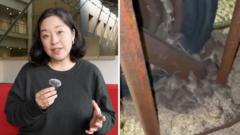
The sound comes first. It is not a roar or a crash. It is a soft, rhythmic rustling, like dry autumn leaves scraping across a concrete driveway. But there are no trees near the grain silos of western New South Wales. There is only dust, steel, and a creeping, suffocating realization.
When you flip the light switch in the shearing shed, the floor does not just look alive. It is alive. A carpet of grey, twitching bodies parts around your boots. The stench hits the back of your throat next—a sharp, ammonia-heavy reek of urine, sour grain, and decay that clings to your clothes long after you wash them.
This is the reality of an Australian mouse plague. It is an ecological anomaly, a economic disaster, and a psychological siege rolled into one. To understand why the eastern grain belt of Australia occasionally vanishes beneath a sea of rodents, you have to look past the sensationalist headlines. You have to understand the delicate, volatile relationship between the Australian climate and a creature built for rapid exploitation.
The Perfect Storm in the Soil
Australia is a land of extremes. The continent bounces violently between crippling droughts and torrential floods. For years, the earth cracks under a baking sun. Crops fail. The topsoil turns to powder. During these harsh times, mice numbers dwindle to almost nothing. They survive in tiny, isolated pockets, waiting.
Then, the rain returns.
Consider the transformation. Within weeks, brown, barren paddocks turn into a lush expanse of green. Farmers, desperate for a win after years of financial ruin, plant bumper crops of wheat, barley, and canola. The harvest is bountiful. Grain is everywhere—in the fields, spilling from augers, piled high in temporary storage bunkers.
For a house mouse (Mus musculus), this is not just a good season. It is an evolutionary jackpot.
A single female mouse can reproduce at just six weeks of age. She can give birth to a litter of up to ten pups every twenty-one days. Do the math. Under ideal conditions, two mice can theoretically give rise to thousands of descendants within a single year. When the Australian winter is mild and the food supply is effectively infinite, the natural checks and balances of the ecosystem simply collapse.
The Cost of the Bounty
Ben (a composite of the countless grain growers who face this nightmare) stands on his porch at midnight. The beam of his flashlight catches thousands of tiny, reflecting red eyes in the paddock. He spent the day checking his combines. The mice had chewed through the electrical wiring, causing thousands of dollars in damage before the harvest could even begin.
The financial toll of these plagues is staggering, often running into the hundreds of millions of dollars. But the hidden cost is the psychological erosion.
Imagine going to bed knowing that mice are running across your ceiling. Imagine hearing them inside the walls, chewing through the plaster. You find them in your toaster. You find them in your clean laundry. Some farmers resort to putting the legs of their beds into glass jars because mice cannot climb the smooth surface. Every morning begins with a grim ritual: emptying traps, burying buckets of drowned rodents, and sweeping up droppings before breakfast.
It is a slow, grinding exhaustion that tests the resilience of the tightest rural communities.
Why Can’t We Just Stop Them?
A common question arises whenever these plagues hit the international news cycle: why don't we just poison them all?
The answer is a complex web of biology, logistics, and environmental ethics. Zinc phosphide is the primary weapon used by Australian authorities. When ingested, it reacts with the acid in the rodent's stomach to create phosphine gas, killing the animal quickly. But deploying bait across millions of hectares of agricultural land is an monumental task.
If the baiting is done too early, the mice prefer the abundant, natural grain left in the fields. If it is done too late, the population explosion is already too massive to control.
There is also the dark shadow of secondary poisoning. Birds of prey, foxes, and domestic pets can die if they consume mice that have ingested certain types of toxins. The ecosystem is a fragile web. Pulling one thread to fix a problem can unravel another entirely. Researchers are constantly searching for smarter solutions, from genetic control technologies to sophisticated computer models that predict population spikes before they happen, but nature remains a step ahead.
The Modern Farm's Unintended Consequence
Paradoxically, some modern, environmentally friendly farming practices have inadvertently created a better environment for mice.
For decades, farmers plowed their fields after harvest, turning over the soil and burying any leftover grain and stubble. This kept the ground bare and exposed mice to predators like owls, hawks, and kites.
Today, sustainable agriculture relies heavily on "no-till" or "conservation" farming. Farmers leave the crop stubble in the ground to retain moisture, prevent soil erosion, and maintain soil health. It is a brilliant system for combating drought and capturing carbon. However, it also creates a perfect, protected playground for rodents. They have a roof over their heads to hide from predators, and an abundant supply of dropped seeds right at their doorstep.
Human ingenuity solves one crisis, only to inadvertently fuel another.
When the Tide Turns
The question is never how a plague begins, but how it ends. Human intervention can protect specific homesteads and save specific silos, but man-made poison rarely ends a plague on a continental scale.
The end is almost always biblical.
As the population density reaches its absolute peak, resources inevitably run out. The infinite food supply disappears. Disease spreads through the crowded burrows like wildfire. Crowded beyond belief, the mice turn on each other. Cannibalism becomes rampant.
Then, the weather changes again. A sudden cold snap or a torrential downpour can wipe out millions of weakened rodents in a matter of days.
Almost as quickly as they arrived, the mice vanish. The rustling in the shearing shed stops. The air clears. The ground becomes still once more.
Farmers like Ben walk out into their quiet paddocks, kick at the dirt, and look up at the sky. They assess the damage, repair the chewed wires, and prepare the soil for the next season. They know the quiet is temporary. Deep in the cracks of the dry earth, the survivors are waiting for the rain.