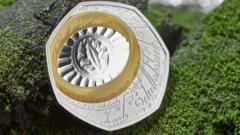
The minting presses are churning, the PR machines are roaring, and the mainstream media is falling over itself to celebrate the Royal Mint’s new Lord of the Rings 50p coin. They call it a "precious" tribute to the anniversary of Peter Jackson’s film trilogy. They talk about craftsmanship, nostalgia, and the enduring magic of Middle-earth.
They are selling you a fantasy, and not the good kind.
If you are buying this coin because you love Frodo Baggins and want a shiny piece of metal on your desk, fine. Spend your money. But if you are buying it because you think you are securing a piece of rare, appreciating numismatic history, you are being taken for a ride. The modern commemorative coin market is a manufactured bubble built on artificial scarcity and emotional exploitation.
I have watched the collector markets for over two decades. I have seen people sink thousands into "limited edition" pop-culture crossovers, only to realize years later that they bought a glorified token whose secondary market value resembles a stone dropped into the Mariana Trench.
Let's dismantle the lazy consensus surrounding this release and look at the cold, hard mechanics of coin collecting.
The Illusion of Scarcity in Modern Minting
The central argument for buying these anniversary coins always hinges on exclusivity. The marketing copy highlights the "limited minting run" and the "brilliant uncirculated" finish.
Here is the truth the Royal Mint will not put in their press release: True scarcity cannot be manufactured on demand.
When a mint decides to produce a commemorative coin for a massive global franchise like The Lord of the Rings, they are not making a rare artifact. They are creating a mass-market consumer product masquerading as a collectible.
- The Hoarding Problem: In the numismatic world, value is driven by historical survival rates. Old coins are valuable because people spent them, lost them, melted them down, or threw them away. Very few survived in pristine condition. With modern commemorative 50p coins, every single buyer puts the coin straight into a plastic capsule and hides it in a drawer. Thirty years from now, the market will be flooded with thousands of absolutely flawless, unblemished Middle-earth coins. When everyone has a perfect specimen, nobody’s specimen is special.
- The Mintage Cap Myth: Even when a mint sets a limit—say, 5,000 or 10,000 pieces for a specific silver proof edition—that number is often far too high to sustain long-term demand once the initial pop-culture hype dies down.
Pop-Culture Crossovers Are a Depreciating Asset
The intersection of fandom and numismatics is almost always a losing proposition for the investor.
Consider the trajectory of similar high-profile releases over the last decade. Look at the data for the deluge of Star Wars, Harry Potter, and Doctor Who coins minted across various Commonwealth nations.
The Commutative Coin Hype Cycle
| Phase | Market Behavior | Financial Reality |
|---|---|---|
| 1. The Launch | High emotional hype, rapid sell-outs of proof editions, artificial queues on mint websites. | Retail price paid at a massive premium over metal content. |
| 2. The Secondary Spike | Scalpers flip coins on eBay for 20% to 50% markups to desperate fans who missed out. | Peak artificial value. Driven entirely by FOMO (Fear Of Missing Out). |
| 3. The Cooling Period | The next movie, anniversary, or franchise coin is announced. Attention shifts. | Prices stabilize back down toward the original retail price. |
| 4. The Long-Term Bottom | Collectors look to liquidate. The pool of interested buyers has shrunk to a fraction of its original size. | Coins struggle to fetch retail value; often trade near their raw bullion weight value. |
The pattern is predictable. The premium you pay above the face value (50p) or the intrinsic metal value (for silver and gold proofs) is a "hype tax." You are paying for the intellectual property rights and the marketing campaign. Once the anniversary year passes, that premium evaporates.
Dismantling the "People Also Ask" Illusions
To understand how skewed the public perception is on this topic, we only need to look at the standard questions people ask when these coins drop. The premises of these questions are fundamentally flawed.
"Will this Lord of the Rings 50p enter general circulation?"
The short answer is no, and even if a few base-metal versions do, it changes nothing. The Royal Mint frequently releases these pop-culture coins as "Brilliant Uncirculated" (BU) collector editions available only via purchase.
If a coin does not circulate, it never enters the cultural bloodstream as true currency. It bypasses the entire romance of coin collecting. A coin that goes from a factory to a presentation box to your safe isn't a coin; it’s a medal with a denomination stamped on it to exploit a legal loophole.
"How much will a Lord of the Rings 50p be worth in ten years?"
Brutal honesty: likely less than you paid for it today, adjusted for inflation.
Unless you possess a hyper-specific error coin—such as a piece struck with the wrong die or a mismatched obverse and reverse—the value will track the general interest in the franchise's physical merchandise, not the coin market. If you want to bet on the long-term value of Tolkein memorabilia, you are vastly better off buying a first-edition printing of The Silmarillion or genuine production ephemera from the films. Numismatists do not want movie merchandise, and movie memorabilia collectors do not want to pay numismatic premiums. You are stranded between two entirely different markets, pleasing neither.
The True Cost of the "Proof" Premium
The trap gets deeper when you look at precious metal "proof" versions of these coins. The Royal Mint will happily sell you a silver or gold version of the 50p coin at a staggering markup over the spot price of the metal.
Imagine a scenario where you buy a silver proof 50p coin for £100. The coin contains roughly 8 grams of silver. At current market rates, 8 grams of silver is worth a fraction of that retail price.
The Precious Metal Reality Check: To break even on the intrinsic value of that coin, the global price of silver would need to multiply manifold.
You are betting entirely on the subjective, speculative value of the design and the brand. If the collecting community decides ten years from now that they no longer care about the 2026 Lord of the Rings anniversary set, your £100 investment collapses down to the raw bullion value of the silver.
How to Actually Collect for Value
If you want to build a coin collection that holds or increases its value, you must run away from the shiny objects manufactured yesterday.
- Buy the History, Not the Marketing: Look for coins that achieved rarity through genuine historical circumstances. Pre-decimal British coinage, sovereigns that survived global conflicts, or coins with documented circulation wear tell a story that a pristine, plastic-encased franchise tie-in never can.
- Focus on Intrinsic Bullion Value: If you want to invest in gold or silver through coins, buy unadorned, high-volume bullion coins like Britannia’s or Sovereigns. The premium over the spot price of the metal is minimal, meaning your money is directly tracking the value of the commodity, not the shifting tides of cinematic nostalgia.
- Acknowledge the Downside: If you absolutely must buy the Lord of the Rings coin, write the money off the moment you enter your credit card details. Treat it as entertainment spending, equivalent to a dinner out or a concert ticket. The moment you frame it as a financial asset, you have lost the game.
The Royal Mint knows exactly what it is doing. They are tapping into a deeply tribal, passionate fanbase that values Middle-earth above market logic. They are converting your love for a fictional world into corporate revenue, using the guise of "collectibility" to justify bloated margins.
Do not mistake a brilliant marketing campaign for a sound investment strategy. Sauron’s ring brought ruin to those who desired it; this 50p coin will do the same to your investment portfolio. Stop buying the hype.