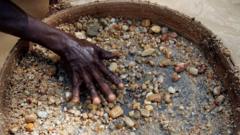
You have probably heard that the traditional diamond industry is dying. For the last few years, the story has been exactly the same: giant industrial microwaves are baking identical, flawless carbon crystals in a matter of days. Consumers get a rock that is chemically, physically, and visually identical to an earth-born gem, but they pay pennies on the dollar. By 2024, lab-grown options captured over half of the engagement ring market in the United States.
It looked like an absolute blowout. Natural diamond prices cratered from their 2022 peaks, mining towns faced devastating layoffs, and critics gleefully predicted the death of the old-school cartels.
But the narrative has quietly flipped. The tech-fueled party hit a wall, and the reality of the diamond market is far more complicated than "new tech beats old rock." If you are looking to buy a stone, invest in luxury, or just understand where the retail market is heading, the easy assumptions about synthetic dominance don't hold up anymore.
The Brutal Math of the Lab Grown Crash
Retailers loved lab-grown diamonds at first because they were cash cows. When tech startups began flooding the market with synthetic stones, wholesale prices dropped, but retailers kept consumer prices relatively high. Jewelers enjoyed gross margins of 80% to 90% on synthetic gems compared to a modest 20% to 40% on natural stones. They pushed lab-grown alternatives hard because it was wildly profitable for them, not just because shoppers demanded it.
Then production scaling did what it always does to manufactured goods. The market became utterly flooded.
Massive factory complexes in Henan, China, and across India started churning out millions of rough carats. Today, wholesale prices for synthetic diamonds have plummeted by up to 96% compared to a decade ago. Industry analyst Paul Zimnisky noted that a high-quality three-carat colorless lab diamond can fetch as little as $300 at wholesale. In some production hubs, factories manufacture rough synthetic stones for less than $10 a carat.
This historic deflation creates a massive headache for jewelry stores. Even with a high percentage margin, an 80% margin on a $500 lab diamond yields far less cash than a 30% margin on a $6,000 natural stone. Jewelers now have to sell multiple synthetic rings just to match the dollar revenue of a single natural diamond sale. Staff commissions are tanking, and retail stores are realizing that their race to the bottom is destroying their top-line revenue.
The Resale Illusion
The biggest shock for consumers has been the complete absence of secondary value. When you buy a natural diamond, it loses value the moment you leave the store—that is an open secret. You can usually recover 20% to 60% of the retail price on the secondary market depending on the stone.
With synthetic stones, that floor completely disappears.
Because the cost of making them drops every year, a synthetic diamond has essentially zero resale value. Pawn shops don't want them. Liquidators won't buy them. Feriel Zerouki, president of the World Diamond Council, pointed out that this rapid price collapse has severely damaged consumer confidence, especially among younger buyers. Nobody wants to buy a milestone luxury item only to see the exact same product selling on Amazon or Alibaba for the price of a pair of sneakers a few years later.
Instead of replacing natural diamonds, synthetic gems are separating into a completely different tier. They are becoming fashion accessories rather than heirloom jewelry.
The Untold Human and Environmental Cost
We have been told that synthetic stones are the clean, ethical alternative to traditional mining. The reality is messy.
Making a diamond requires mimicking the interior of the earth, which means running high-pressure, high-temperature (HPHT) presses or chemical vapor deposition (CVD) reactors around the clock. These machines consume enormous amounts of electricity—roughly 250 kilowatt-hours per rough carat. Because the vast majority of these factories operate in China and India, they run predominantly on coal-heavy power grids. Your "eco-friendly" stone might actually have a massive carbon footprint.
On the other side of the ledger, the decline of natural mining has caused severe economic pain in regions that depend on it. Countries like Botswana, Namibia, and South Africa rely on diamond revenues to fund public infrastructure, schools, and healthcare systems.
When western consumers completely switch to synthetic alternatives under the assumption that they are doing good, they often starve developing economies of their primary source of legitimate income. The trade-off isn't between clean tech and dirty mining; it is between factory emissions in industrial parks and the economic survival of entire nations.
How the Market Splits From Here
The diamond industry is undergoing a permanent bifurcation. Big traditional players like De Beers are abandoning the synthetic space entirely, shutting down their own lab-grown lines to double down on the exclusivity of natural stones. They are shifting their marketing away from generic "forever" slogans and focusing heavily on traceability and absolute rarity.
If you are trying to navigate this landscape as a buyer, look at the reality of what you are purchasing:
- Treat synthetic diamonds like high-end electronics. Buy them if you want maximum visual impact for minimum upfront cost, but assume the monetary value drops to zero immediately.
- Expect retailers to change their tune. You will see more jewelers physically separating their inventories or dropping synthetic options altogether to protect their brand equity and profit dollars.
- Verify the origin story. If you choose natural, look for stones backed by modern tracking protocols like the Luanda Accord or independent digital ledger verification to ensure your money actually supports mining communities rather than funding conflict.
The synthetic bubble didn't pop because the tech failed; it popped because the tech worked too well. When scarcity disappears, luxury goes with it. Traditional miners are still digging because they know that at the end of the day, you can't manufacture the billions of years of history that make a natural stone rare.