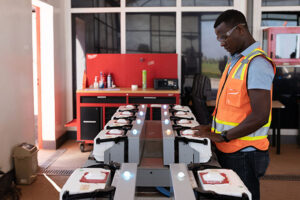
India’s current position in the global technology architecture is defined by a fundamental asymmetric capability: dominance in software engineering paired with near-total dependence on foreign physical infrastructure. The narrative that India can leapfrog directly into artificial intelligence (AI) dominance while bypassing hardware manufacturing ignores the physics of compute. Software cannot run without silicon, and silicon cannot be manufactured without massive capital expenditure, highly specific talent, and reliable supply chains. To secure strategic autonomy and capture the economic value of the AI stack, India must execute a dual-track strategy that builds domestic chip assembly and test capabilities while simultaneously optimizing its massive engineering talent for applied AI.
This transformation requires moving past the broad optimism of generic technology expansion and analyzing the precise bottlenecks across capital, infrastructure, and human resources.
The Three Pillars of the Semiconductor Stack
The semiconductor industry is not a monolith. It is divided into three distinct operational layers, each with its own capital intensity, talent requirements, and strategic entry barriers. India’s strategic entry points must be evaluated against these constraints.
+-----------------------------------------------------------------+
|                         Value Chain Layer                       |
+-----------------------------------------------------------------+
| 1. Design (High IP, Low Capex, High Talent Dependency)         |
| 2. ATMP/OSAT (Medium Capex, High Operational Precision)         |
| 3. Fabrication (Extreme Capex, Long Lead Times, High Risk)     |
+-----------------------------------------------------------------+
1. Chip Design and Intellectual Property
India already holds a significant footprint here. Nearly 20% of the world’s semiconductor design engineers work within the country, primarily inside global Global Capability Centers (GCCs). The primary challenge is structural ownership. While the engineering work happens in Bangalore or Hyderabad, the intellectual property (IP) and ultimate profit margins reside with parent corporations in the United States or Taiwan.
2. Assembly, Testing, Marking, and Packaging (ATMP)
ATMP, also known as Outsourced Semiconductor Assembly and Test (OSAT), represents the immediate tactical bridge for India. It requires significantly less capital than fabrication plants ($500 million to $1 billion compared to $10 billion to $20 billion) and has faster deployment timelines. Advanced packaging is increasingly becoming the bottleneck in AI chip manufacturing, as stacking multiple dies (like HBM memory next to a GPU) is required to beat physical scaling limits.
3. Fabrication (Fabs)
Fabrication is the most capital-intensive industrial process on earth. Building a leading-edge fab (sub-5nm) requires deep pockets, reliable water and power infrastructure, and a highly mature ecosystem of chemical and equipment suppliers (such as ASML, Tokyo Electron, and Lam Research). For India, aiming immediately for leading-edge logic fabrication is economically inefficient. The focus must start with legacy nodes (28nm to 90nm), which are critical for automotive, industrial IoT, and defense applications.
The Cost Function of Sovereign Fabrication
The economics of a semiconductor fabrication plant are brutal and unforgiving. The primary metric of success for a fab is utilization rate. A fab must run at 85% to 90% capacity 24 hours a day, 365 days a year, just to depreciate its equipment before it becomes obsolete.
The mathematical reality of setting up a domestic fab involves a complex cost function:
$$C_{total} = C_{capex} + C_{operational} + C_{input_risk}$$
Where:
- $C_{capex}$ is driven by the cost of lithography and cleanroom equipment.
- $C_{operational}$ is dictated by the continuous supply of specialized inputs.
- $C_{input_risk}$ represents the economic penalty of infrastructure failure.
The structural bottlenecks that increase $C_{input_risk}$ in India include:
- Power Continuity: A power flicker lasting fractions of a second can ruin an entire batch of silicon wafers, costing millions of dollars and wiping out weeks of production. Fabs require dedicated, redundant power grids backed by massive independent generation capabilities.
- Water Purity: A single fab can consume millions of gallons of ultra-pure water (UPW) daily. This water must be treated to a level where it is completely free of trace minerals and particulates. Securing this volume of water without depleting local municipal resources is a significant logistical hurdle.
- Supply Chain Proximity: Fabs require rapid access to ultra-pure specialty gases and chemicals. If a shipment is delayed at a port or stuck in transit due to domestic logistics bottlenecks, production stalls.
Because of these factors, India’s immediate focus on ATMP facilities is logically sound. ATMP operations have lower power and water sensitivities while allowing the domestic workforce to develop the rigorous operational disciplines required for high-yield cleanroom manufacturing.
The AI Stack Inversion: From Infrastructure to Sovereign Applications
While the hardware foundation is being built, India faces an immediate imperative in the software layer of the AI stack. The global AI market is currently dominated by foundational LLMs trained on massive web-scale English datasets. This creates a functional misalignment for the Indian economy.
The value in AI is shifting from foundational training to domain-specific inference. India’s strategic advantage lies in its vast, proprietary, closed-loop datasets across agriculture, public healthcare, digital payments (via the Unified Payments Interface, or UPI), and localized logistics.
The Compute Asymmetry
India cannot immediately compete with US hyperscalers on raw compute clusters for training trillion-parameter models. The capital concentration in Silicon Valley for raw GPU procurement creates an insurmountable short-term barrier. However, the economic returns on AI do not come from training models; they come from deploying them efficiently.
By focusing on small, highly optimized models (7B to 70B parameters) trained on specific domestic datasets, Indian enterprises can achieve comparable performance to global models at a fraction of the operational cost. This requires utilizing techniques like parameter-efficient fine-tuning (PEFT) and quantization, which reduce the hardware requirements for inference.
Localized Data Architectures
The Indian consumer base is multilingual, mobile-first, and highly diverse in literacy levels. Global models built primarily on Western data struggle with contextual understanding, regional dialects, and local nuances. Developing models trained on native data assets is a matter of economic utility. For instance, an AI voice assistant that accurately understands rural dialects can unlock banking, government services, and e-commerce for hundreds of millions of users who are currently excluded by text-based English interfaces.
Talent Redirection: Up-skilling the Services Engine
India possesses the largest pool of software developers globally, but the vast majority are employed in the traditional IT services paradigm—maintenance, application development, and cloud migrations. This talent pool must undergo a structural transformation to remain competitive in an AI-driven economy.
The traditional linear billing model of IT services (revenue linked directly to headcount) is collapsing due to AI-driven code automation. To adapt, the workforce must shift from basic programming to specialized engineering roles:
- Data Engineers: The unsung heroes of the AI pipeline. Models are only as good as the data fed into them. India needs professionals who can clean, structure, label, and pipeline massive distributed datasets safely and legally.
- AI Architecture and Infrastructure Specialists: Engineers who understand how to distribute workloads across clusters, optimize model inference, and manage the energy costs of running models at scale.
- Silicon Design Engineers: Bridging the gap between software and hardware. As domain-specific architectures (ASICs) replace general-purpose GPUs for specific workloads, engineers who understand both hardware description languages (like Verilog) and AI software frameworks (like PyTorch) will be in high demand.
This transition cannot rely solely on traditional university curricula, which often lag behind industry requirements by several years. It requires structural co-investment between private enterprises and public institutions to build hands-on labs and micro-credentialing programs focused on real-world deployment.
Structural Vulnerabilities and Strategy Limitations
Any realistic assessment of India’s technology roadmap must acknowledge its limitations. There are no fast or easy answers in the semiconductor and AI space.
- Subsidies vs. Long-Term Viability: The Indian government's Modified Programme for Development of Semiconductors and Display Manufacturing Ecosystem provides substantial financial incentives (up to 50% of project costs). While this is necessary to attract initial investments, subsidies cannot sustain an industry indefinitely. The facilities must become globally competitive on yield and cost structures before the subsidy windows close.
- Geopolitical Vulnerabilities: The semiconductor supply chain is highly fragmented and exposed to geopolitical friction. India relies on international partnerships for EDA (Electronic Design Automation) software, manufacturing equipment, and raw chemical inputs. Any disruption in global trade routes or diplomatic alignments directly impacts domestic timelines.
- The Brain Drain Dynamic: High-end design talent developed in India often migrates to traditional technology hubs in Silicon Valley or Europe due to wage differentials and ecosystem maturity. Retaining top-tier talent requires domestic firms to offer globally competitive compensation structures and intellectual ownership opportunities.
The Strategic Path Forward
To translate current momentum into a self-sustaining technological ecosystem, India must execute three specific moves over the next 24 to 36 months.
First, prioritize the build-out of OSAT and ATMP facilities over leading-edge fabrication. This creates an immediate manufacturing footprint, develops the local supply chain for cleanroom logistics, and generates revenue while the broader infrastructure matures. Focus fab investments specifically on mature nodes (28nm and above) that feed directly into the domestic automotive and industrial sectors, ensuring a built-in local market that reduces reliance on exports.
Second, establish a sovereign compute reserve. The government must treat compute access like a strategic commodity, similar to oil or grain reserves. By building centralized, publicly accessible GPU clusters dedicated to Indian startups, researchers, and academic institutions, the state can lower the capital barrier to entry for AI innovation and prevent monopolization by a few well-capitalized firms.
Third, mandate open data standards across public infrastructure projects. The value of India’s AI ecosystem lies in its data. By safely anonymizing and opening data pipelines from public transport, health networks, and agricultural markets, the country can give domestic developers the raw material needed to train highly accurate, localized models that global competitors cannot match.