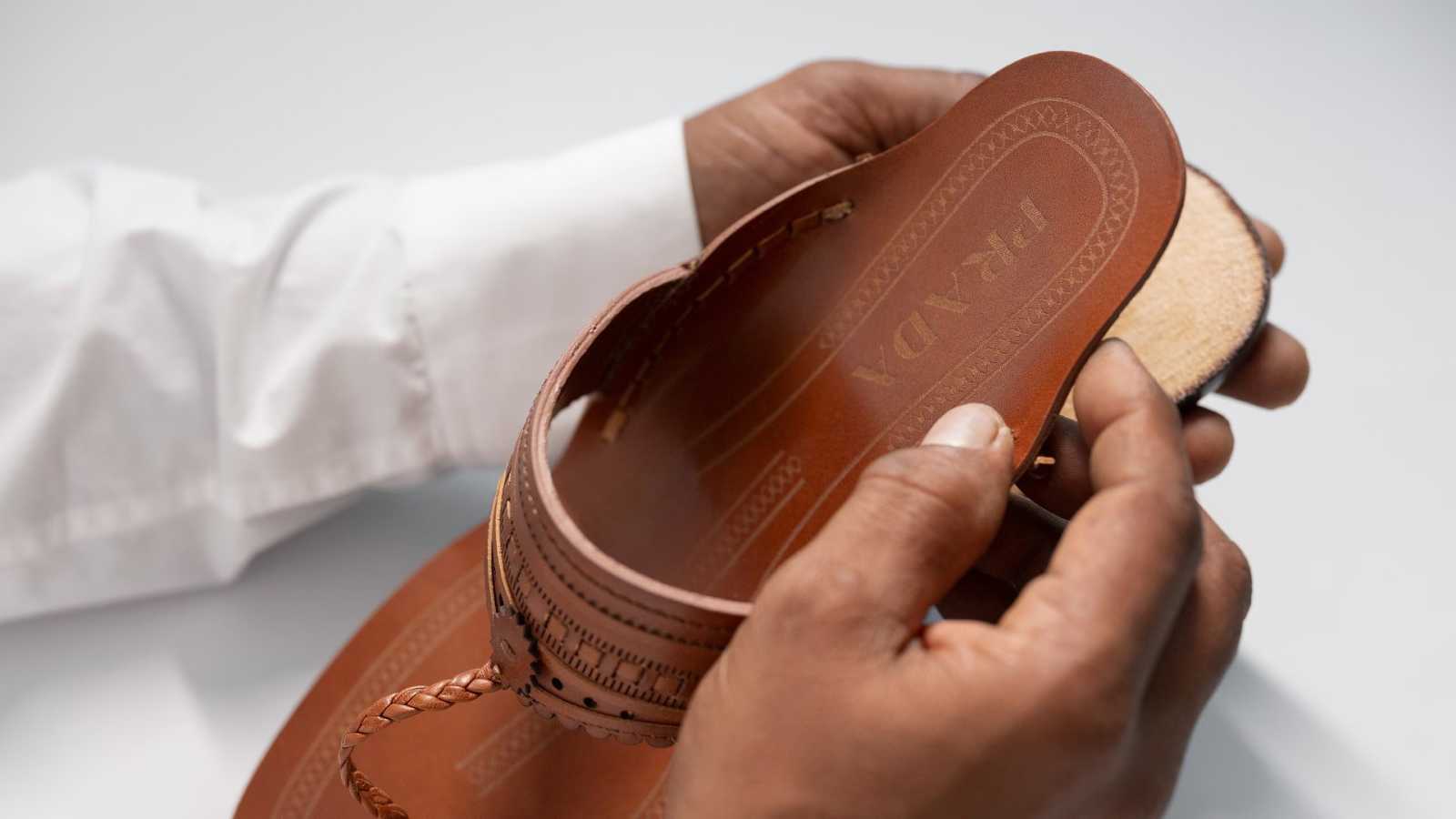
The valuation of a luxury product is rarely a reflection of its material utility; it is a calculation of brand equity, scarcity, and the successful appropriation of specialized craftsmanship. Prada’s release of leather sandals inspired by the Indian Kolhapuri—priced at approximately ₹83,000 ($1,000)—represents a strategic shift in the luxury sector’s approach to intellectual property and cultural credit. While previous iterations of high-fashion "homages" often bypassed direct attribution, this instance utilizes "artisanal credit" as a core marketing component to justify a price premium that exceeds the local market rate by a factor of 100.
The Value Disconnect: Margin vs. Labor
To understand the 10,000% markup from a standard Kolhapuri to a Prada-branded version, one must examine the Triad of Luxury Pricing. This framework decomposes the final retail price into three distinct layers:
- Direct Production Costs: This includes raw material sourcing (premium calf leather vs. local buffalo hide) and the cost of labor. Even when paying fair wages to Indian artisans, this segment remains a negligible fraction of the final price.
- The Brand Multiplier: The Prada logo functions as a financial instrument. It converts a functional item into a Veblen good, where demand increases as the price rises because the price itself signals status.
- The Validation Tax: This is the cost associated with the logistics, global marketing, and "editorializing" of a traditional design. Prada is not selling a sandal; they are selling their curation of that sandal.
The disparity between the ₹800 local price and the ₹83,000 retail price highlights a massive arbitrage opportunity. Prada leverages the lower cost of production in specialized clusters (like Maharashtra) while selling into a global market that operates on Euro-centric luxury valuations.
The Attribution Pivot: From Appropriation to Partnership Branding
Historically, luxury houses faced significant reputational risk through "cultural appropriation"—the act of taking traditional designs without acknowledgment. Prada’s decision to explicitly credit Indian artisans is a calculated risk-mitigation strategy. It moves the narrative from theft to patronage.
This shift serves two functional purposes:
- ESG Compliance: Institutional investors increasingly demand transparency in supply chains. By naming the source of the craftsmanship, Prada aligns itself with modern ethical standards, even if the profit distribution remains heavily skewed toward the brand owner.
- Authenticity as a Commodity: In a market saturated with synthetic, mass-produced goods, "hand-crafted by Indian artisans" becomes a technical specification. It provides a veneer of soul and history that a purely machine-made product lacks.
The mechanism at work here is Coded Credibility. The brand uses the artisan’s heritage to provide the product with a "pedigree," which is then used to justify the luxury price point to a consumer base that values "storytelling" alongside physical quality.
Structural Comparison: Traditional vs. Luxury-Modified Kolhapuris
A technical analysis of the design reveals where the luxury house modifies a traditional blueprint to meet global ergonomic and aesthetic expectations.
- Sole Construction: Traditional Kolhapuris use hard, vegetable-tanned leather that requires a "breaking-in" period. Prada replaces this with multi-layered, cushioned soles and rubber outsoles to ensure immediate comfort for a global consumer.
- Material Uniformity: Traditional artisans work with hides that have natural imperfections. Prada’s quality control mandates high-grade, uniform leathers, often sourced from European tanneries and sent to India for assembly, or vice versa.
- Fastening Systems: The traditional "toe-ring" and leather braid (the veni) are preserved for visual identity, but the structural integrity is often reinforced with modern adhesives and stitching techniques that local artisans typically do not use.
This creates a hybrid product: the visual syntax of India combined with the industrial grammar of Milan.
The Economic Bottleneck of Local Craftsmanship
The reason local Indian brands cannot easily command Prada-level pricing, despite producing the same design, is a failure of Market Infrastructure. There are three primary bottlenecks preventing local artisans from capturing higher value:
- Standardization Deficit: Global luxury buyers demand exact consistency across 10,000 units. Traditional artisanal clusters often produce high variance, which the global market penalizes.
- The Distribution Barrier: Prada maintains prime real estate in every major global city. The "rent" on this physical and digital visibility is baked into the ₹83,000 price tag.
- The Trust Gap: Consumers trust a centralized European entity to handle returns, quality guarantees, and repairs. Local artisans lack the institutional framework to offer this level of post-purchase security.
Intellectual Property and the Commons
The Kolhapuri sandal has a Geographical Indication (GI) tag in India, which is intended to protect the origin and quality of the product. However, GI tags are often weak tools against global luxury conglomerates. Because Prada is "inspired" by the design rather than claiming to sell an "Authentic Kolhapuri™" in a way that violates the specific legal constraints of the tag, they navigate a legal grey area.
They are essentially mining the "Cultural Commons"—a repository of human design that has existed for centuries—and refining it for a specific high-net-worth demographic. This creates a parasitic relationship where the luxury brand gains a "story," while the local industry remains trapped in a low-margin, high-volume production cycle.
The Luxury-Artisan Feedback Loop
While the immediate reaction to an ₹83,000 sandal is often one of outrage, the long-term impact on the craft cluster is more nuanced. This "Prada Effect" creates a high-altitude validation for the design.
- Price Anchoring: When a top-tier brand sets a price of ₹83,000, it makes a premium local brand selling for ₹8,000 seem like a bargain. This allows domestic premium brands to raise their ceilings.
- Skill Preservation: If Prada or similar houses invest in these clusters, they often introduce better tanning technologies and ergonomic standards that can trickle down to the local market.
However, the risk is Design Gentrification. As the design becomes associated with high-fashion runways, the original cultural context—a rugged, all-weather shoe for farmers and rural workers—is erased in favor of a "bohemian chic" aesthetic.
Strategic Optimization for Heritage Brands
For local industries or emerging Indian luxury houses to compete with this arbitrage, they must move beyond being "suppliers" to being "brand architects."
- Vertical Integration: Capturing the margin requires owning the tannery, the workshop, and the retail storefront.
- Aggressive Narrative Control: Instead of allowing Prada to define the "story" of the Kolhapuri, local entities must build a brand identity that emphasizes the specific history and technical superiority of their specific lineage of makers.
- Technical Modernization: Adopting the comfort-focused engineering of European brands (cushioning, sizing consistency) without sacrificing the hand-made aesthetic.
The Prada Kolhapuri is not a product; it is a case study in the power of branding to redefine the economic value of a commodity. The "credit" given to the artisans is a necessary evolution in a world where consumers demand ethical narratives, but it does not fundamentally alter the power dynamics of the global fashion economy. The profit remains with the entity that owns the platform, not the one that owns the craft.
Moving forward, the success of cultural products will depend on the ability of the source communities to build their own luxury frameworks, effectively closing the arbitrage gap by asserting control over both the physical production and the symbolic meaning of their heritage.