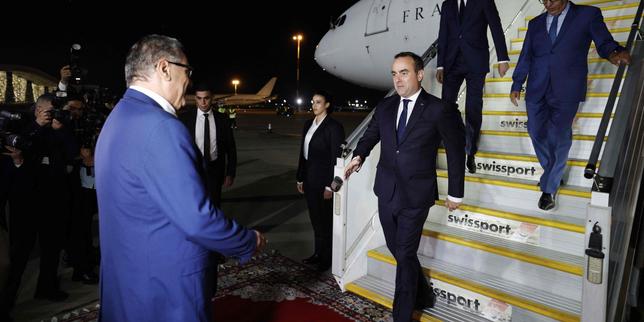
The diplomatic normalization between Paris and Rabat, culminating in France’s formal recognition of Moroccan sovereignty over the Western Sahara, has been widely characterized as a historic reset. However, analyzing this bilateral shift through a strictly transactional lens reveals a stark divergence between diplomatic rhetoric and macroeconomic reality. The realignment does not represent a structural expansion of economic and strategic ties. Instead, it serves as a costly restoration of the bilateral status quo.
To understand why this diplomatic warming fails to trigger a genuine scale-up in bilateral relations, one must dissect the structural bottlenecks, shifting trade dynamics, and competitive realities that define the modern Euro-Mediterranean corridor.
The Strategic Asymmetry of the Western Sahara Concession
The primary catalyst for the diplomatic thaw was the letter sent by French President Emmanuel Macron to King Mohammed VI, aligning Paris with Morocco's autonomy plan for the Western Sahara. While celebrated in Rabat as a decisive diplomatic victory, this move carries structural asymmetries that limit its capacity to generate new economic velocity.
For France, the concession represents a high-risk diplomatic expenditure with diminishing marginal returns. The immediate consequence was the predictable freezing of relations with Algiers, complicating French gas import strategies and security coordination in the Sahel. In return for this geopolitical cost, France did not secure exclusive economic privileges; rather, it merely regained access to the negotiating table.
From the Moroccan perspective, French alignment was not viewed as a favor to be rewarded with asymmetric economic concessions, but as a long-overdue correction. This divergent perception creates a structural friction:
- The French expectation: Diplomatic alignment should yield preferential treatment for French multinational corporations in major infrastructure, energy, and defense procurement.
- The Moroccan expectation: Diplomatic alignment is a baseline requirement for participation in the domestic market, meaning French firms must still compete on equal terms with Spanish, American, and Chinese rivals.
Because France treated its diplomatic shift as a premium asset while Morocco treated it as a entry-level prerequisite, the transaction could not produce a structural leap in cooperation. It merely removed a political veto, leaving the underlying economic competition unchanged.
The Competitive Erosion of French Market Share
The thesis that a diplomatic reset will automatically translate into a commercial renaissance ignores the secular decline of French economic dominance in Morocco over the past two decades.
In 2012, France was displaced by Spain as Morocco's primary trading partner. This was not a temporary fluctuation but the result of a structural shift in supply chain geography and cost competitiveness. Spanish logistics networks, operating across the narrow Strait of Gibraltar, offer shorter transit times and lower overheads for just-in-time manufacturing systems, particularly in the automotive and textile sectors.
[French Share of Moroccan Imports: Historical Trend]
2000: ~24%
2010: ~15%
2020: ~11%
2025: ~10.5%
This contraction is not driven by political animosity; it is driven by structural diversification. Morocco has deliberately pursued a policy of partner diversification to reduce systemic dependency on any single European state. The entry of new global actors has permanently altered the competitive environment:
The Rise of Chinese Industrial Capital
Chinese state-owned enterprises have integrated themselves into Morocco's industrial strategy, particularly in the development of the Tanger-Med industrial basin and the Mohammed VI Tangier Tech City. Chinese firms are heavily invested in the battery supply chain for electric vehicles, a sector where French capital has been slow to mobilize at scale.
The German and British Energy Push
While French energy giants like Engie and EDF possess deep historical footprints in Morocco, they face fierce competition from German engineering firms and British developers in the renewable energy sector. Morocco’s ambition to become a premier green hydrogen exporter has attracted international consortia that operate independently of traditional French-Moroccan financial networks.
Consequently, any incremental market share gained by French firms through recent bilateral agreements does not represent an expansion of the total market pie. It represents a highly contested effort to defend remaining positions against highly competitive global alternatives.
Three Structural Bottlenecks Inhibiting Scalability
To understand why the bilateral relationship cannot easily change scale, we must examine the physical and regulatory bottlenecks that govern economic integration between the two nations.
1. The Capital Allocation Bottleneck in Green Hydrogen and Renewables
Morocco’s national strategy is heavily oriented toward the export of green electrons and green hydrogen to Europe. While French developers are eager to secure concessions, the financial architecture of these projects is constrained by European Union regulatory frameworks.
The EU’s Renewable Energy Directive (RED III) and the Carbon Border Adjustment Mechanism (CBAM) impose strict additionality and temporal correlation rules on hydrogen production. French firms attempting to develop export-oriented green hydrogen projects in southern Morocco face a complex regulatory maze. The capital expenditures required for these gigawatt-scale projects are immense, and French state-backed utilities are constrained by high domestic debt loads and competing domestic nuclear commitments. This limits their ability to deploy the highly subsidized, low-cost capital that Gulf-state sovereign wealth funds can bring to the table.
2. The Industrial Integration Ceiling in Automotive and Aerospace
The automotive sector (anchored by Renault in Tangier and Stellantis in Kenitra) and the aerospace sector in Casablanca represent the crown jewels of Moroccan industrialization. Both sectors were built with significant French participation. However, these value chains have reached a point of structural maturity where further integration yields diminishing returns.
To move up the value chain, Morocco is prioritizing local integration—shifting from simple assembly to high-value component manufacturing, such as engine blocks, advanced electronics, and composite aerospace structures. French tier-one suppliers are often hesitant to transfer these proprietary technologies or relocate high-value R&D centers from Europe, fearing the hollow-out of their domestic industrial bases. This creates a protectionist ceiling: Morocco wants technology transfer, while French industrial policy under the banner of "economic sovereignty" increasingly disincentivizes offshoring high-value manufacturing assets.
3. The Mobility and Knowledge-Transfer Deficit
The most severe bottleneck is the legacy of the 2021–2022 visa crisis. The French decision to slash visa issuance rates for Moroccan nationals by fifty percent caused profound damage to the bilateral business ecosystem.
[The Visa Friction Loop]
Visa Restrictions
  └── Reduced mobility for Moroccan executives, engineers, and academics
        └── Interruption of collaborative projects and joint ventures
              └── Realignment of corporate procurement toward non-French partners
                    └── Permanent shift in institutional and professional networks
Although visa issuance rates have normalized, the structural friction remains. The Moroccan intellectual and business elite, historically predisposed to French academic institutions and corporate partnerships, has increasingly diversified its intellectual capital. Moroccan students and professionals are pivoting toward English-speaking academic jurisdictions and corporate environments in North America, the United Kingdom, and Germany. A relationship cannot scale when its foundational human capital network is undergoing a generational diversification away from the metropole.
The Geopolitical Zero-Sum Game in North Africa
The limits of the French-Moroccan realignment are also defined by the geopolitics of the Maghreb. France’s foreign policy apparatus has historically attempted a delicate balancing act between Rabat and Algiers. This dual-track diplomacy was designed to protect French security interests in the Sahel and secure energy imports from Algeria while maintaining deep economic and cultural ties with Morocco.
The recognition of Morocco's autonomy plan over the Western Sahara shattered this equilibrium. By making a structural choice in favor of Rabat, Paris has severely degraded its diplomatic leverage in Algiers. This has immediate operational consequences:
- Security in the Sahel: The complete breakdown of security cooperation with Mali, Burkina Faso, and Niger has left France highly dependent on intelligence sharing. The loss of Algerian cooperation in monitoring Sahelian border regions creates a strategic blind spot that Morocco, despite its sophisticated security apparatus, cannot fully compensate for due to geographical disconnects.
- Energy Diversification: As Europe seeks to reduce its reliance on Russian hydrocarbons, Algeria’s gas pipelines to southern Europe (Medgaz and Transmed) remain critical infrastructure. France's diplomatic isolation from Algiers limits its influence over future trans-Mediterranean energy corridors.
Thus, the "gains" achieved in Rabat are directly offset by "losses" in Algiers. From a macro-regional perspective, France has not expanded its strategic footprint; it has merely redistributed its diplomatic capital in a zero-sum game.
A Strategic Framework for Real Value Creation
If the current diplomatic thaw is to transcend mere political theater and achieve a genuine change of scale, both nations must abandon historical sentimentality and execute a strategy based on complementary industrial development. This requires moving beyond the traditional buyer-seller or donor-recipient models toward a highly integrated co-development framework.
Shared Co-Development of West African Infrastructure
Rather than competing for influence in West Africa, French engineering capacity and capital market access should be paired with Morocco’s deep banking, telecommunications, and logistics footprint in the CFA franc zone. This would involve co-financing infrastructure projects—such as port expansions and regional transport corridors—where Moroccan firms execute the ground operations and French firms provide advanced technological integration and structured finance.
Establishing a Synchronized Green Energy Corridor
Rather than viewing Morocco simply as a source of cheap green electricity, France must support the integration of the Moroccan and European electricity grids through high-voltage direct current (HVDC) subsea cables. This requires France to actively advocate within the European Network of Transmission System Operators (ENTSO-E) for the physical integration of the Moroccan grid, transforming Morocco from an external supplier into an active participant in European energy security.
Industrial Co-Location in Deep-Tech and Defense
Instead of simple assembly lines, French defense and aerospace firms must establish joint R&D laboratories and manufacturing facilities in Morocco. This co-location strategy would allow French firms to lower their production costs for highly contested export markets while fulfilling Morocco's demand for technological transfer and industrial autonomy.
Strategic Forecast
The bilateral relationship will remain highly stable, characterized by smooth diplomatic protocols and steady, linear trade volumes. However, a major structural scale-up will not occur.
Morocco will continue its relentless pursuit of multi-polar alliances, using its strategic position at the intersection of Africa, Europe, and the Atlantic to play global powers against one another. Spain will consolidate its position as Morocco’s primary commercial conduit into Europe, while Chinese and American capital will dominate the high-growth sectors of electric mobility and security infrastructure, respectively. France will remain a respected historical partner, but its days of holding a structural monopoly over the Moroccan economy are permanently over. The diplomatic realignment of 2024 was not the beginning of a new era of French-Moroccan integration; it was the formal acknowledgment of a more competitive, multi-polar reality.