The acoustic tiles of an office building absorb sound. Concrete tanks, filled with millions of gallons of chemically treated water, do the opposite. They bounce it back. For a creature that perceives the world almost entirely through sonar—a mind that maps its reality by reading the echoes of its own voice—a concrete tank is a hall of mirrors reflecting a scream.
For decades, the Niagara Falls tourism strip was defined by a specific sensory clash. On one side, the thundering majesty of the natural world. On the other, just down the road at Marineland, the high-pitched whistles of captive cetaceans, cutting through the smell of popcorn and chlorine.
But parks close. Crowds thin. The neon signs fade. What remains when the music stops is a profound, echoing silence, interrupted only by the heavy, mechanical breathing of animals trapped in a limbo they cannot comprehend.
The Canadian government recently greenlit a massive, logistical rescue operation to relocate the remaining marine mammals from the shuttered Marineland facility to new sanctuaries and facilities in the United States and Spain. It sounds like a victory. On paper, it is a triumph of modern conservation policy and bureaucratic cooperation.
But paper doesn't capture the weight of a moving mammal. It doesn't capture the fragile emotional networks of creatures that mourn, communicate in distinct dialects, and bond with a intensity that rivals our own. Moving them isn't a matter of shipping cargo. It is an evacuation of refugees from a world we built and then abandoned.
The Weight of the Echo
To understand the stakes of this relocation, one has to understand what captivity does to a brain built for the open ocean.
In the wild, a killer whale or a beluga swims up to a hundred miles a day. They dive into the ink-black depths of the sea, navigating by a complex, communal web of sound. When you place that same animal in a stadium pool, its world shrinks to a bathtub.
Imagine spending forty years in a room where every wall reflects your own voice back at you with a slight, distorted delay.
Dr. Naomi Rose, a leading marine mammal scientist who has spent decades studying these animals, has often pointed out that the stress of this confinement manifests physically. Dorsal fins collapse. Teeth are worn down to the gums from pacing and chewing on underwater metal gates out of sheer, agonizing boredom. The immune systems of these apex predators compromise, leaving them vulnerable to infections that a wild whale would easily shake off.
Over the years, Marineland became a flashpoint for this reality. Investigations, public protests, and changing legislation slowly turned the park from a family destination into a cultural relic. Canada passed historic laws banning the breeding and captivity of whales and dolphins, signaling a massive societal shift. We decided, collectively, that the show should not go on.
But declaring an end to an era is the easy part. The hard part is dealing with the living, breathing legacy left behind in the water.
The Diplomacy of the Deep
You cannot simply open a gate and let a captive whale swim into the Atlantic. They lack the hunting skills required to survive. Their social structures are fractured. Many have been conditioned to rely entirely on human caretakers for food. A direct release is often a death sentence.
The solution is a complex, international game of musical chairs, requiring the approval of federal agencies, environmental ministries, and international transport authorities. Canada’s Department of Fisheries and Oceans faced a daunting puzzle: where do you send creatures that belong nowhere?
The destination list reveals the scale of the operation. Some animals are bound for specialized ocean sanctuaries in the United States, places where they can experience the natural rhythms of the sea within a protected boundary. Others are headed to advanced care facilities in Spain, where the climate and veterinary infrastructure can support their highly specific medical needs.
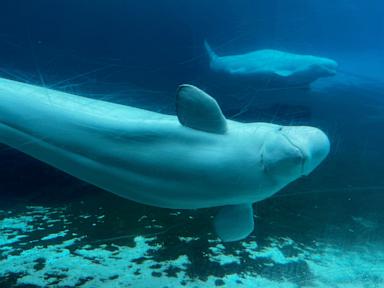
Consider the logistics of moving a single beluga whale.
It requires a custom-built sling, lined with thick padding to protect its delicate skin. A crane must hoist the multi-ton animal out of its familiar tank, suspending it in mid-air while teams of veterinarians monitor its heart rate and respiration. From there, it is transferred to a temperature-controlled transport container, filled with just enough water to keep the animal buoyant but not enough to cause sloshing during a long-haul flight.
The animal is then driven to an airfield, loaded onto a cargo plane, and flown across continents. Throughout the entire journey, humans must stand over the container, constantly applying ointment to the whale’s skin to prevent it from drying out, speaking to it in low, soothing tones.
It is a terrifying, disorienting experience for the animal. Every vibration of the aircraft engine, every shift in air pressure, every unfamiliar scent is a potential trigger for lethal shock. The humans involved aren't just logistics managers; they are life-support systems, holding their breath along with the passenger in the cargo hold.
The Human Cost of Care
Behind the political announcements and the celebratory press releases from animal welfare groups lies a quiet, exhausting human reality.
Think of the trainers and caretakers who stayed behind at Marineland long after the public stopped buying tickets. These aren't the corporate executives or the faceless entities that owned the park. These are individuals who spent their twenties and thirties working early morning shifts in the freezing Canadian winter, chopping frozen fish, and monitoring water chemistry.
For many of these keepers, the relationship with the animals is deeply complicated. They know the arguments against captivity. They see the physical toll it takes. Yet, they also know that they are the only source of comfort, stimulation, and consistency these animals have ever known.
When a keeper walks up to the edge of a tank, a beluga doesn't just see a source of food. It sees a familiar face in an otherwise sterile universe. They have shared histories. They recognize individual voices.
As these animals are crated up and shipped across the globe, the people who cared for them are left behind with empty tanks and a strange, hollow grief. They have successfully helped their charges escape, but the cost of that escape is the permanent severing of a profound bond. The park becomes a ghost town of concrete and rusted pipes, a monument to a collective mistake that took half a century to correct.
The Sanctuaries of Tomorrow
The push toward ocean sanctuaries represents a middle ground between the cruelty of the concrete tank and the impossibility of total freedom.
In a seaside sanctuary, a whale can feel the natural currents of the ocean. They can chase live fish, feel the rain on their skin, and interact with the sandy bottom of a bay. They are still managed by humans, still fed and medicated, but the horizon is no longer a blue-painted wall.
The transition is a slow, psychological rehabilitation.
When first introduced to a larger, natural environment, many captive whales are hesitant to explore. They have been trained to swim in circles. For days, or even weeks, they may stick to the perimeter of their new enclosure, terrified of the vast emptiness ahead of them. They have to relearn how to be whales.
The move to facilities in Spain and the US is a compromise born of necessity. True ocean sanctuaries are incredibly expensive to build and maintain, and there are currently far more captive whales in the world than there are sanctuary spaces available. Every spot gained is a hard-fought victory, but the line of animals waiting for a better life remains long.
An Ending, Unrehearsed
We are witnessing the slow, agonizing sunset of an industry built on the premise that nature exists for our casual amusement. The empty tanks at Marineland are not a failure of business; they are a victory of empathy.
But as the cargo planes lift off from Canadian soil, carrying their massive, mammalian cargo toward sunnier skies and larger waters, there is no room for triumphant celebration. The damage has already been done. Generations of whales lived and died in the service of a weekend distraction.
The true success of this relocation will not be measured by the signatures on the federal permits or the efficiency of the transport cranes. It will be measured in the quiet moments a year from now, when a beluga whale, swimming in a bay or a massive European habitat, stops swimming in circles.
It will look down into the depths, find a stretch of water it has never seen before, and send out a single, long whistle. And this time, the world will not shout it back.