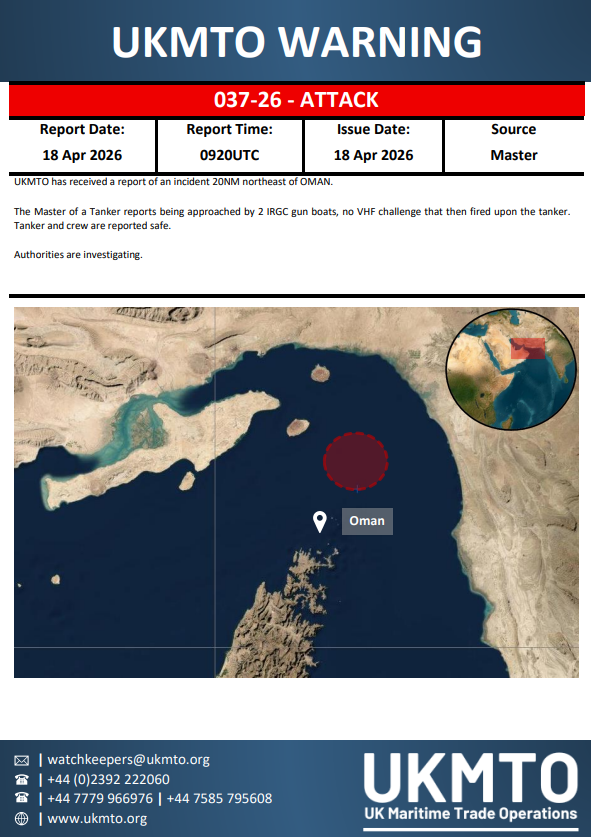
The maritime industry is currently witnessing a calculated erosion of global trade security. A container ship has once again been struck by a projectile in the Bab el-Mandeb strait, marking the second such incident in a forty-eight-hour window. While initial reports lean on the convenience of the word "unknown" to describe the ordnance, the reality in the water suggests a sophisticated, asymmetrical campaign designed to paralyze specific shipping lanes. This is not a series of random accidents or the work of amateur pirates. It is a targeted demonstration of how easily a few million dollars in drone technology can hold hundreds of billions in global commerce hostage.
The projectile strike hit the vessel’s port side, causing a fire that the crew eventually suppressed. No casualties occurred, but the psychological and economic damage is already vibrating through the insurance markets. When a strait that handles nearly 10% of global seaborne oil and even more of its containerized consumer goods becomes a shooting gallery, the "just-in-time" supply chain begins to fracture.
The Myth of the Unknown Projectile
Labeling these strikes as "unknown" serves a political purpose, but it ignores the forensic reality of modern regional warfare. Since late 2023, the proliferation of Iranian-designed loitering munitions and anti-ship cruise missiles has rewritten the risk profile for every shipping company operating between the Red Sea and the Gulf of Aden.
These aren't traditional missiles that require a massive radar signature and a destroyer-class launch platform. We are seeing the deployment of low-cost, GPS-guided drones that fly low and slow to evade standard commercial radar. The "unknown" factor usually refers to the specific point of origin or the exact model of the drone, but the architecture of the attack remains consistent. They target the superstructure or the engine room, aiming to disable rather than sink. A sunken ship creates an ecological disaster that might trigger a massive international military escalation; a disabled ship creates a lingering, expensive nightmare that drives up freight rates and war-risk premiums for everyone else.
The shift in tactics is clear. The goal is no longer hijacking for ransom, which was the hallmark of Somali piracy a decade ago. This is kinetic disruption.
The Geometry of a Chokepoint
To understand why this specific strait is so vulnerable, one must look at the math of the passage. The Bab el-Mandeb is only 18 miles wide at its narrowest point. When you factor in the designated shipping lanes required for massive ultra-large container vessels (ULCVs), the maneuverable space shrinks further.
A ship traveling at 20 knots is a sitting duck for a drone that costs less than a luxury SUV.
Why Conventional Defense is Struggling
Standard naval escorts are designed to fight other navies. Using a $2 million interceptor missile to take down a $20,000 drone is an unsustainable defensive strategy. It is an "attrition of the wallet." Furthermore, the sheer volume of traffic makes a 1:1 escort ratio impossible.
- Vessel Identification: Attackers use open-source Intelligence (OSINT), including AIS (Automatic Identification System) data, to pick targets based on their ownership, destination, or perceived political affiliation.
- Saturation Tactics: By launching multiple low-cost projectiles, attackers can overwhelm the automated point-defense systems of modern warships.
- The Proximity Problem: Launch sites are often mobile, hidden in civilian coastal areas, making preemptive strikes politically sensitive and operationally difficult.
The Economic Shrapnel
The immediate impact of a projectile strike is measured in hull damage and salvage costs. The secondary impact is far more corrosive. Within hours of the latest report, major carriers began rerouting vessels around the Cape of Good Hope.
This is not a minor detour. Taking the long way around Africa adds roughly 3,500 nautical miles and 10 to 14 days to the journey. For a standard container ship, that means an extra $1 million in fuel costs alone. When you multiply that across an entire fleet, the numbers become staggering.
Insurance and the War Risk Premium
Insurance underwriters are not in the business of losing money. Following the second incident, war risk premiums for the Red Sea transit have surged. In some cases, these premiums now account for nearly 1% of the total value of the ship's hull. For a vessel valued at $100 million, that is $1 million per transit just for the "privilege" of sailing through a combat zone.
This cost is never absorbed by the shipping lines. It is passed down the line, eventually landing on the price tags of electronics in London, car parts in New York, and grain in Cairo. We are seeing a "security tax" being levied on the global consumer by non-state actors with a handful of drones.
The Technological Counter-Shift
If the threat is asymmetrical, the defense must be as well. The industry is currently scrambling to implement new layers of protection that don't rely on a multi-billion dollar naval presence.
Electronic warfare (EW) suites are being tested on commercial hulls to jam the GPS and radio frequencies used by loitering munitions. There is also a renewed focus on "hardening" the superstructure—the part of the ship where the crew lives and the bridge is located. Some companies are even exploring the use of high-energy lasers, which offer a much lower "cost per shot" compared to traditional missiles, though the power requirements for a commercial ship remain a significant hurdle.
However, technology cannot solve a geographical reality. As long as ships must pass through a narrow corridor flanked by unstable or hostile territories, they will remain vulnerable.
The Real Objective Behind the Chaos
It is a mistake to view these incidents through the narrow lens of regional conflict. The broader objective is the de-globalization of trade. By making traditional routes unreliable and expensive, the actors behind these strikes are forcing a shift in how the world moves goods.
We are entering an era where the safety of the seas can no longer be taken for granted. For thirty years, the global economy operated under the assumption that the "high seas" were a neutral, safe commons. That era ended the moment the first "unknown projectile" hit a commercial hull in the Bab el-Mandeb.
The shipping industry is now facing a choice: pay the escalating tax of war-risk premiums and fuel surcharges, or invest in a permanent, privatized security infrastructure that mirrors the convoys of the mid-20th century. Neither option is cheap. Both signify the end of the low-cost, high-speed logistics model that built the modern world.
The Logistics of the Long Way Around
Rerouting around Africa isn't just a fuel issue; it’s a capacity crisis. When a ship takes two extra weeks to complete a circuit, it isn't available to start its next scheduled voyage. This effectively reduces the global fleet's carrying capacity by 10% to 15% without a single ship being lost.
Ports in the Mediterranean, which usually receive ships via the Suez Canal, are already seeing "vessel bunching." This occurs when multiple ships, delayed by the detour, arrive at once, overwhelming the port's ability to unload. The result is a backlog that can take months to clear.
The Erosion of International Law
The most dangerous aspect of these "unknown" strikes is the precedent they set. International maritime law, specifically the United Nations Convention on the Law of the Sea (UNCLOS), is based on the "innocent passage" of commercial vessels. When non-state actors can ignore these laws with impunity, the very foundation of global trade begins to crumble.
If a projectile can hit a ship today with no clear consequence, what stops a sea mine tomorrow? Or a coordinated swarm of underwater drones targeting the rudder and propulsion systems?
The silence from major global powers on a cohesive, aggressive solution to these chokepoint threats is telling. It suggests a lack of appetite for a sustained maritime conflict, a fact that the attackers are exploiting with surgical precision. They know exactly how much pressure to apply to cause pain without triggering a full-scale invasion.
Hard Realities for the C-Suite
Logistics directors and CEOs can no longer treat "geopolitical risk" as a footnote in their annual reports. It is now a primary operational cost.
- Diversification of Routes: Dependence on the Suez/Red Sea corridor is being re-evaluated in favor of more expensive but stable land-bridge options or increased usage of the Panama Canal, despite its own drought-related issues.
- Strategic Stockpiling: The "just-in-time" model is being replaced by "just-in-case." Companies are holding more inventory closer to their end markets to buffer against a sudden closure of a major strait.
- Security Investment: Direct investment in on-board defense systems and private maritime security teams is no longer optional for high-value cargoes.
The projectile that hit that ship in the Bab el-Mandeb didn't just pierce a steel hull. It pierced the illusion of a frictionless global economy. The "unknown" factor isn't the weapon used, but rather how much more of this disruption the global market can take before the current system of maritime trade undergoes a violent, permanent transformation.
The era of cheap, safe, and fast shipping is over. Prepare for the era of the guarded, the expensive, and the slow.