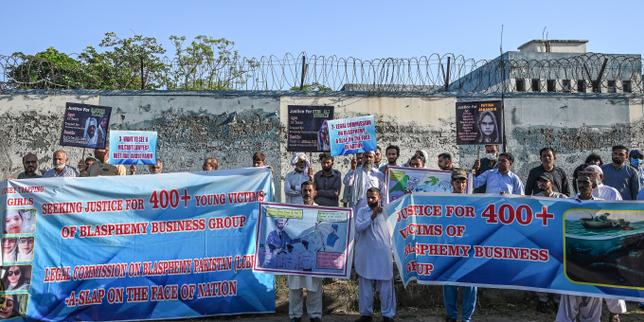
Online blasphemy accusations in Pakistan have transformed from spontaneous communal flare-ups into a highly organized, digital extortion industry. Criminal syndicates now systematically weaponize social media platforms to fabricate blasphemy charges against innocent citizens, exploiting the state's draconian laws and the constant threat of mob violence to extract money. This is a highly profitable criminal enterprise where the state acts as the unwitting enforcer and vigilante mobs serve as the executioners. For victims, a single photoshopped screenshot represents an immediate death sentence or a lifetime in a maximum-security prison isolation cell.
The terror is absolute. It begins with a random message on a secure chat application, showing a fabricated post that carries the victim's name and photograph.
The Architecture of a Digital Trap
The mechanics of these operations reveal a sophisticated understanding of both local laws and digital vulnerabilities. Organized blackmail rings do not select their targets at random. They identify individuals with middle-class incomes, small business owners, or members of vulnerable religious minorities who have something to lose and lack the political connections to protect themselves.
A typical campaign begins with the creation of cloned social media profiles. Using publicly available photos and personal details harvested from Facebook, Instagram, or LinkedIn, the extortionists build a digital duplicate of the target. They then post highly offensive, sacrilegious content from this fake account. Before the victim even realizes the profile exists, the criminals take high-resolution screenshots and screen recordings to serve as permanent "evidence."
Then comes the ultimatum. The victim receives a message demanding an immediate payment, often through untraceable cryptocurrency wallets or localized mobile money applications registered under stolen identities. If the victim refuses to pay, the blackmailers threaten to blast the screenshots across public WhatsApp groups, tag hardline religious organizations, and file a formal complaint with the Federal Investigation Agency.
The financial demands are calibrated to squeeze the victim to their absolute limit. They ask for sums that require selling family land, liquidating businesses, or draining life savings. If the victim pays, the extortion rarely stops. The criminals simply mark the target as a reliable source of income and return months later with higher demands. If the victim cannot or will not pay, the machinery of the state is deliberately triggered to destroy them.
The Legislative Weaponization of Cyber Laws
To understand why this digital extortion is so effective, one must look at the legal framework meant to police the internet. The Prevention of Electronic Crimes Act, passed in 2016, was sold to the public as a tool to combat online harassment, financial fraud, and terrorism. Instead, it has become the primary mechanism through which digital executioners operate.
Under Section 11 of this cybercrime law, which deals with hate speech, and its intersection with the Pakistan Penal Code's notorious blasphemy laws, the Federal Investigation Agency is legally obligated to investigate claims of online sacrilege. Section 295-C of the Penal Code mandates the death penalty for insulting the Prophet Muhammad. Because the law contains no meaningful provisions to punish false accusers, filing a complaint carries zero risk for the criminal syndicates.
Once an official complaint is lodged, the bureaucracy moves with terrifying speed. The cybercrime wing faces immense pressure from extremist political factions to show efficiency in handling these cases. Investigators regularly arrest targets based entirely on digital screenshots, without conducting the basic digital forensics required to verify IP addresses, device signatures, or account creation histories.
The legal system offers no safety net. Lower-court judges are routinely intimidated by crowds of extremists who pack the courtrooms during hearings. To grant bail or acquit an accused individual is to invite a personal death sentence for the judge. Consequently, cases are passed up the judicial ladder, leaving the accused to rot in solitary confinement for years while awaiting an appeal at the High Court or Supreme Court level.
Silicon Valley Complicity and the Language Deficit
The growth of this extortion industry thrives on the systemic neglect of major tech corporations. Social media giants have spent over a decade aggressively expanding their user bases across South Asia without investing in the localized moderation infrastructure necessary to keep those users safe.
The core of the problem lies in the linguistic and cultural incompetence of automated moderation algorithms. The vast majority of the content used to incite violence or orchestrate these scams is written in Urdu, Pashto, or regional dialects, often utilizing Romanized scripts. Silicon Valley's automated safety tools routinely fail to flag these coordinates of danger.
Human moderation teams are equally ill-equipped. Content reviewers based in distant regional hubs lack the contextual awareness to distinguish between a genuine profile and a malicious clone designed for blackmail. By the time a victim reports a fake account, the damaging posts have already been screenshotted, downloaded, and distributed through closed peer-to-peer networks like WhatsApp.
Once a blasphemy accusation enters the ecosystem of closed chat applications, it becomes impossible to contain. WhatsApp groups functioning as local news networks or religious notice boards amplify the unverified screenshots to thousands of users within minutes. The platforms provide the scale and speed necessary to assemble a lynch mob before the victim can even log out of their accounts.
The Commercialization of Absolute Terror
What was once a tool for personal vendettas or land disputes has become a fully commercialized criminal subculture. On dark web forums and encrypted Telegram channels, actors trade toolkits specifically designed to bypass social media security measures and generate flawless, deepfaked digital evidence.
These syndicates operate like corporate entities. They employ specialized roles: hunters who identify profitable targets, digital designers who forge the evidence, and money mules who manage the complex web of accounts used to launder the extortion payouts. Some groups even offer "blasphemy-as-a-service," taking fees from third parties to ruin a competitor's business or settle a family grudge by manufacturing an online trail of sacrilege.
The terror is not confined to the digital space. The physical consequences are immediate and absolute. When an accusation goes public, the social fabric surrounding the victim disintegrates instantly.
Families face an impossible choice. To stand by an accused relative is to invite the destruction of the entire household. Neighbors turn away, landlords evict families overnight, and employers terminate contracts immediately to protect their own premises from mob fury. The accused are abandoned by the very people who know them best, forced into hiding or delivered directly into police custody just to escape being lynched on the street.
The Impossibility of Institutional Defense
Defending against these digital operations is nearly impossible within the current institutional framework. Human rights lawyers who take on these cases face immense personal peril. Many have been assassinated in their offices or gunned down on their way to court, rendering legal representation a rare and extraordinarily expensive shield.
Civil society organizations attempting to track these digital syndicates operate under constant surveillance and threat of closure. The state apparatus remains trapped in a cycle of appeasement, terrified that reforming the laws or aggressively prosecuting false accusers will trigger nationwide civil unrest led by radical religious parties. This institutional paralysis ensures that the digital blackmail cartels can continue to operate with near-total impunity.
The standard advice given by digital rights experts—using strong passwords, enabling two-factor authentication, and keeping profiles private—is entirely useless against this specific threat vector. A criminal does not need to hack your account if they can simply clone your public image and manufacture a parallel digital identity that looks identical to the untrained eye of a local policeman or an angry mob leader. The burden of proof has been completely inverted; the accused must prove a negative in an environment where digital forgery is flawless and institutional panic overrides the rule of law.
The state's failure to address the systemic flaws in its cybercrime investigative processes has effectively deputized the internet as an extrajudicial execution chamber. Every day that the Federal Investigation Agency continues to accept unverified digital screenshots as primary evidence for capital offenses, it validates the business model of the extortion syndicates. The digital cartels understand this perfectly, and they will continue to refine their methods, scale their operations, and collect their profits from the terror of citizens who know that survival requires absolute silence and a willingness to pay whatever price the blackmailers demand.



