The ambitious India-Middle East-Europe Economic Corridor (IMEC) is currently stalled by a fundamental geopolitical contradiction. While the project was sold as a modern-day Spice Route that would bypass the volatility of the Suez Canal, it now finds itself paralyzed by the very regional instability it sought to transcend. The conflict in Gaza and the subsequent escalation across the "Axis of Resistance" have not just delayed construction; they have fractured the diplomatic consensus required to bridge the gap between Haifa and the Gulf.
New Delhi’s dream of a 40% faster trade route to Europe is being recalculated in real-time. This isn’t just about shipping containers. It is about a high-stakes attempt to redraw the map of global trade to counter China’s Belt and Road Initiative. However, you cannot build a railway through a war zone, and you cannot secure a corridor when the terminal points are under fire.
The Geography of Risk
The IMEC concept relies on a multi-modal journey. Goods would travel by sea from Mumbai to ports in the United Arab Emirates, then by rail through Saudi Arabia and Jordan, reaching the Mediterranean at the Port of Haifa in Israel. From there, they would ship to Greece and into the heart of Europe. On paper, it is a masterpiece of efficiency. In practice, it requires a level of regional cooperation that hasn't existed in decades.
The Red Sea crisis has already demonstrated how fragile maritime logistics can be. As Houthi rebels continue to target commercial shipping, the insurance premiums for any vessel entering these waters have skyrocketed. This volatility makes the land-bridge component of IMEC look more attractive in theory, but the land-bridge depends entirely on the normalization of ties between Israel and its Arab neighbors—specifically Saudi Arabia. That normalization is currently on life support.
The Haifa Bottleneck
Israel's Port of Haifa is the linchpin of the entire operation. Owned by India’s Adani Group, the port was intended to be the gateway for Indian goods into the European market. When Adani purchased the port for $1.2 billion, the move was seen as a masterstroke of economic diplomacy. Today, it looks like an exposed nerve.
If Haifa cannot operate at full capacity due to security threats or if Arab states feel politically unable to funnel their trade through an Israeli port, the entire IMEC value proposition collapses. The "missing link" isn't just the physical tracks through the Saudi desert; it is the political will to treat Israel as a permanent, integrated economic partner.
Why Suez Still Wins
For all its flaws, the Suez Canal exists. It is a proven, singular maritime route. IMEC requires the constant loading and unloading of cargo—from ship to train, then train back to ship. Every "touch" of a container adds cost and time. Logisticians call this friction. To justify this friction, the corridor must offer absolute reliability and significant speed.
Currently, the Middle East offers neither.
The regional escalation has forced India to double down on the International North-South Transport Corridor (INSTC), which runs through Iran and Russia. It is a messy, politically sensitive alternative, but it highlights a cold truth for New Delhi: diversification is a necessity, not a luxury. Relying on the Middle East to be a stable transit hub for the next fifty years is a gamble that currently looks poorly hedged.
The Chinese Shadow
Beijing isn't watching the IMEC delays with indifference. The Belt and Road Initiative (BRI) has already spent a decade sinking roots into the same geography. While India and the U.S. pitch IMEC as a transparent, high-standard alternative, China has the advantage of being "all-in" on existing infrastructure.
China has invested heavily in UAE ports and has a functional, albeit complex, relationship with both Tehran and Riyadh. While the U.S. seeks to use IMEC to pull Saudi Arabia closer to the Western orbit, China is content to let the region’s internal conflicts bleed Western projects dry. The longer the IMEC remains a series of PowerPoint slides and Memorandums of Understanding, the more entrenched Chinese logistics become.
Financing the Void
Who actually pays for the thousands of kilometers of rail through the desert? The initial announcements were light on specific financial commitments. While the U.S. is the primary diplomatic driver, it is not the primary financier. That burden falls on the sovereign wealth funds of the Gulf and private Indian capital.
Private capital is notoriously allergic to uncertainty. If a CFO in Mumbai has to choose between a proven maritime route that is currently dangerous and an unbuilt rail route that relies on a peace treaty that may never happen, they will stick to the water and pay the higher insurance. The "infrastructure gap" is actually a "trust gap."
The Jordan Dilemma
Jordan is often the forgotten piece of the IMEC puzzle. It is a nation that has maintained a cold peace with Israel for decades, but its domestic population is fiercely opposed to further integration. For the IMEC rail to reach the sea, it must pass through Jordan.
The monarchy in Amman is walking a tightrope. It needs the economic revitalization that a major trade corridor would bring, but it cannot afford the internal political blowback of becoming a permanent conduit for Israeli-bound trade during a period of intense regional conflict. If Jordan wobbles, the corridor stops at the Saudi border.
Recalibrating the Indian Strategy
India’s Ministry of External Affairs is playing a long game. They argue that the fundamentals of IMEC remain sound because the global economy needs an alternative to the Malacca Strait and the Suez Canal. They aren't wrong. The problem is timing.
India is currently pushing for "early harvest" projects—smaller sections of the corridor that can be completed and utilized while the larger geopolitical issues are negotiated. This includes expanding port capacity in Gujarat and deepening ties with Mediterranean partners like Greece. By the time the dust settles in the Levant, New Delhi wants the bookends of the corridor to be ready.
The Greece Connection
Prime Minister Narendra Modi’s recent outreach to Athens is a direct result of the IMEC strategy. If Haifa is the gateway, Greece is the lobby. India is looking at the Port of Piraeus and other Greek maritime hubs as the primary landing points for Indian goods. This creates a strategic pincer move: India controls the starting point in the Arabian Sea and maintains a heavy influence at the Mediterranean terminus.
However, even this requires the middle section to function. Without the Saudi-Jordanian rail link, the Greece-India connection is just another long sea route around the Cape of Good Hope or through the Suez.
The Hydrogen Factor
IMEC was never just about shipping containers. A significant part of the proposal involves pipelines for green hydrogen and undersea cables for data. The Middle East has the sun and the space to produce massive amounts of green energy; Europe has the demand.
This energy component is actually more resilient than the physical shipping of goods. You can secure a pipeline more easily than a railway line, and the economic incentives for Europe to de-risk its energy supply are massive. If IMEC succeeds, it might be as an energy and digital corridor first, and a trade route second.
The Brutal Bottom Line
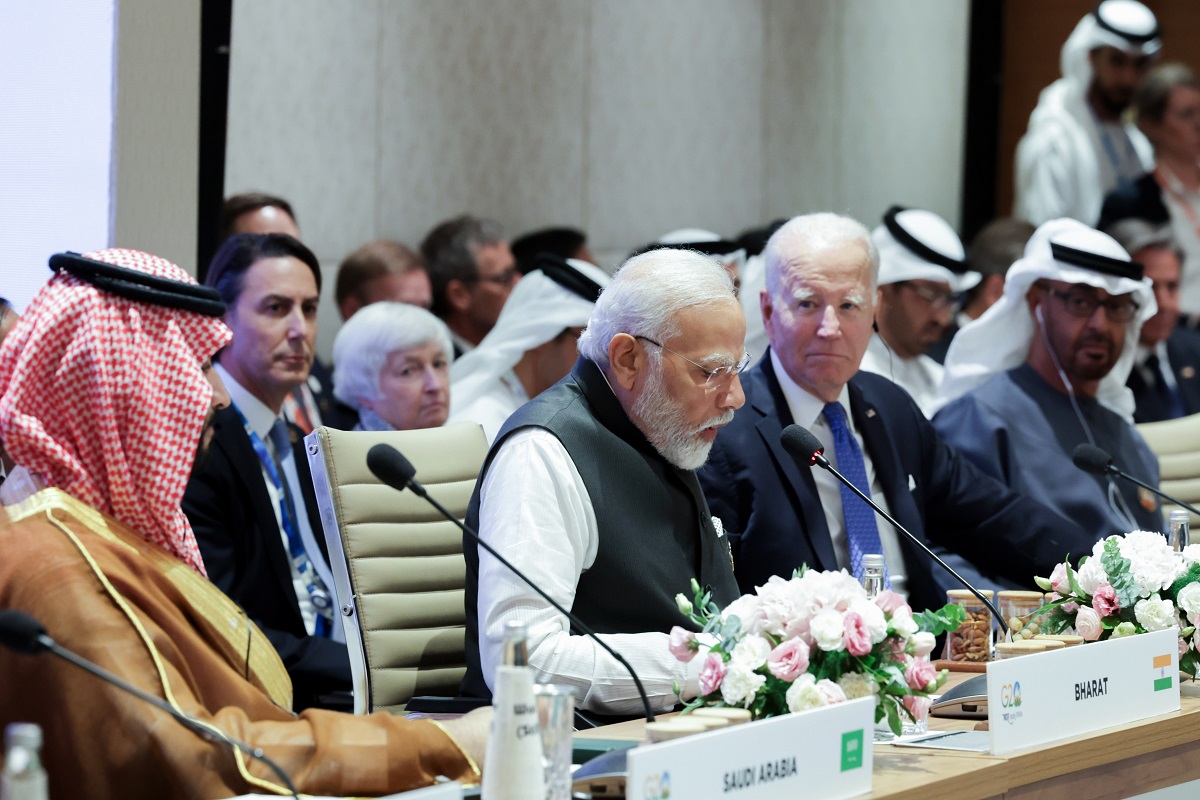
The war in the Middle East has stripped away the techno-optimism that surrounded the IMEC launch at the G20. It has exposed the project for what it is: a high-risk geopolitical gamble.
For India, the corridor is a ticket to the "Great Power" table. It represents a shift from being a regional player to a global architect of trade. But architects must deal with the ground as it is, not as they wish it to be. The ground in the Middle East is currently shifting, and not in favor of stability.
The project isn't dead, but it is in a state of suspended animation. The "why" remains compelling—shorter times, lower costs, and strategic autonomy from China. The "how" is where the project is bleeding. Until there is a regional settlement that includes a clear path for Palestinian statehood or a definitive security guarantee that Riyadh can sell to its public, the rail tracks will remain unlaid.
New Delhi must now decide if it will wait for the Middle East to stabilize or if it will pivot its massive infrastructure energy toward the sea, reinforcing its naval presence and maritime partnerships while the land-bridge remains a mirage. The cost of waiting is high; the cost of building a corridor to nowhere is higher.
Ask any shipping logistics head at a major firm in Mundra if they are ready to book space on the "IMEC Express" for 2027. They will likely laugh. They are currently more worried about Houthi drones and the price of bunker fuel. The gap between the diplomatic vision of the corridor and the operational reality on the water has never been wider.
Would you like me to analyze the specific port capacities of the UAE and India to see where the current physical bottlenecks lie?