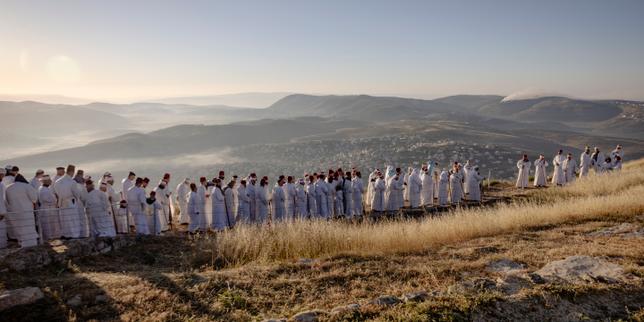
On a windswept ridge overlooking the flashpoint city of Nablus, a tiny community of roughly 900 people is attempting the most fragile balancing act in the modern Middle East. The Samaritans, an ancient ethno-religious group claiming direct descent from the Israelite tribes, live split between the village of Kiryat Luza on Mount Gerizim in the West Bank and the Israeli city of Holon. They hold unique status. They are the only people possessing Israeli IDs, Palestinian passports, and Jordanian citizenship simultaneously. Yet, as the Israeli-Palestinian conflict intensifies around them, this engineered neutrality is facing an unprecedented existential strain that threatens their survival.
Maintaining this dual identity is not a spiritual preference. It is a strict survival mechanism.
For decades, the Samaritans have functioned as a human bridge. They speak Arabic as their mother tongue, study in Palestinian universities, and conduct business in Nablus. Simultaneously, they speak Hebrew, receive Israeli social security, and send their children to Israeli schools. They do not serve in the military of either side. In a region where identity is absolute and weaponized, refusing to choose a side is a dangerous posture.
The Economics of Survival
Neutrality requires economic independence, but the geography of the West Bank makes total isolation impossible. The Samaritans of Mount Gerizim rely heavily on the economic health of Nablus, a major commercial hub in the northern West Bank. When violence escalates, checkpoints close. The economy stalls.
The community's financial stability rests on a delicate matrix of civil service employment, local retail, and international cultural funding. Because they hold Palestinian identity cards, several Samaritans serve in the Palestinian Authority’s civil service, including high-ranking bureaucratic roles. This integrates them into the Palestinian governance structure. On the flip side, their Israeli documentation allows them access to the Israeli labor market, providing a financial safety net that their Palestinian neighbors lack.
This economic duality creates friction. To Palestinians in Nablus, the Samaritans enjoy privileges denied to the general population, such as freedom of movement through military checkpoints. To Israeli authorities, they are an anomaly—Arab-speaking locals who require security integration but refuse national service. The money flowing into Kiryat Luza from both Israeli state budgets and Palestinian trade keeps the village afloat, but it binds them to the fortunes of two warring entities.
The Genetic Bottleneck
While geopolitical pressures squeeze the community from the outside, an internal crisis threatens them from within. The Samaritan population is one of the smallest distinct demographic groups in the world. For centuries, strict religious laws forbade marriage outside the faith. The result was predictable. Severe genetic mutations, high rates of infant mortality, and physical disabilities plagued the community due to generations of consanguineous marriage.
By the late 20th century, the situation was untenable. The community was dying out.
The leadership made a radical pragmatic shift. They permitted Samaritan men to marry women from outside the community, primarily from Ukraine and other Eastern European nations, on the condition that the brides convert to the Samaritan faith. This influx of new genetic material saved the population from demographic collapse. Today, walking through Kiryat Luza, it is common to hear Ukrainian spoken alongside Arabic and ancient Hebrew.
This demographic band-aid introduced new cultural complexities. The foreign brides must adapt to an incredibly conservative lifestyle. The Samaritans observe Biblical laws with literal rigidity. During the Sabbath, they use no electricity, no phones, and do not cook. During menstruation, women are isolated within the home for seven days according to Levitical law. The integration of outside women has succeeded in diversifying the gene pool, but it has strained the internal social fabric of a community trying to remain frozen in time.
The Geopolitical Squeeze
The geography of Mount Gerizim is an explicit map of the pressures the Samaritans face. The village of Kiryat Luza sits directly below an Israeli settlement, Har Bracha, and directly above the sprawling Palestinian city of Nablus. When clashes erupt below, the sounds of gunfire and tear gas echo up the mountainside.
The current escalation following recent regional conflicts has eroded the gray zones that the Samaritans inhabit.
Historically, the Samaritans maintained excellent relations with the Palestinian leadership. Yasser Arafat allocated a seat for a Samaritan representative in the Palestinian Legislative Council during the 1990s. This gesture was meant to demonstrate that the Palestinian struggle was national, not religious. But that older generation of secular Palestinian leadership is fading. The rise of younger, localized armed factions in Nablus, such as the Lions' Den, has shifted the dynamic. These groups do not share the historical memory of institutional cooperation with the Samaritans. They see the Israeli license plates on the cars driving up to Mount Gerizim and view them with suspicion.
Concurrently, the political shift within Israel toward nationalist extremism complicates the relationship. Right-wing settlers in nearby outposts do not view the Samaritans as cousins or ancient Israelites. They see an Arabic-speaking population that refuses to declare allegiance to the state of Israel. The military protection provided to Mount Gerizim is strategic for the Israel Defense Forces, not ideological.
The Myth of Total Isolation
It is a mistake to view Kiryat Luza as a utopian sanctuary detached from reality. The youth of the community are increasingly exposed to the outside world through the internet and smartphones. They see the sharp polarization of the region and find it harder to maintain the detached, neutral stance of their elders.
Some young Samaritans are drawn closer to Israeli society, attracted by the economic opportunities in Tel Aviv and central Israel. Others feel a deeper connection to their Palestinian neighbors, sharing the daily frustrations of living under military occupation and movement restrictions. The older generation, led by the High Priest, works constantly to suppress these political leanings. They know that if the youth begin taking political sides, the collective safety of the entire community disappears.
The strategy of dual loyalty works only as long as both sides accept the ambiguity. In the current political climate, ambiguity is viewed as treason.
The Relocation Trap
The division of the community between Mount Gerizim and Holon creates a permanent internal migration pressure. Holon offers a modern, urban Israeli lifestyle. Life there is secularized, connected to a developed economy, and free from the immediate physical dangers of the West Bank. For many young Samaritans, the choice between the tense, restrictive environment of Mount Gerizim and the freedom of Holon is simple.
Yet, if the population shifts entirely to Israel, the Samaritans lose their historic anchor.
Mount Gerizim is not just a village; it is the center of their universe. Unlike Jews, who look to Jerusalem, Samaritans believe Mount Gerizim is the original holy site chosen by God. Their annual Passover sacrifice, where the entire community gathers to slaughter sheep according to ancient rites, must take place on the mountain. To abandon the West Bank would mean abandoning their sacred geography. It would turn a living, ancient culture into an urban minority group inside Israel, vulnerable to complete assimilation within a few generations.
The Samaritans are trapped between a geographic reality that threatens their physical safety and a cultural necessity that prevents them from leaving. They continue to navigate the checkpoints, renew their multiple passports, and greet both Israeli soldiers and Palestinian merchants with the same practiced, neutral courtesy. It is a performance requiring absolute discipline, played out daily on a stage that is rapidly burning.


_Biopsy.png?branch=uat_release_3)
