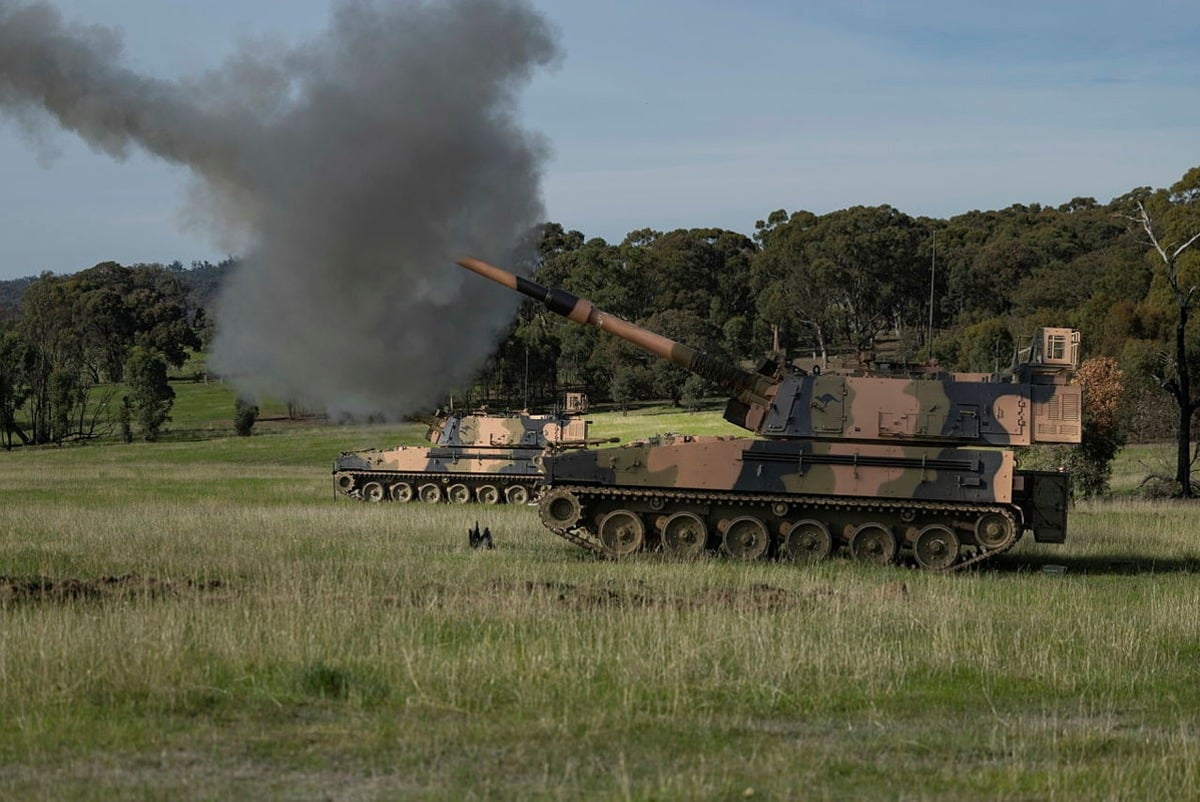
Australia has officially entered the era of modern self-propelled artillery, but the celebration surrounding its new hardware masks a deeper crisis in strategic procurement.
Army gunners from the Townsville-based 4th Regiment, Royal Australian Artillery, recently concluded the inaugural live-fire training course for the locally built AS9 Huntsman 155mm self-propelled howitzer. Operating at the School of Artillery in Puckapunyal, Victoria, crews successfully transitioned from the assembly line to live-fire operations in a matter of months. This milestone marks the first time in decades that advanced tracked artillery has been produced and fired on Australian soil, providing the army with a heavily armored, mobile platform capable of firing and relocating before enemy counter-battery fire can zero in.
Yet, behind the optimistic press releases from the Department of Defence lies a troubling reality. The program took 17 years of bureaucratic hesitation, cancellations, and political pivots to deliver a meager fleet of 30 howitzers and 15 AS10 ammunition resupply vehicles. In a high-intensity regional conflict, an entire fleet of 30 guns could be depleted in weeks. While the technology itself works flawlessly, the structural and strategic framework underpinning its procurement exposes a defense strategy caught between the desire for domestic industrial prestige and the harsh realities of modern warfare supply chains.
The Mirage of Homegrown Manufacturing
The term "Australian-made" is being heavily utilized by Canberra officials to describe the AS9 Huntsman, but the phrasing is industrially misleading. The Huntsman is an adapted variant of South Korea’s Hanwha K9 Thunder, a highly successful and globally proven platform.
The vehicles are being assembled at the newly established Hanwha Armoured Vehicle Centre of Excellence in Geelong, Victoria. While building a massive assembly plant in Geelong creates local jobs, the complex internal components—the barrel metallurgy, the advanced fire control software, and the engine transmission systems—rely heavily on intellectual property and supply nodes anchored in Seoul.
True sovereign manufacturing requires an independent supply chain capable of surviving a global maritime blockade. If a major conflict disrupts shipping lanes in the Indo-Pacific, the Geelong facility cannot simply forge its own 155mm/52-calibre chrome-plated barrels from scratch. Australia is essentially assembling high-tech Lego sets designed and manufactured abroad. This model mimics past Australian procurement efforts, such as the assembly of the Boxer armored vehicles or the now-retired Tiger helicopters. It maximizes political capital and union employment in key electoral districts, but it does not achieve true strategic self-reliance.
The Lethality Leap vs. the Inventory Deficit
To understand why the army is desperate for the AS9, one must look at the aging inventory it is designed to supplement. For years, Australia relied on the M777 towed howitzer, a lightweight titanium gun that performed exceptionally well in the permissive environments of Afghanistan and Iraq.
In a modern contested environment saturated with loitering munitions, thermal imaging drones, and rapid counter-battery radar, a towed gun is a death sentence for its crew. The manual setup, anchoring, and firing process of an M777 takes minutes. Minutes mean destruction.
| Capability Metric | M777 Towed Howitzer | AS9 Huntsman SPH |
|---|---|---|
| Mobility Platform | Towed (Requires Truck) | Tracked Armored Vehicle |
| Crew Protection | None (Exposed in open) | High-grade Armoured Hull |
| Setup to Fire Time | Several Minutes (Manual) | Under 60 Seconds (Automated) |
| Shoot-and-Scoot Capability | Low | Exceptionally High |
| Total Australian Procurement | 54 active units | 30 units ordered |
The AS9 allows gunners to receive targeting data, automatically lay the gun via computerized systems, fire a burst of 155mm shells, and drive away before the first round even impacts the target. Gunner Maxwell Cleal, a veteran of towed artillery systems who participated in the Puckapunyal trials, noted that the automation removes the grueling physical labor of manual emplacement. A crewman simply enters the data and presses a button.
But the mathematics of the acquisition do not add up. The LAND 8116 program delivers just 30 howitzers. In Ukraine, the Russian military and Ukrainian forces exhaust dozens of artillery pieces monthly due to wear, barrel degradation, and drone strikes. Australia’s acquisition of 30 units is an artisanal boutique order for a continental defense force. It is an army configured for display and limited training interventions, not the brutal attrition of a peer-to-peer war.
A Decoupled Strategic Vision
The revival of the self-propelled howitzer program in 2019 was a direct reaction to land warfare lessons emerging from regional skirmishes. However, since the signing of the initial $890 million contract with Hanwha, Australia’s broader strategic posture has shifted radically under the Defence Strategic Review.
Canberra’s official defense doctrine now prioritizes long-range missile strike capabilities, anti-ship deterrence, and maritime denial, shifting funding toward HIMARS rocket artillery and the AUKUS nuclear-powered submarine enterprise. This pivot leaves the heavy tracked armor units of the army in a doctrinal gray area.
The 3rd Brigade in Townsville is transforming into a focused armored formation, but it must now figure out how to integrate a tiny fleet of 30 heavy howitzers into a national strategy that is fundamentally obsessed with maritime choke points thousands of kilometers away from the Australian mainland. Transporting heavy, tracked, 47-tonne armored vehicles across the Indo-Pacific archipelago requires specialized strategic sealift ships—a capability that Australia currently lacks in sufficient numbers.
The Logistics of the Underbelly
An artillery piece is only as lethal as its supply line. The AS9 is supported by the AS10 armoured ammunition resupply vehicle, a tracked platform designed to transfer heavy shells automatically under armor protection.
This tandem operation keeps the howitzer fed without exposing the crew to shrapnel. However, the domestic production of actual 155mm artillery shells remains a critical vulnerability. Australia has made strides to boost domestic munitions production, but the raw chemical inputs, propellants, and specialized fuses are still subject to international supply vulnerabilities.
Possessing the most advanced automated gun in the southern hemisphere matters very little if the national stockpile can only sustain maximum-rate firing for a few consecutive days of combat. The Puckapunyal live-fire exercise proved that the technical integration between the Australian Army, the Capability Acquisition and Sustainment Group, and Hanwha is functioning efficiently. The soldiers can operate the machinery, the digital networks can relay targeting data, and the guns hit their marks with thunderous precision.
But true military capability cannot be measured solely by successful test firings in the controlled environment of a Victorian training range. It is measured by mass, industrial depth, and the logistical stamina to endure a protracted crisis. Australia has bought a world-class weapon system, but it has yet to build the sovereign industrial engine required to sustain it when the real shooting starts.