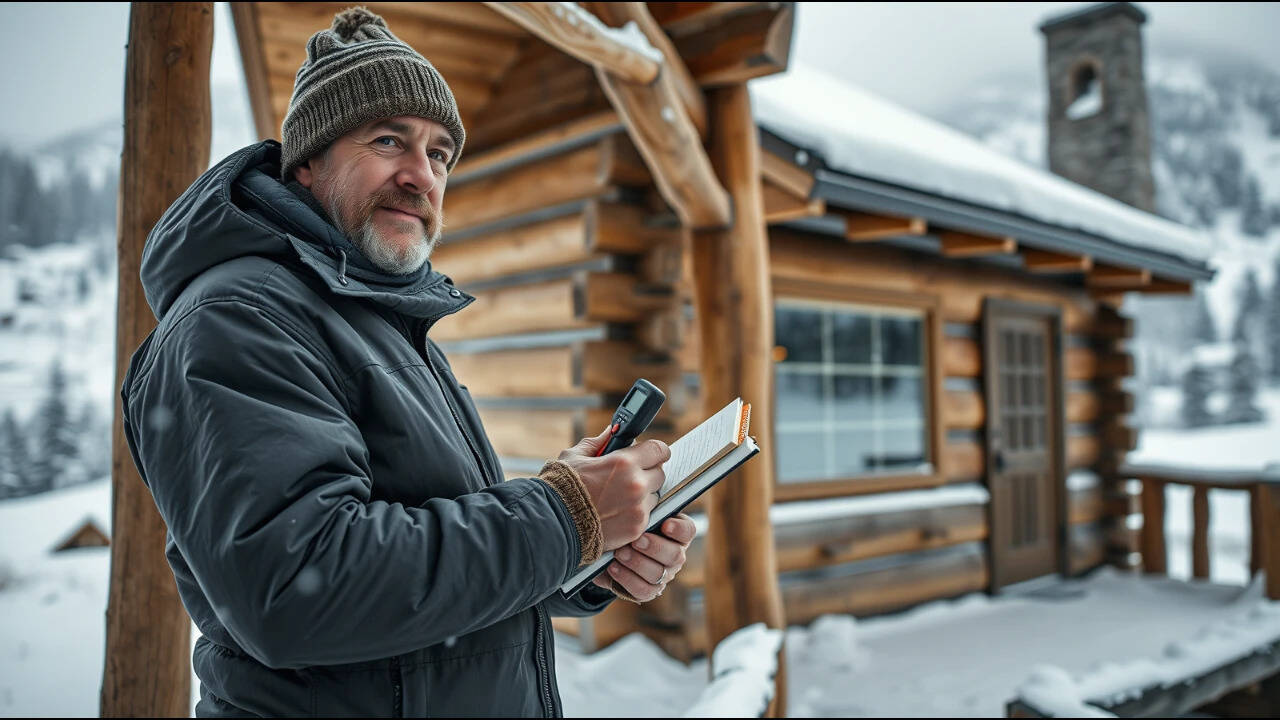
For over half a century, a solitary man living at 9,600 feet in an abandoned Colorado mining town did what automated weather networks and multi-million-dollar satellite systems could not manage on their own: he paid attention. Billy Barr spent 52 consecutive winters in Gothic, Colorado, stepping out of his off-grid cabin every single day to thrust a ruler into the snow, measure its depth, weigh its water content, and log the data. What started in 1974 as an eccentric personal hobby to cure winter isolation has transformed into one of the most reliable ground-truth climate datasets in the American West. Yet the true story is not merely a romanticized tale of mountain hermits and pristine wilderness. It is an uncomfortable institutional vulnerability. Modern climate science, for all its computational horsepower and remote-sensing satellite arrays, remains dangerously dependent on individual idiosyncrasy and manual persistence.
The Fragility of Baseline Data
We tend to view climate tracking as a sleek, high-tech enterprise. We picture supercomputers running global circulation models, or orbital lasers bouncing off mountain ranges to estimate snowpack volume. The reality on the ground is far more precarious. Automated weather stations fail with frustrating regularity. Batteries freeze, solar panels choke under heavy rime ice, and telemetry links drop out when storms lash the high passes.
When instruments go dark in remote subalpine zones, data streams flatline. Fixing those remote stations requires expensive helicopter maintenance or grueling ski-in expeditions that agencies budget for only under duress.
Enter the manual observer. Because Barr stayed put through decades of blizzards, mud seasons, and shifting economic tides, his records possess zero gaps. He did not miss a day because of a government shutdown, a funding shortfall, or a broken circuit board.
+-------------------------------------------------------------------------+
|                  THE DATA INTEGRITY GAP                                 |
|                                                                         |
|  Satellite Remote Sensing  ---> Requires Ground Calibration (Barr Data)   |
|  Automated Stations        ---> Prone to Freezing, Power Loss, & Drift  |
|  Manual Daily Logs         ---> Uninterrupted Continuity (52 Years)     |
+-------------------------------------------------------------------------+
This unbroken chain of observations provides something quantitative models crave above all else: a consistent baseline. When ecologist Ian Breckheimer and other researchers at the nearby Rocky Mountain Biological Laboratory evaluate satellite-derived snow metrics, they use Barr's daily tallies to anchor their algorithms to reality. Satellites can map broad swaths of white across the continental divide, but they struggle to differentiate between dense, water-heavy spring slush and a fluffy, wind-blown powder layer without localized calibration. Barr's yardstick provided that translation key.
The Blind Spot of Institutional Science
The existence of a half-century climate archive maintained by an accountant working part-time for a biological field station indicts standard institutional planning. Major federal and state agencies spend astronomical sums on climate monitoring infrastructure, yet they routinely overlook the value of hyper-local, continuous human observation until an amateur accidentally creates a gold standard.
Consider a hypothetical example. If a regional water authority relies entirely on regional telemetry nodes spaced thirty miles apart, local topographical anomalies—wind scours, micro-slopes, and localized rain-on-snow events—vanish into generalized averages. Water managers downstream in the Colorado River Basin, serving tens of millions of people, make multi-million-dollar allocation decisions based on these smoothed-out estimates. When those estimates miss the mark because ground-level compaction was improperly modeled, municipal reservoirs face unexpected deficits.
Barr never set out to fix regional hydrology. He recorded snow density, first animal emergence dates for marmots, and hummingbird arrivals because he possessed a meticulous intellect and plenty of winter silence.
- Consistency outranks complexity: A simple ruler used daily for fifty years beats a sophisticated sensor array deployed yesterday.
- Proximity breeds accuracy: Living inside the ecosystem allows for contextual notes that algorithms discard.
- Institutional blind spots: Formal research bodies often fail to fund or value hyper-local, long-tail data collection until an individual proves its worth.
The Succession Crisis
The most pressing issue hiding behind the romance of the lone mountain observer is the total lack of a succession plan. Barr's half-century dataset is a masterpiece of continuity, but it rests on a single pair of knees and hips that have already undergone surgical replacement.
When individual passion drives critical scientific infrastructure, the system becomes dangerously fragile. There is no corporate redundancy for Billy Barr. While automated tools are slowly improving, local scientists openly admit that remote sensors still cannot fully replicate the nuanced physical touch required to measure snow water equivalent accurately—the precise heft of a core sample cut from a vertical wall of snow.
As climate volatility accelerates across the West, manifesting as compressed winters, erratic melt patterns, and severe drought cycles, the demand for high-resolution historical context escalates. Yet the institutional framework to train, fund, and support decentralized human monitors remains largely undeveloped. We celebrate citizen science in public interest pieces, but we rarely build resilient pipelines to institutionalize it before the pioneers pack up their notebooks and walk down the mountain for the last time.
The next century of water security in the American West will not be secured solely by hardware in orbit, but by whether we learn to value and systematically protect the quiet human labor happening right at the snow line.
This short documentary explores Billy Barr's isolated life in Gothic, Colorado, offering an up-close look at the daily routines and environmental conditions that shaped his fifty-year climate record.
http://googleusercontent.com/youtube_content/1