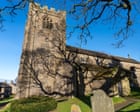
The rain in Lancashire does not just fall. It bleeds into the stone. For over a century, St. Mary’s Church had stood against that damp, biting northern wind, its gray spire cutting into a perennially bruised sky. To the casual passerby, it was just another piece of ecclesiastical architecture fading into the background of a modern world. But to the handful of people who still gathered inside its drafty nave every Sunday, it was an anchor.
Then, the heating system failed.
It sounds mundane. A broken boiler is an inconvenience in a house; in a historic stone church, it is a death sentence. The estimate for repairs was sixty thousand pounds. To a congregation whose weekly collection plate rarely yielded more than a few crumpled twenties and a handful of copper coins, that number might as well have been a million.
The diocese looked at the spreadsheets. The math was brutal. Attendance was down, costs were up, and the structural integrity of the roof was a ticking time bomb. The decision was whispered before it was announced. St. Mary’s was going to close. Its doors would be locked, its stained glass boarded up, and the heartbeat of a community would simply cease.
Margaret knew what that closure meant. She is seventy-four, with hands roughened by decades of local factory work and a spine that refuses to bend to age. Her parents were married at that altar. She had carried her own children to the font there, the water cool against their foreheads. For Margaret, the church wasn't just about theology. It was the only place left in the village where someone would notice if you didn’t show up.
Consider what happens next when a community loses its center. The loneliness does not arrive with a crash. It creeps. It settles into the quiet afternoons when the elderly have nowhere to walk to, and no one to exchange a word with over a cup of weak tea.
The vicar, a man worn thin by administrative duties and the grim reality of managing decline, sat in the vestry with a stack of cardboard boxes. The sorting had begun. Decades of accumulated history were being categorized into what could be saved, what could be donated, and what was destined for the skip.
He reached into the back of a deep, damp cupboard that smelled of beeswax and dry rot. His fingers brushed against something heavy, wrapped in greasy, decades-old newspaper.
He pulled it out. The paper flaked away like dead skin.
Inside was a chalice. It was dull, tarnished to a deep, unappealing brown, and coated in a thick layer of grime that looked like old engine oil. It looked like junk. It looked like a piece of brass that someone had forgotten to throw away fifty years ago.
But when the vicar lifted it, the weight felt wrong. Brass is light, brittle. This object had an density that seemed to pull the air down around it.
He took it to the sink. With a piece of old cloth and a bit of dish soap, he began to scrub. The brown residue gave way reluctantly. Underneath the filth, a sliver of yellow caught the weak light filtering through the vestry window. Not the harsh, bright yellow of plated metal. A deep, warm, unmistakable luster.
Gold.
The chalice was solid gold, dating back to the early Victorian era, gifted to the parish by a wealthy benefactor whose name had long been bleached from the parish registers. For over half a century, it had sat in the dark, hidden in plain sight, completely forgotten by a parish that was starving to death on top of a fortune.
The valuation came back from Liverpool. Eighty-five thousand pounds.
Miracle is a word people use too lightly. They use it for late goals in football matches or finding a parking space in the rain. But standing in the damp nave, watching the engineers dismantle the ancient, broken pipes of the heating system, Margaret called it nothing else. The gold did not just buy a new boiler. It bought time. It bought another generation of christenings, another decade of morning light hitting the altar rail, another year of Margaret knowing she had a place where her absence would be mourned.
But the real problem lies elsewhere. The chalice saved St. Mary’s, but it exposed a deeper, more fragile truth about the landscape of our communal lives.
We are living in an era of quiet evictions. Across the country, the spaces that cost nothing to inhabit are vanishing. The libraries with reduced hours, the youth centers converted into flats, the churches facing the hammer. When these places disappear, the social fabric does not just tear; it dissolves.
The gold chalice was a freak accident of history. A stroke of luck. But a society cannot rely on hidden treasure to keep its soul alive. The true value of St. Mary’s was never the gold hidden in the cupboard. It was the fact that the door was unlocked on a Tuesday afternoon when a grieving widower needed a place to sit in the dark and cry without anyone asking him for a receipt.
Next Sunday, the bells will ring out over the Lancashire hills. The air inside will be warm, the radiators humming a low, comforting tune. Margaret will sit in her usual pew, third from the front, on the left. The gold is gone, melted down or locked away in a museum vault where it can no longer be touched by human hands. In its place is something far more valuable: a room full of people who refuse to let the silence win.