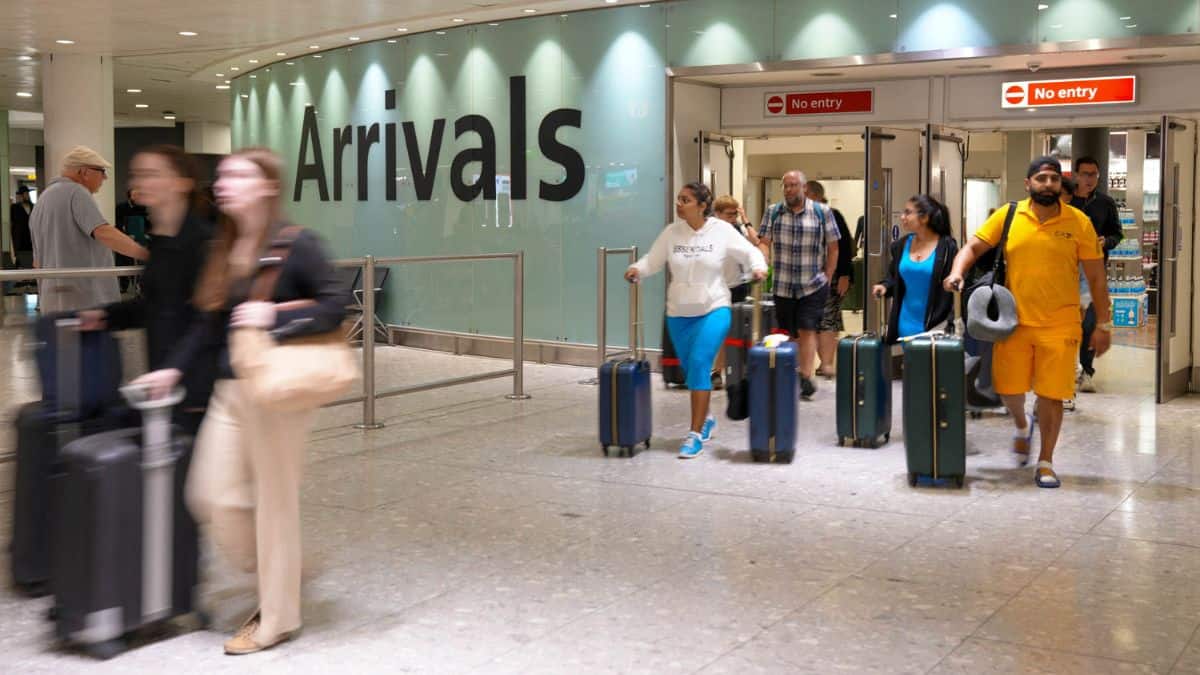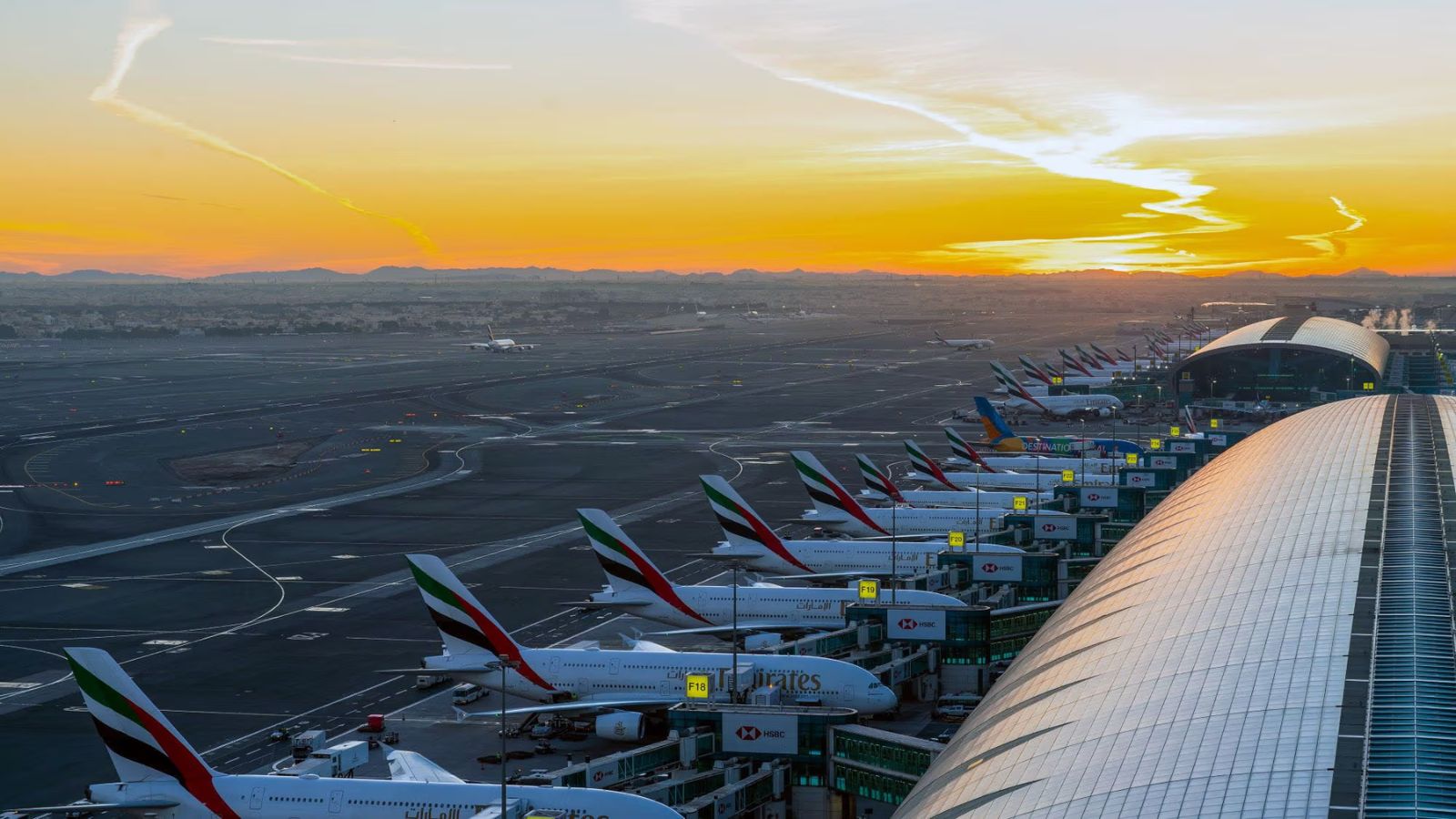
The air inside Terminal 3 doesn't smell like a building. It smells like a planet. It is a pressurized, temperature-controlled cocktail of expensive French perfumes, scorched jet fuel, roasted Arabica beans, and the faint, electric ozone of a million charging smartphones. If you sit long enough near the waterfall features, you can hear the world moving. It isn't a roar; it is a hum. A frantic, rhythmic pulse of rolling suitcases and polyglot whispers.
Dubai International (DXB) has ceased to be just an airport. It has become the world’s central nervous system. When the 2025 traffic reports landed, they weren't just spreadsheets. They were a map of where the human heart is beating loudest.
Last year, 93 million souls moved through these gates. That is not a statistic. It is the entire population of Vietnam deciding to change locations over the course of twelve months. And at the very center of this tectonic shift in human geography sits a single, undeniable truth: the bridge between India and the world has never been shorter, or more crowded.
The Mumbai to Manhattan Shortcut
Consider a hypothetical traveler named Arjun. He is sitting in a recliner in Concourse B, nursing a lukewarm tea. He left Mumbai four hours ago. In six hours, he will be over the Atlantic, bound for JFK. Arjun is one of the 11.9 million Indian travelers who made India the undisputed king of Dubai’s tarmac in 2025.
For Arjun, and millions like him, Dubai isn't a destination. It’s a comma.
India didn't just retain the top spot by a narrow margin; it dominated the ledger. To understand why, you have to look past the duty-free gold and the shimmering glass. The story of 11.9 million people is a story of the New Indian Century. It represents the tech consultants heading to London, the construction crews returning to Kerala with suitcases full of electronics, and the families reuniting for weddings that span three continents. Dubai is the hinge on which the door between the East and the West swings.
The sheer volume is staggering. If you lined up every traveler who flew between India and Dubai last year, they would wrap around the earth’s circumference. They are the engine of this terminal.
The Saudi Surge and the Regional Pivot
While India sits on the throne, the landscape behind it is shifting. Saudi Arabia has claimed the second position with 6.7 million passengers. This isn't just about business trips to Riyadh or weekend getaways to Jeddah. We are witnessing the physical manifestation of "Vision 2030."
There was a time, perhaps a decade ago, when the flow between Dubai and Saudi was predictable—steady, but unremarkable. That time is dead. Today, the corridor is a blur of activity. You see it in the lounges: young Saudi entrepreneurs in sleek sneakers, international investors heading to Neom, and a burgeoning class of tourists exploring a kingdom that was once a closed book.
The UK follows closely with 5.9 million travelers. The link between London and Dubai remains the "prestige" route, the aerial highway of the global elite and the sun-starved British holidaymaker. But the energy is different here. While the UK traffic feels like an established, comfortable habit, the growth in the Saudi and Indian sectors feels like an explosion.
The Logistics of a Miracle
How do you move 93 million people without the whole thing collapsing under the weight of its own ambition? It requires a level of mechanical choreography that borders on the spiritual.
During the peak months of 2025, DXB handled an average of 1.8 million passengers per week. Think about the luggage. Imagine a mountain of suitcases, millions of them, navigating miles of conveyor belts beneath your feet, sorted by lasers and robots with the precision of a Swiss watch. If the system fails for ten minutes, the ripple effect is felt in Sydney, Cairo, and Los Angeles.
The airport handled over 430,000 flight movements in 2025. That is a takeoff or landing nearly every minute, 24 hours a day, 365 days a year. The sky above the desert is never empty. It is a permanent carousel of aluminum and titanium.
The Empty Seat That Isn't There
The most telling metric of 2025 isn't the total number of people, but the "load factor." In the world of aviation, an empty seat is a tragedy—a wasted opportunity that can never be recovered.
DXB saw an average load factor of 82.3%.
In plain English, the planes are full. People aren't just flying because they have to; they are flying because the world has reopened with a vengeance. We are in the era of "revenge travel," but it has matured into something more permanent. We have realized that digital connections are a pale imitation of physical presence. We want to touch the soil, smell the spices, and shake the hand.
Beyond the Top Three
If you look further down the list, the story of global recovery becomes even clearer.
- Pakistan: 4.2 million passengers.
- The United States: 3.5 million passengers.
- Germany: 2.8 million passengers.
The American numbers are particularly fascinating. Ten years ago, the idea of Dubai as a primary transit point for Americans heading to Africa or South Asia was a niche strategy for savvy travelers. Today, it’s the standard. The "United" in United Arab Emirates has taken on a literal meaning; it is where the fragmented pieces of the globe are stitched back together.
The Ghost in the Machine
There is a specific kind of exhaustion unique to Dubai International. It is a high-end, cushioned fatigue. You see it in the eyes of the man sleeping on a $5,000 sofa in the First Class lounge, and you see it in the family of five sprawled across the plastic chairs at Gate A12.
We often talk about airports as "non-places"—spaces that have no identity of their own. But DXB has defied that. It has an identity of relentless, unapologetic ambition. It is a city that exists only to facilitate leaving.
I remember standing near the flight information display system—the "Big Board"—late one Tuesday night. The screen flickered every few seconds, refreshing a list of cities that sounded like a prayer: Addis Ababa, Bangkok, Casablanca, Delhi, Edinburgh, Frankfurt. A woman stood next to me, crying quietly into her phone. I don't know if she was leaving home or going toward it. In Dubai, those two things often look exactly the same. That is the human element the spreadsheets miss. The 11.9 million Indians are not "traffic." They are 11.9 million stories of ambition, sacrifice, and longing.
They are the daughter going to study engineering in Toronto. They are the grandfather visiting his grandkids in Melbourne for the first time. They are the CEO closing a deal that will employ thousands.
The Weight of 93 Million
As we move through 2026, the question isn't whether Dubai will continue to grow, but how much the world can lean on a single hub before it reaches its physical limit. There are plans, of course. Al Maktoum International (DWC) looms in the distance, a gargantuan project designed to eventually dwarf the current airport.
But for now, the pressure remains on the Silver Spire of DXB.
The 2025 data tells us that the global economy is no longer centered solely in the North Atlantic. The axis has tilted. It has tilted toward the subcontinent, toward the Gulf, and toward a future where the most important road in the world isn't a road at all, but a flight path between two points in the desert.
We are a species that moved. We migrated out of the Rift Valley on foot, and now we migrate across the troposphere in pressurized tubes. We are still the same restless nomads, just with better Wi-Fi and shorter layovers.
The 11.9 million from India. The 6.7 million from Saudi. The 5.9 million from the UK. They are the new pulse of the planet. And as you walk through the terminal, dodging a cleaning robot or staring at a $200,000 watch in a glass case, you realize that you aren't just a passenger. You are a single cell in a massive, global organism that has decided, collectively, that it is time to go somewhere else.
The hum continues. The board flickers. Another flight from Dubai to Kochi begins its boarding process. The world is moving, and for a few hours, it all passes through a single point in the sand.
Would you like me to analyze the specific economic impact these passenger volumes have on the local Dubai hospitality sector for 2026?