The wind off the English Channel carries a specific kind of cold. It is the sort of chill that seeps straight into your bones, regardless of the month, carrying the faint, salty scent of old wood and deep water. If you stand at the edge of the Normandy American Cemetery in Colleville-sur-Mer, the grass beneath your feet is manicured to a surreal, velvet perfection. Beneath that grass lie more than 9,000 white marble crosses and Stars of David, all facing west, back toward the home those young men never saw again.
It is a place reserved for heavy silence.
But silence is a luxury the modern political world rarely tolerates. On a Saturday meant to honor the 82nd anniversary of the D-Day landings, the solemnity of the bluffs overlooking Omaha Beach was replaced by a different kind of electricity. The air was thick not with the memory of the greatest amphibious invasion in human history, but with a sharp, modern ideological conflict.
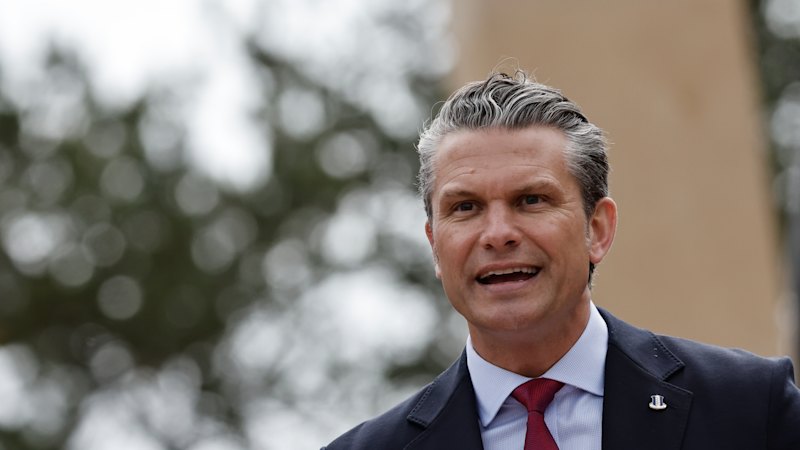
U.S. Defense Secretary Pete Hegseth stood before the rows of white stone and chose to draw a straight line from June 6, 1944, to the small, leaking rubber dinghies currently washing ashore on the southern edges of the European continent.
He spoke of an invasion.
To understand how a memorial service morphed into an international flashpoint, you have to look at how history is being rewritten in real-time. For decades, Normandy was a symbol of Western unity, a physical reminder of what happens when democratic nations pool their blood to crush total tyranny. Today, it is a backdrop for a fierce debate over sovereignty, identity, and the definition of a border.
The Words on the Bluffs
Consider the scene. On one side, elderly veterans, their chests heavy with medals, sitting in the fading June light. On the other side, the machinery of American defense policy. Hegseth looked out across the audience and shifted the focus from the totalitarian threats of the 20th century to the migrants arriving on Europe’s shores.
"Sadly, today, different European beaches are stormed by different dangerous ideologies," Hegseth said. He named them explicitly: Spain, Italy, Greece, Bulgaria. "Boats and men arrive. When will European capitals do something about that invasion? Or is it too late?"
The rhetorical pivot was deliberate. By swapping the landing craft of Nazi-occupied Europe with the migrant vessels crossing the Mediterranean, the administration wasn't just commenting on immigration policy. They were reframing the very nature of Western survival.
The strategy behind these remarks runs deep. For months, Washington has been quietly signaling a massive shift in its worldview. A National Security Strategy document released by the administration warned in stark terms that Europe faces the prospect of civilizational erasure within two decades. The argument is simple, if brutal: the freedom won by the men in 1944 was not a permanent gift. It was a temporary lease, and European leaders are letting the property fall into ruin.
The Invisible Friction
But what does this rhetorical battle look like on the ground? Let us use a hypothetical scenario to ground these abstract policy points in everyday reality.
Imagine a local official in a small coastal town in southern Italy, let's call him Marco. For years, Marco has watched his town's population shrink as young people move north for jobs. Now, his weekly routine involves coordinating emergency housing, medical checks, and basic food supplies for seventy-five people who survived a three-day journey across the sea on a vessel meant for twelve. Marco isn't thinking about civilizational erasure. He is thinking about blankets. He is wondering why the regional government hasn't sent the funds they promised three months ago.
Now look across the ocean to a diner in Ohio, where an American voter named Sarah watches clips of Hegseth’s speech on her phone. Sarah’s grandfather is buried in Ohio, but his brother stayed in France, beneath one of those white crosses in Colleville-sur-Mer. To Sarah, her family’s sacrifice feels linked to a specific idea of Western culture. When she hears that European nations are struggling to control their borders, she feels a sense of betrayal. She wonders why American tax dollars and American lives were spent securing a continent that seems unable, or unwilling, to secure itself.
These two human perspectives are completely disconnected, yet they are trapped in the same political orbit. Hegseth’s speech was designed to speak directly to Sarah, using the sacred ground of Normandy to validate her anxiety. In doing so, it bypassed the chaotic, practical reality that Marco deals with every morning.
A Fractured Alliance
The fallout from this rhetorical shift was immediate and messy. The modern alliance between America and Europe has long been built on shared assumptions about human rights, international law, and collective defense. But those assumptions are fraying.
While Hegseth was speaking in France, a parallel diplomatic storm was brewing across the English Channel. British Prime Minister Keir Starmer’s office found itself forced to publicly condemn U.S. Vice President JD Vance. The dispute centered on a tragic local crime: the fatal stabbing of an 18-year-old student named Henry Nowak in Southampton. Vance had publicly blamed the murder on mass migration and European elite self-hatred. The problem? Both the victim and the perpetrator were British citizens.
Downing Street hit back, accusing American officials of trying to interfere in domestic democracy and stir up division on British streets. It was an extraordinary public rupture between two historical allies, happening on the exact weekend meant to celebrate their ultimate cooperation.
This is the real cost of the new rhetorical strategy. It treats international relations not as a delicate web of diplomatic agreements, but as a domestic political theater. The goal is no longer to reassure allies, but to pressure them into aligning with a specific nationalist ideology.
The Shift in the Wind
If you talk to European diplomats behind closed doors, the emotion isn't just anger. It is a profound, unsettling fatigue. For generations, Europe relied on the United States as the ultimate guarantor of its security and its values. Now, European capitals are waking up to the reality that the American security umbrella comes with severe ideological conditions.
Washington’s critique of Europe isn't limited to border control. The administration has frequently targeted what it calls the "censorship" of nationalist and far-right voices by European governments, alongside complaints about weak defense spending and suffocating bureaucracy. The message from the White House is clear: Europe is failing to defend its own heritage, and America is losing patience.
This pressure is forcing a massive, uncomfortable evolution across the continent. European leaders are realizing they can no longer outsource their defense or their geopolitical identity to Washington. There is a frantic, quiet scramble to diversify away from American technology, to build independent military capabilities, and to find a unified European response to migration that doesn't rely on American approval.
The View from the Water
The tragedy of using Normandy as a weapon in a modern culture war is that it obscures the actual human stakes on both sides of the equation.
The men who climbed those cliffs in 1944 were terrified, ordinary teenagers facing machine-gun fire to defeat a system that industrialized human slaughter. The people crossing the Mediterranean today are often terrified, ordinary families fleeing economic collapse, dictatorship, or climate ruin, looking for a sliver of the prosperity the West created.
By labeling the latter as an "invasion" equivalent to the former, the language of geopolitics loses its precision. It replaces policy with poetry, and analysis with anger.
As the sun went down over the Normandy American Cemetery, the crowds cleared out. The television lights were packed away. The politicians boarded their jets back to Washington, London, and Paris.
Left behind were the rows of marble crosses, perfectly straight, perfectly silent, gleaming in the twilight. They do not care about modern border policies or election cycles. They remain exactly where they fell, a permanent testament to a moment when the West knew exactly what it was fighting against, long before it forgot how to talk to itself.