A wind is howling across the Siberian Taimyr Peninsula. It is not the wind of 2026. This wind carries the scent of melting permafrost and the metallic tang of deep history. Somewhere beneath the frozen mud, a fragment of a rib bone has been waiting for thirty-five thousand years to tell us we were wrong.
We have long told ourselves a comfortable story about how we met our best friends. It was a transactional fable. We imagined a late-stage Stone Age camp, perhaps fifteen thousand years ago, where a particularly bold wolf lingered near the trash heaps. We gave it a scrap of charred mammoth; it gave us its loyalty. It was a neat, orderly progression from wild predator to fireside companion, coinciding conveniently with the rise of agriculture and "civilization."
But the math never quite worked. The heart knew better.
Recent genetic sequencing of that ancient Siberian bone, along with sophisticated genomic modeling of modern breeds, has shattered the timeline. We didn't "invent" dogs at the dawn of farming. We found each other in the deep, dark heart of the Last Glacial Maximum.
The Long Walk Together
Consider a hypothetical woman named Aya. She lives 30,000 years ago. She is not a primitive caricature; her brain is as complex as yours, her grief just as sharp, her laughter just as loud. Aya is moving across a landscape that wants to kill her. The cold is a physical weight. The shadows hold lions that weigh five hundred pounds.
In the traditional scientific narrative, Aya’s relationship with the wild was purely adversarial. But the new data suggests a different reality. The genetic split between the ancestors of modern wolves and the ancestors of modern dogs happened much earlier than the textbooks claimed. We are looking at a partnership that began between 27,000 and 40,000 years ago.
This means dogs didn't join us because we had extra grain or permanent houses. They joined us when we were both desperate.
The gray wolf and the Paleolithic human were the two most successful social hunters on the planet. We were competitors. Normally, competitors eliminate one another. Instead, a biological miracle occurred. A subset of wolves—perhaps those with lower cortisol levels, the ones less prone to "fight or flight" in the presence of a stranger—began to trail the human caravans.
They weren't looking for a master. They were looking for an edge. And so were we.
The Genetic Echo
When scientists look at the DNA of the Taimyr wolf, they see a "ghost population." This creature lived just after the point where dogs and wolves took different paths. By comparing this ancient genome to the genetic makeup of modern Huskies and Greenland sled dogs, a startling amount of shared ancestry appears.
The overlap is not a coincidence. It is a map of a shared journey.
Most people assume that "domestication" is something humans do to animals. We imagine a prehistoric genius catching a litter of puppies and raising them to be submissive. But the reality is more likely "self-domestication." The wolves who could tolerate us survived better. They ate our leftovers; they alerted us to the approach of a cave bear in the middle of a moonless night.
Those who survived passed on those "friendly" genes.
Over thousands of years, their snouts shortened. Their coats developed patches of white. Their ears began to flop. These are the physical markers of a hormonal shift—a reduction in adrenaline that fundamentally changed their soul. We didn't just change their diet. We changed their chemical response to the world.
The Invisible Stakes of the Ice Age
Why does a difference of twenty thousand years matter?
It matters because it changes what it means to be human. If dogs joined us 15,000 years ago, they were a luxury of a settled people. But if they joined us 35,000 years ago, they were a biological technology that allowed us to survive the Ice Age.
Without them, we might not be here.
Imagine Aya’s tribe trying to track a wounded reindeer through a blizzard. Their human eyes are useless in the whiteout. Their sense of smell is pathetic. But at Aya’s side is a creature that can smell the iron in a drop of blood a mile away. A creature that can hear the footsteps of a predator long before it reaches the circle of firelight.
This wasn't a pet. This was an extension of the human sensory system. We gave them our warmth and our cooked proteins—which are easier to digest and provide a massive caloric boost—and they gave us their nose, their ears, and their ferocity.
It was the first great merger. A biological synergy that turned two vulnerable species into an apex predator unlike anything the Earth had ever seen.
The Language of the Eyes
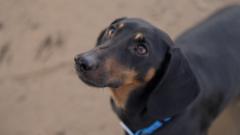
There is a specific muscle in the eyes of modern dogs called the levator anguli oculi medialis. Its only job is to raise the inner eyebrow, giving dogs 그 "puppy dog eyes" look. It mimics a human infant’s expression of sadness or longing.
Interestingly, wolves don't have this muscle.
This is evolution's way of hard-wiring a bridge between species. We have spent tens of millennia staring into each other's eyes, trying to guess what the other is thinking. Over those thirty thousand years, we co-evolved. Our brains actually produce oxytocin—the "love hormone"—when we look at our dogs, and their brains produce it when they look at us.
This isn't just "training." This is a profound, ancient neurobiological hack.
When you sit on your sofa today and your Golden Retriever rests its head on your knee, you are experiencing the culmination of a thirty-thousand-year-old survival strategy. That weight on your leg is the same weight Aya felt in a cave in France or a hut in Siberia.
The Mystery of the Taimyr Bone
The discovery of the Taimyr fragment forced a massive recalibration of our history. By using "molecular clock" dating—which measures the rate of genetic mutations over time—researchers realized that the common ancestor of all modern dogs lived significantly deeper in the past than previously suspected.
The data suggests that the "dog-ness" of the dog was already well underway while we were still painting mammoths on cave walls.
It also suggests that this didn't happen in just one place. There may have been multiple "start" points—one in Europe, one in Asia—where different groups of humans and wolves realized they were better together than apart. It was a global phenomenon, a collective realization among the most intelligent hunters on the planet.
The Shared Grave
The most poignant evidence of this bond isn't found in a laboratory, but in the earth itself. Across the world, archaeologists have found "dog burials" that date back far into the Paleolithic. These aren't just animals tossed into a pit. These are companions laid to rest with care.
In some graves, dogs are found with mammoth bone "toys" or necklaces of deer teeth. In others, they are buried beside their humans, their heads resting near the person's hand.
These burials tell a story that DNA cannot. They tell a story of grief. You don't bury a tool with honors. You don't mourn a "trash-eater." You mourn a friend. You mourn a being who saw the world with you, who shivered when you shivered, and who stood between you and the dark.
The Echo in the Modern World
We live in a world of high-speed internet and artificial intelligence, yet we still share our beds with a modified Pleistocene predator. It is the most successful biological partnership in history.
We often worry about our "disconnection" from nature. We fret over our concrete cities and our glowing screens. But every time we whistle and a four-legged creature comes running, we are touching the wild. We are reaching back through thirty-five thousand years of ice and wind to that first fire.
The Taimyr bone reminds us that we didn't conquer the world alone. We had help.
The bond isn't a result of our cleverness or our ability to dominate. It is the result of a long, slow conversation between two different kinds of souls who decided, against all odds, that the night was less terrifying if they faced it together.
As the permafrost continues to yield its secrets, we will likely find that the date moves even further back. We will find that the "best friend" label isn't just a sentimental cliché; it is a historical fact that predates the wheel, the plow, and the written word.
Aya looks out into the darkness beyond the fire. She sees a pair of amber eyes reflecting the flames. She doesn't reach for her spear. She reaches for a piece of dried meat and whistles, a low, sharp sound that cuts through the Siberian wind. The amber eyes move closer.
The walk continues.