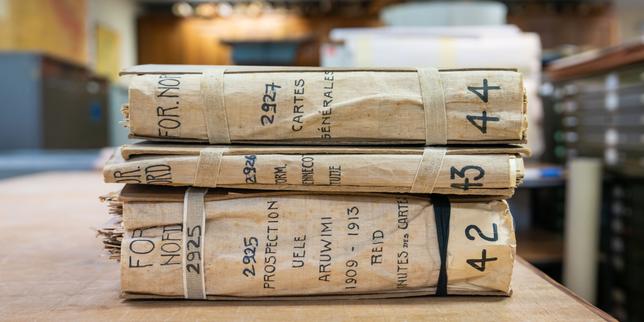
The modern global economy operates on a physical foundation of critical minerals, yet the most valuable asset in the race for resource security is not the lithium or cobalt itself, but the geological data that dictates where these deposits reside. The ongoing dispute between the Democratic Republic of the Congo (DRC) and Belgium regarding millions of colonial-era geological archives is a conflict over the reduction of exploration risk. In the mining industry, information is the primary variable in the cost-to-discovery ratio. By holding these archives, Belgium retains a legacy of "geological intelligence" that creates a bottleneck for the DRC’s sovereign development and an opportunity for third-party investors to bypass traditional exploration costs.
The Three Pillars of Geological Intelligence
To understand why paper archives from the mid-20th century remain a flashpoint in 2026, we must categorize their utility into three distinct functional pillars. These are not merely historical records; they are technical blueprints that compress the time-to-market for mining operations.
- Baseline Geological Mapping: The archives contain deep-soil samples, chemical assays, and mapping data collected over decades of Belgian colonial administration. In mining, the "Greenfield" stage—exploring untouched land—is the most capital-intensive. These archives effectively transform "Greenfield" sites into "Brownfield" sites, providing a starting point that eliminates years of preliminary sensor work.
- Structural Metallogeny: The documents detail the subsurface tectonic history of the Congo Basin. Understanding the "plumbing" of the earth—how minerals migrated into veins millions of years ago—allows engineers to predict the concentration levels (grade) of a deposit before a single drill hits the ground.
- Historical Extraction Data: The archives include records of abandoned or "exhausted" mines from the 1940s and 50s. Modern extraction technology, such as bio-leaching or advanced flotation cells, can now profitably process "tailings" or low-grade ores that the Belgians deemed waste. The archives provide the exact coordinates of these high-value waste sites.
The Cost Function of Information Retention
The central tension lies in the economic delta between "Original Data" and "Replicated Data." If the DRC wants to map its own territory without these archives, it must engage in a massive capital expenditure (CAPEX) cycle.
The cost of a modern airborne geophysical survey (using LiDAR and magnetometry) ranges from $100 to $300 per linear kilometer. For a country the size of Western Europe, the bill for complete re-mapping is prohibitive. By withholding the original Belgian Congo archives, the Royal Museum for Central Africa maintains a "data monopoly." This creates a specific market inefficiency:
- Risk Premium: Because the DRC cannot present a complete geological package to potential investors, those investors demand higher equity stakes or lower royalties to offset the "uncertainty risk" of exploration.
- Negotiation Asymmetry: When a multinational mining firm approaches the DRC government, the firm may already possess leaked or digitized segments of these archives. If the government lacks the same data, they are negotiating from a position of blindness, often underselling the true value of a mineral concession.
The Mechanism of Digital Repatriation
The debate has shifted from physical ownership to digital access, yet "digitization" is often used as a stalling tactic rather than a solution. The technical bottleneck in transferring these archives is not the scanning of paper, but the standardization of metadata.
A map from 1934 uses different coordinate systems and chemical nomenclatures than a 2026 satellite survey. "Repatriating" the data requires a massive effort in GIS (Geographic Information Systems) rectification. Without this conversion, the archives are merely pictures of paper. The Belgian strategy has largely focused on providing "access" to digital copies while retaining the master database and the technical expertise required to interpret the archaic data. This ensures that while the DRC has the information, they lack the integrated intelligence necessary to leverage it against global markets.
The Geopolitical Multiplier: China and the Race for 2030
The timing of this archival friction is driven by the 2030 energy transition targets. The DRC provides roughly 70% of the world's cobalt, a necessity for high-density lithium-ion batteries. The "Great Game" for minerals has moved beyond surface-level mining into a battle over Predictive Analytics.
China’s dominance in the DRC’s mining sector is built on aggressive infrastructure-for-minerals deals. However, even Chinese firms are limited by the geological "black boxes" in certain provinces. If the Belgian archives were fully integrated into a public-facing DRC geological survey, it would likely trigger a bidding war that could drive up the price of concessions, breaking the current bilateral grip held by a few major players. Belgium’s retention of these records acts as a stabilizing force for Western interests, keeping the data "offline" and away from competitors who could use it to further monopolize the battery supply chain.
Barriers to Sovereign Data Management
The DRC faces internal structural limitations that prevent it from fully utilizing the archives even if they were returned tomorrow. High-level analysis reveals three primary bottlenecks:
- Institutional Memory Gap: The displacement of Congolese geologists during decades of conflict has created a shortage of senior analysts capable of merging colonial data with modern 3D modeling software.
- Infrastructure for Big Data: Storing and processing petabytes of high-resolution geological data requires a server infrastructure and power stability that is currently lacking in Kinshasa.
- Legal Fragmentation: The DRC mining code is subject to frequent revisions. Without a stable legal framework, the "transparency" provided by these archives could actually lead to more litigation over historical land rights and colonial-era concessions.
Strategic Reconfiguration of the Asset
The archives should not be viewed as cultural artifacts, but as Stranded Economic Assets. For the DRC, the path forward is not merely demanding the return of paper, but the enforcement of a "Geological Data Sovereignty" law. This would require any firm currently mining in the DRC to contribute their own proprietary findings to a central national database, essentially building a modern archive that renders the colonial one obsolete.
For Belgium and the European Union, holding the archives is a diminishing return. As satellite-based hyperspectral imaging improves, the unique value of 80-year-old ground samples will decay. The strategic move is to trade the archives for "Preferential Access" agreements now, while the data still holds a high premium for exploration.
The ultimate value of the Congo archives is found in the compression of the exploration-to-extraction cycle. In a world where the demand for copper, cobalt, and coltan is projected to triple by 2040, the party that controls the historical record of the earth's crust controls the speed of the global energy transition. The dispute is not about the past; it is a calculated struggle for the future of industrial supply chains.
The DRC must pivot from a policy of "Historical Justice" to one of "Technical Integration." This involves the creation of a semi-autonomous National Geological Bureau, funded by a 0.5% levy on all mineral exports, specifically tasked with the ingestion and GIS-mapping of any returned Belgian data. By treating the archives as a high-tech database rather than a museum collection, the DRC can reduce its risk profile, attract diversified investment, and finally decouple its resource wealth from its colonial shadow.