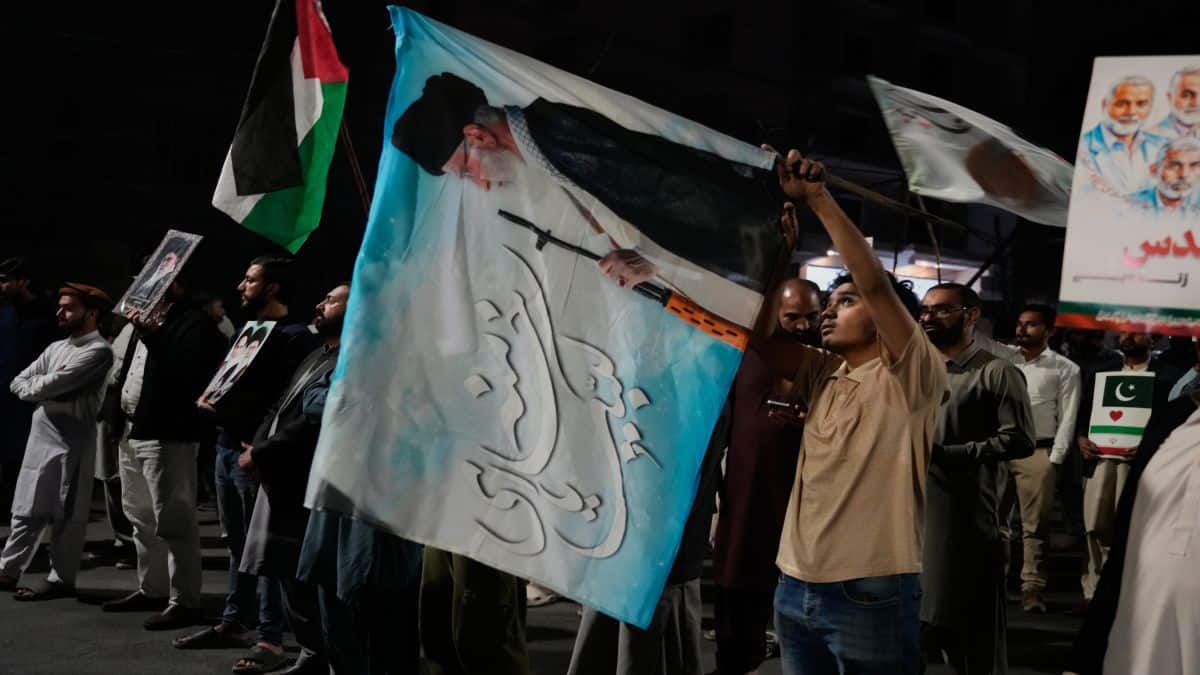
The sudden vacancy of the Iranian Supreme Leadership during an active regional war with Israel forces Pakistan into a strategic bottleneck where neutrality is no longer a passive stance, but a high-maintenance operational burden. Pakistan’s traditional "hedging" strategy—maintaining a security partnership with Saudi Arabia, a tactical alliance with China, and a volatile border with Iran—is failing because the internal stability of Iran directly dictates the security of Pakistan’s western frontier. Any power vacuum in Tehran risks a spillover of sectarian friction and insurgent movements into Balochistan, creating a multi-front security crisis that the Pakistani state, currently hampered by debt-servicing requirements and IMF-mandated austerity, cannot afford to contain.
The Mechanism of Transborder Contagion
The risk to Pakistan following the death of Ayatollah Ali Khamenei is defined by the Contagion of Governance Failure. When a centralized ideological state faces a succession crisis, its peripheral control weakens. For Pakistan, this manifests in three distinct vectors:
- Insurgent Opportunism: Groups such as the Jaish al-Adl operate in the borderlands of Sistan-Baluchestan. In the event of Iranian internal preoccupation, these groups increase kinetic activity. Pakistan then faces a binary choice: ignore the builds-up and risk Iranian retaliatory strikes (as seen in early 2024), or conduct unilateral operations that Iran might interpret as a violation of sovereignty during a period of vulnerability.
- Refugee Flow Dynamics: Iran hosts millions of Afghan refugees. A destabilized Iran, or one shifting toward more nationalist, less pan-Islamic governance, may accelerate the deportation of these populations. Pakistan, already struggling with its own "Illegal Foreigners Repatriation Plan," lacks the infrastructure to manage a secondary influx from the west.
- The Proxy Synchronization Problem: Pakistan’s domestic Shia and Sunni dynamics are sensitive to the health of the "Axis of Resistance." If the successor to Khamenei adopts a more aggressive or, conversely, a more isolationist stance, the ripples affect the internal social cohesion of Pakistan’s parastatal groups.
The Economic Connectivity Trap
Pakistan’s energy security and regional trade ambitions are tethered to Iranian stability through the Iran-Pakistan (IP) Gas Pipeline and the China-Pakistan Economic Corridor (CPEC). The strategic logic of these projects relies on Iran being a stable, albeit sanctioned, partner.
The primary friction point is the $18 billion penalty Pakistan faces for failing to complete its portion of the pipeline. Tehran has historically used this as a diplomatic lever. A new leadership in Tehran, seeking to project strength or secure hard currency, may move to enforce these penalties or demand immediate construction. However, Pakistan is trapped by the threat of U.S. "secondary sanctions." If the post-Khamenei era results in a harder Iranian line against the West, the U.S. will likely tighten the enforcement of the Iran Sanctions Act, making it impossible for Islamabad to satisfy both Tehran’s legal demands and Washington’s financial restrictions.
The Nuclear Signaling Dilemma
The Iran-Israel war introduces a "Nuclear Proximity" variable. Pakistan is the only nuclear-armed state in the immediate vicinity of the conflict that is not an active belligerent.
- Doctrine Drift: If Iran, under new leadership, decides that the death of Khamenei and the war with Israel necessitate a dash for a nuclear weapon, Pakistan’s "Credible Minimum Deterrence" logic is challenged. A nuclear Iran would likely trigger a Saudi Arabian quest for similar capabilities.
- The Saudi-Pakistani Defense Pact: Pakistan has long-standing, though often opaque, security guarantees with Riyadh. If Israel or the U.S. strikes Iranian nuclear facilities during the succession transition, and Iran retaliates against Gulf states, Pakistan is forced to decide between its "Brotherly Islamic Ties" with Iran and its "Strategic Financial Lifeline" with Saudi Arabia.
Structural Breakdown of the Security Apparatus
The Pakistan Military’s "Green Shield" doctrine—the focus on internal security and the eastern border with India—is compromised by a volatile western border. The operational cost of maintaining a permanent presence on the Durand Line (Afghanistan) and the 900-kilometer border with Iran creates a Force Multiplication Deficit.
Resources diverted to manage Iranian border volatility are resources taken away from counter-terrorism operations against the TTP (Tehrik-i-Taliban Pakistan). The logic of the Pakistani deep state has always been to avoid a "two-front" war. However, the current environment presents a "two-and-a-half front" scenario: India to the East, the TTP to the Northwest, and a destabilized Iran to the West.
The Chinese Equilibrium
China is the only actor capable of moderating the Iran-Pakistan-Israel friction. As the primary buyer of Iranian oil and the primary lender to Pakistan, Beijing views the Iran-Israel war through the lens of Energy Supply Chain Integrity.
If the Iranian succession leads to a fragmented IRGC (Islamic Revolutionary Guard Corps), the security of Chinese investments in Gwadar Port becomes questionable. Gwadar is the crown jewel of CPEC, but its proximity to the Iranian border makes it vulnerable to cross-border shelling or insurgent sabotage. Pakistan’s strategy must therefore involve a hyper-alignment with Chinese mediation efforts. Islamabad cannot afford to be the "frontline state" for Western interests this time; it must instead position itself as the "logistical corridor" for Chinese-led regional stabilization.
Information Warfare and Sectarian Resilience
The death of a figure as central as Khamenei triggers a predictable surge in information operations. Within Pakistan, this risks igniting latent sectarian tensions. The Pakistani state's ability to manage its digital borders is as critical as its physical ones.
The "Sectarian Multiplier" works as follows:
- Event: Death of Khamenei or an Israeli strike on an Iranian holy site.
- Trigger: Rapid dissemination of polarized content via encrypted platforms (WhatsApp/Telegram).
- Result: Localized protests in Parachinar or Karachi that escalate into urban instability, requiring the deployment of Rangers or the Army.
This internal deployment further thins the resources available for national defense and economic management.
Strategic Play: The Buffer State Protocol
Pakistan must shift from a policy of "Reactive Neutrality" to "Active Buffer Management." This requires three immediate shifts in the state’s operational manual.
First, the establishment of a Trilateral Intelligence Cell involving China, Pakistan, and the interim Iranian leadership. The goal is to ensure that insurgent groups do not exploit the transition period. This is not about ideological alignment; it is about "Border Deconfliction" to prevent accidental escalation during the fog of war.
Second, Pakistan must formalize a Sanctions Waiver Framework with the U.S. Treasury. By framing the IP Pipeline and trade with Iran as a "Regional Stability Necessity" rather than a defiance of Western norms, Islamabad can attempt to carve out a narrow economic corridor that keeps the Iranian border functional without triggering a collapse of the IMF program.
Third, the military must execute a Strategic Pivot to the West without withdrawing from the East. This involves the "Digitization of the Border"—using drone surveillance and seismic sensors to replace high-density troop deployments. In a period of high inflation and low growth, Pakistan cannot afford to station more boots on the ground. Technology must bridge the gap between a crumbling budget and an expanding threat.
The endgame for Islamabad is not the victory of Iran or Israel, but the preservation of the Status Quo Ante. Any radical shift in the Iranian power structure—whether toward total collapse or towards a nuclear-armed posture—ends the era of Pakistani hedging and forces a choice that will inevitably bankrupt the state or compromise its sovereignty. The path forward is a cold, calculated distance from the ideological fervor of the war, coupled with an intrusive, security-first engagement with the new power brokers in Tehran.
Would you like me to analyze the specific economic impact of the Iran-Pakistan pipeline penalties on Pakistan's current IMF debt-servicing schedule?