The water of the Neelum River does not care about borders, but it knows how to hum. It rushes down from the high snows of the Himalayas, icy and relentless, cutting through the steep valleys of Muzaffarabad. For generations, the people living along its banks have used that sound to drown out their own anxieties. They watched the white foam churn, believing that as long as the river ran, they possessed something inherently theirs.
Then came the concrete.
Huge diversion tunnels were bored into the mountains. Mega-dams rose to choke the currents, redirecting the water to power distant cities down in the plains of Punjab. Today, if you stand on the banks in the heat of summer, the riverbed is often little more than a trickling graveyard of grey stones. The hum is gone. In its place is a dry, suffocating heat, and the quiet, simmering anger of a population that realized their very geography had been hollowed out from under them.
To understand why thousands of people recently gathered under a burning sun in a crowded mountain square, you have to understand the cruel irony of a word.
That word is Azad.
In Urdu, it means free. For over seven decades, the official map-makers and state broadcasters have insisted on prefixing this strip of mountain territory with that beautiful, heavy word. But when your rivers are drained to light up factories hundreds of miles away, while your own lightbulbs flicker and die under the weight of exorbitant electricity bills you cannot afford, the word begins to taste like ash.
The Theater of the Absurd
Every morning, local shopkeepers in Muzaffarabad roll up their rusted metal shutters. They sell almonds, dried apricots, and heavy woolen shawls. They also sell bottled water harvested from their own vanishing springs, sold back to them by companies based far to the south.
Consider the absurdity of their daily routine.
A butcher named Farhan—a quiet man with hands calloused by decades of hard labor—keeps a small ledger. In it, he doesn't just record what his customers owe him for mutton. He records his utility bills. Over the last two years, those bills have grown larger than his rent. His shop runs on a single, naked bulb and a small refrigerator that struggles to stay cold during the frequent, hours-long power outages.
"They tell us we are sovereign," Farhan says, pointing a blunt finger toward the government offices perched on the hills above. "They tell us we have our own Prime Minister, our own flag, our own assembly. But if I cannot even afford the power generated by the river running through my own backyard, who is actually in charge?"
The answer to Farhan's question is an open secret, whispered in tea stalls and taxi stands. The local assembly is a stage play. The real scripts are written in Islamabad, by bureaucrats and military officers who view this mountain corridor through a single, cold lens: national security.
For decades, the official narrative maintained a rigid posture. This region was a self-governing paradise, a stark contrast to the heavily militarized valley just across the Line of Control. It was either "free" or, at the very least, a "disputed territory" awaiting an international arbiter.
But narratives have a shelf life. Especially when people are hungry.
The Day the Script Broke
It started not with grand geopolitical theories, but with flour and electricity.
When the state slashed subsidies on basic foodstuffs and allowed power tariffs to skyrocket, it broke a silent social contract. The people of the region had tolerated their political disenfranchisement in exchange for a quiet life and basic survival. When survival became a luxury, the tolerance vanished.
The rallies grew from small corner meetings into massive, roaring crowds that choked the narrow mountain highways. The Jammu Kashmir Joint Awami Action Committee became the voice of this collective exhaustion. They did not wave the flags of distant political parties. They carried black flags, or no flags at all.
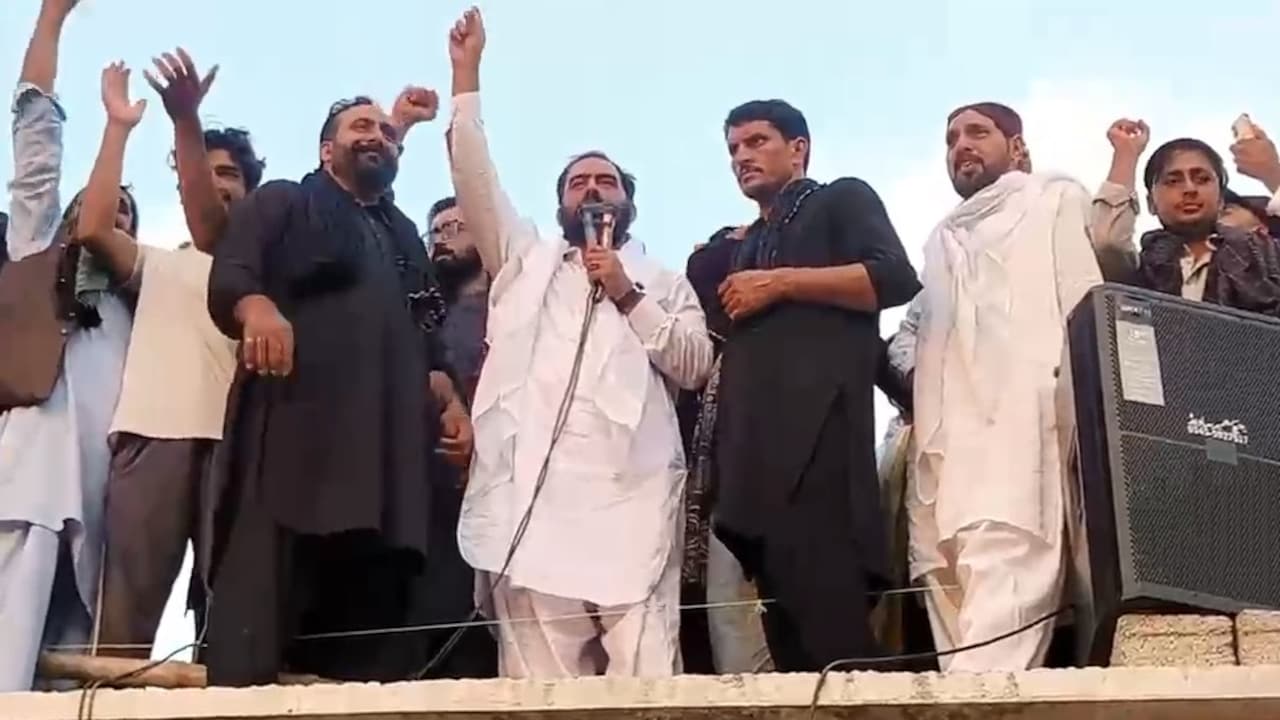
At one of these recent gatherings, a local leader stood before a sea of weathered faces. The air was thick with dust and the smell of cheap diesel exhaust from the idling trucks blocking the roads. The crowd was tense, expecting the usual platitudes about solidarity and patience.
Instead, the speaker threw away the script.
"We are told this land is Azad," his voice crackled through a cheap, distorted loudspeaker, echoing off the concrete storefronts. "We are told we are a disputed territory. Let us stop lying to ourselves. We are neither free nor disputed. We are occupied."
The word hung in the air.
Cold. Heavy. Dangerous.
In this region, speaking that word aloud is not a mere political disagreement; it is an act of defiance that can make a person vanish into the labyrinth of the security apparatus. For years, the fear of that disappearance kept the word locked behind teeth. But when the speaker said it, the crowd did not scatter in fear.
They roared.
The Illusion of the Middle Ground
To understand the weight of that moment, we must dissect the political vocabulary that has kept this region suspended in amber since 1947.
Historically, the territory has been treated as a pawn in a larger, deadlocked game. The international community refers to it as a dispute. The neighboring nuclear powers view it as a buffer zone, a launchpad, or a territorial claim to be defended at all costs.
But "disputed" is a lawyer's word. It belongs in the carpeted hallways of Geneva or New York. It suggests an ongoing debate, a technical disagreement over surveys and colonial-era treaties. It reduces the lived experience of millions of people to a footnote in a legal brief.
"Occupied," however, is a physical reality.
It is the checkpoint at the bridge where local residents must show their identity cards to soldiers who do not speak their local dialect. It is the sudden block on mobile internet when protests flare up. It is the extraction of timber from the pristine pine forests, transported down the mountains on heavy trucks, leaving the hillsides vulnerable to devastating landslides that bury entire villages when the monsoons arrive.
The local leader’s declaration was a rejection of the middle ground. It was an admission that the colonial administrative structures never truly left; they simply changed their uniforms and their accents.
The Invisible Stakes
Let us step away from the political rhetoric and look at what this means on the ground.
Imagine a young woman named Sana. She is twenty-two years old, the first in her family to graduate from a local university with a degree in computer science. She sits in her family's small home, staring at her laptop screen. She has a remote freelance job writing code for a client in Europe.
But her internet connection is cut off for three days because there is a protest two towns over. She loses the contract. The client does not care about local political sensitivities or security clampdowns; they only care about missed deadlines.
Sana walks out onto her terrace. Below her, the mountain slopes are scarred by the construction of a new highway designed to transport heavy military equipment and goods to the northern border. The highway is built by foreign contractors, using foreign labor, under the supervision of the federal government. Local youth, desperate for work, watch the earthmovers from the roadsides.
"They build roads through our mountains, but we cannot travel on them without being questioned," Sana says, her voice quiet but sharp. "They build power stations on our rivers, but we burn candles at night. This is not a dispute. A dispute is when two people have an honest disagreement. This is a theft."
This is the emotional core that the dry news agency reports always miss. They report on the number of protestors arrested, the statements issued by the foreign office, or the deployment of paramilitary rangers. They do not report on the slow, grinding erosion of human dignity that occurs when a population is told they are free, yet treated as suspects in their own homes.
The Crack in the Wall
The recent protests have achieved something that decades of diplomatic posturing could not: they have forced a crack in the wall of silence.
For the longest time, the administration believed that local anger could be managed through a combination of minor concessions and selective intimidation. A small reduction in wheat prices here, a temporary suspension of a tax hike there, coupled with the quiet arrest of a few vocal activists in the dead of night.
But the anger today is decentralized. It has no single head to cut off. It is driven by mothers who cannot feed their children, by young graduates who see no future but emigration, and by elders who are tired of living under the shadow of a lie.
The old labels are failing. The romanticized idea of the region as a pristine, peaceful sanctuary is gone, replaced by the stark reality of an exploited frontier. The local leader who spoke at the rally did not create this reality; he merely gave it a name that could no longer be denied.
As the sun sets over Muzaffarabad, the shadows of the mountains stretch across the dry riverbed. The local shops close their shutters. Farhan packs his ledger into a drawer, blows out his candle, and locks his door.
Above him, the high-voltage power lines stretch across the valley, carrying electricity generated by the roaring mountain waters down to the glittering cities of the south. The cables hum in the night sky, a steady, mechanical vibration that serves as a constant, mocking reminder of who owns the mountains, and who merely lives in their shadow.