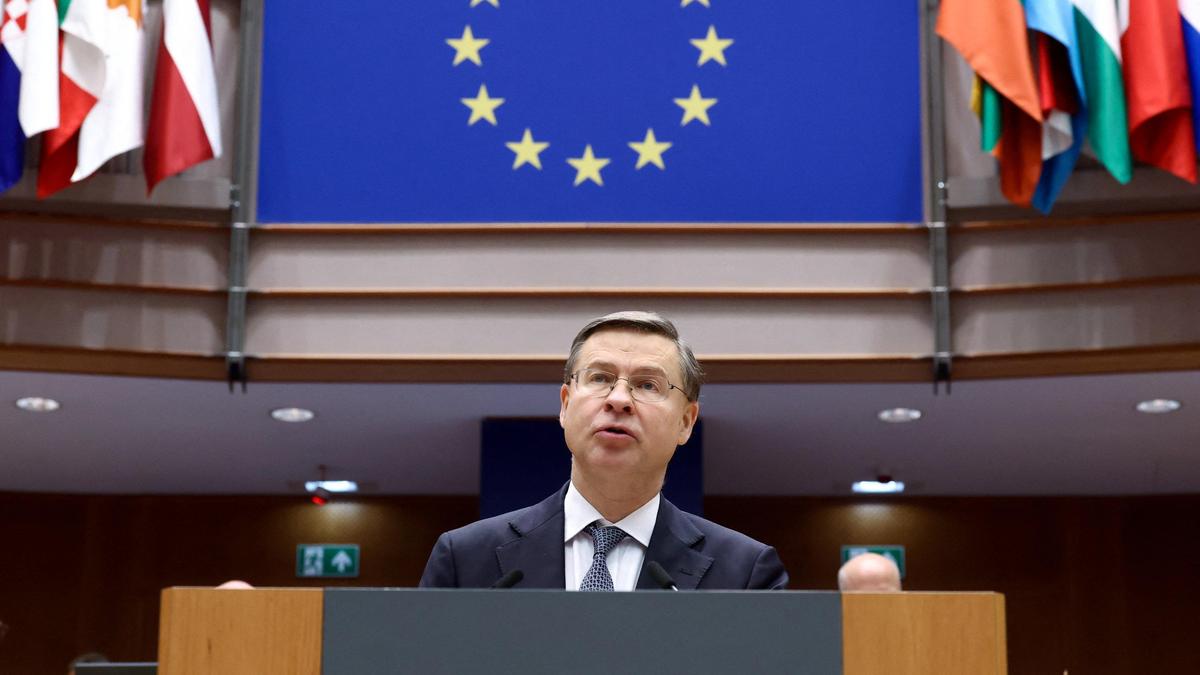
Brussels is currently projecting an image of hard-won stability, claiming it has secured firm guarantees from Washington that the United States will honor its existing trade commitments. On the surface, this looks like a diplomatic win for the European Commission, a sign that the erratic swings of global trade policy have finally been smoothed over by professional diplomacy. But look closer at the mechanics of these "assurances" and the picture shifts from one of stability to one of deep-seated anxiety. The reality is that the European Union is operating on borrowed time, clinging to verbal promises while the underlying structural tensions of the transatlantic relationship continue to fray at the edges.
The core of the current friction involves a complex web of subsidies, steel tariffs, and the fundamental disagreement over how to green the global economy without triggering a race to the bottom. While EU officials publicly state they have received the necessary comfort from their American counterparts, the lack of a formal, legally binding treaty means these assurances are only as good as the political survival of the people making them. In high-stakes international trade, a handshake is not a hedge against a change in administration or a sudden shift in domestic populist sentiment.
The Steel and Aluminum Deadlock
For years, the ghosts of Section 232 tariffs have haunted the relationship between the EU and the US. These duties, originally sold as a matter of national security, acted as a blunt instrument that forced Europe to the negotiating table. The current "assurance" rests on a temporary suspension of these tariffs, replaced by a complex quota system that effectively limits European exports while keeping the threat of reinstatement in the American back pocket.
Brussels wants a permanent solution. Washington wants to maintain its leverage. This is not a meeting of minds; it is a tactical stalemate. By accepting "assurances" rather than a signed treaty, the EU has essentially agreed to a perpetual state of probation. European manufacturers cannot plan five or ten years into the future when their access to the American market depends on a rolling executive waiver. The uncertainty acts as a silent tax on European industry, stifling investment even when the ships are moving freely.
The Green Subsidy Arms Race
The most significant rupture in recent history wasn't a tariff, but a piece of domestic American legislation. The Inflation Reduction Act (IRA) sent shockwaves through the Berlaymont building not because of its environmental goals, but because of its unapologetic "Buy American" requirements. It represented a fundamental shift in US policy—a move away from the rules-based order of the World Trade Organization (WTO) toward a more muscular, interventionist industrial strategy.
Europe’s response has been a mix of indignation and imitation. While EU trade negotiators claim they have carved out exceptions for European electric vehicle components and raw materials, these are side deals, not fundamental changes to the IRA's structure. The US is effectively pulling the center of gravity for green tech toward North America, using massive capital injections that the EU, with its strict state-aid rules and fragmented fiscal policies, struggles to match. The "assurances" Brussels cites are often little more than promises to interpret existing regulations in a way that doesn't immediately bankrupt European carmakers.
Why Verbal Guarantees Are Failing the Market
Institutional investors and industrial titans don't trade on vibes. They trade on certainty. When a CEO in Stuttgart or Lyon looks at the transatlantic trade map, they see a series of "understandings" that could evaporate with a single post on social media or a shift in congressional control. This creates a two-tier trade environment.
On the top tier, politicians celebrate the lack of an active trade war. On the bottom tier, the actual machinery of business is moving toward regionalization. European firms are increasingly moving production to US soil to bypass the need for "assurances" altogether. This isn't trade cooperation; it's a slow-motion hollowing out of European industrial capacity. The assurances aren't stopping the capital flight; they are merely making the departure look less like a crisis and more like a transition.
- Investment Leakage: Capital is flowing toward the US because the regulatory environment there is perceived as more protective of domestic interests, regardless of what negotiators say.
- Regulatory Divergence: While the US moves toward tax credits, the EU is doubling down on its Carbon Border Adjustment Mechanism (CBAM), a move that Washington views with suspicion.
- The China Factor: Both sides are trying to "de-risk" from Beijing, but they have fundamentally different ideas about how much pain they are willing to endure to get there.
The Illusion of WTO Primacy
There was a time when the WTO was the final arbiter of these disputes. Those days are gone. The US has effectively neutralized the WTO's appellate body by refusing to appoint new judges, leaving the global trade referee without a whistle. In this vacuum, power is the only currency that matters.
When the EU says it has received assurances, it is acknowledging that it can no longer rely on international law to protect its interests. It is now a client-state relationship where the larger partner promises to be "fair," but retains the sole right to define what fairness looks like. This shift from a rules-based system to a power-based system is the most significant change in trade dynamics since the end of the Cold War, and no amount of diplomatic spin can hide the loss of European leverage.
The Domestic Pressure Cooker
Inside the United States, trade is no longer a matter of economic theory; it is a core component of identity politics and electoral strategy in the Rust Belt. No American politician, regardless of party, can afford to look "weak" on trade or appear to be giving away American jobs to satisfy European allies. This domestic reality makes any long-term, binding trade deal nearly impossible.
The "assurances" given to the EU are often phrased in a way that allows the US administration to tell Brussels "we're friends" while telling voters in Ohio "we're winning." This double-speak is a necessary survival mechanism for the current White House, but it leaves European leaders in a precarious position. They have to sell these vague promises to their own skeptical publics and domestic industries that are seeing their energy costs soar while their American competitors enjoy massive subsidies.
Defense and Trade the New Linkage
We are seeing a new, more transactional era of diplomacy where trade deals are increasingly linked to defense spending and geopolitical alignment. The US expects Europe to take a harder line on Chinese technology and Russian energy as a prerequisite for continued trade "harmony."
The assurances provided on trade are often the "carrot" meant to keep Europe in line with American security priorities. This creates a hidden cost for the EU. To keep the trade peace, they may be forced to adopt export controls or investment screenings that hurt their own economic ties with the rest of the world. The price of an American trade assurance is often a European geopolitical concession.
The Credibility Gap in Brussels
There is a growing divide between the trade technocrats in Brussels and the political leaders in national capitals like Paris and Berlin. While the Commission handles the negotiations, it is the national leaders who feel the heat when a factory closes.
If these assurances fail—if a new administration in Washington decides to scrap the quotas and bring back the tariffs—the fallout won't just be economic. It will be a crisis of confidence in the European project itself. The Commission has staked a great deal of its credibility on its ability to manage the relationship with the US. If it turns out they were sold a bill of goods, the push for "strategic autonomy" will turn from a rhetorical slogan into a desperate, and potentially chaotic, reality.
The Raw Materials Scramble
Beyond finished goods like cars and steel, the real battleground is in critical minerals. Lithium, cobalt, and rare earth elements are the lifeblood of the future economy. The US and the EU are currently trying to form a "Critical Minerals Club" to counter Chinese dominance.
This is where the assurances are most tested. If the US provides subsidies for batteries that only include minerals processed in North America, the European mining and processing sector dies in its infancy. The "assurances" currently on the table suggest a middle ground where European-sourced minerals might qualify, but the fine print is still being written by lawyers in DC who have no mandate to protect European jobs.
The End of the Era of Good Feelings
The transatlantic trade relationship is not returning to the status quo of the 1990s or early 2000s. The world has changed. The US has turned inward, focusing on its middle class and its rivalry with China. Europe is caught in the middle, trying to maintain its social model and its industrial base in a world that is becoming increasingly protectionist.
The current "assurances" are a temporary ceasefire, not a lasting peace. They provide a breathing room that both sides are using to re-arm for the next phase of economic competition. To view them as a return to normalcy is to fundamentally misunderstand the current trajectory of global power. The deal isn't about mutual prosperity; it's about managed decline of the old order.
The European Union needs to stop celebrating the fact that it hasn't been hit and start asking why the hammer is still hanging over its head. True trade security doesn't come from a verbal promise made in a DC boardroom. It comes from having enough independent economic weight that no partner, no matter how large, can afford to threaten you. Until Europe achieves that, it will remain a beggar for assurances in a world that has little interest in giving them.
Audit your supply chains for hidden dependencies on American executive orders before the next political cycle turns a "firm assurance" into a historical footnote.